Archive for March, 2011

*hold music*

March 22, 2011 - 1:51 pm Comments Off

Any day where I spend half of it in an office and I get an ovary handshake by someone I’ve only just met is one where I’m not inclined to spend a lot of brainpower trying to gin up content. (Yes, I am fine. I just got the medical equivalent of an oil change and tire rotation, it just took a long time because there was so much routine left un-recently-done. Damn nurse didn’t give me a sucker OR a sticker for putting up with the booster shots, though.)

Meantime read Peter, who has a response to my response on the real-man thing, specifically providing a lot more African cultural context. I plan to reply when my genitals are less furious.

Not All Tools Are Chipped And Carved

March 21, 2011 - 4:30 pm Comments Off

A large underdose of sleep and and equally substantial overdose of caffeine (feeling my heart whanging off my sternum while still no sharper than I had been was depressing) has left me feeling somewhat like this*. I am sure the high-spirited New Mexico spring wind currently blowing every plant gamete in the state through the air is not helping either.

Go read this, which I am currently entirely too stupid to have meaningful commentary on. I am still very taken by the notion of viewing certain human developments as cognitive technology, however. I’m also very curious as to whether art might fall under the same category, as it represents a handy way for humans to rotate ideas and concepts in a representation of space that can be shared. Or that might be the juniper pollen talking.

*Read the original context, it’s completely hilarious as Allie Brosh usually is.

This Needs More Eyeballs

March 20, 2011 - 2:59 pm Comments Off

Elmo Iscariot proposes Lovecraft Action Shooting. I particularly like the last stage’s conception.

“I love this plan! I’m happy to be a part of it!”

There Is No Way This Can Go Poorly

March 18, 2011 - 4:18 pm Comments Off

So it looks like we’re going to be fighting a third war in the middle east, with deliberately vague wording on the degree of our actual involvement, the degree of commitment from our allies, and some handsy rules about what we’re actually allowed to do. Also the terms of our… ceasing being involved or something… involve no actual resolution of the situation in Libya whatsoever, just that Qadaffi (shut up, I always liked the version with the Q best) stop actively hunting the rebels down.

Goodness knows going in with arbitrary rules and undefined allied support in order to accomplish nebulously defined humanitarian goals has always worked out well for us. It can only go better when we’re also already committed to two no-fooling wars, right?

Not Mutually Exclusive

March 17, 2011 - 3:27 pm Comments Off

At this point I’m considering creating a category just for lengthy responses to and/or twists on something Peter has posted. “Civilized culture wars”, perhaps. Or “tea and vehemence”.

Anyway, this week it’s a post about another post, one of the better of the “reclaiming America’s lost manhood” genre. I have some (fairly minor) issues with that post, which I’ll address at the bottom, but what I really wanted to respond to was this from Peter:

I guess I don’t altogether ‘get’ the anti-masculine emphasis among feminists and their ilk. Perhaps that’s because I come from Africa, where to be ‘manly’ (in the classical sense) is rather more important than it is in other parts of the world. Sure, you can be a ‘metrosexual’ in a big African city (if you don’t mind being laughed to scorn) . . . but drive a few miles out of town, where there are things with teeth and horns and hooves that don’t like you, and see how far your ‘metrosexuality’ will get you (and your loved ones) as a survival skill!

Then, just so we’re all on the same page about exactly what we’re talking about, I’ll excerpt the first part of the bit he did:

I grew up with sitcoms that bashed the cigar-smoking, poker playing man. Tide commercials with women wrinkling their noses at the presence of a man’s laundry. What was communicated was that there was something wrong with men in general. Or at least that was what was driven into me.

But the caveman was fixed by making him a sensitive wimp. The gruff man was emasculated. Cut down, not improved. Man became polyester disco weenies, man became preppy effeminate pansies. And now what does the world have as a result?

The caveman could be called upon to change the oil in your Chevy. The caveman would repair a woman’s roof, build things. Kill spiders. The caveman might have grunted too much, may have drank too much. Wasn’t polite in mixed company. But the caveman was a man.

A transition occurred. It was once that the “Wifey” served up a steak meal for her man. Unfair and sexist, and fuel for a positive change. The change, though, turned modern man into a weak passive herbivore. Modern man was forced to fix his faults by no longer being a man.

The fix to ‘improve’ man took away too much. Watered a strong man down to a woman that could grow facial hair - but wouldn’t of course. Men were conditioned to be sensitive, but as a result became nonsupporting. Men would cry with you, but no longer have a shoulder to cry upon.

Okay then.

The first thing I want to point out which is necessary to my argument making any sort of sense, is that there is nothing whatsoever about cigars, steak, poker, oil changes, or spider slaying that actually relates to having testicles and producing small gametes with them. It’s entirely a cultural construction of masculinity, or a culture of manhood if you prefer. It doesn’t rest on any one thing, but many things are included in the idea and culture of manhood being discussed, including physical courage, stoicism, a sometimes confused blend of assertiveness and aggression, and all sorts of pastimes and arcana of man-ness, which (most) American men want to defend and reclaim and (some) feminists would rather see dialed back if not destroyed altogether.

Anyone who has met my better half knows that I am not in that camp of feminists. I enjoy men and masculinity, and for the most part I enjoy a lot of “man culture” as well- I’ll take a pass on the sports and farting contests, but cigars and meat and muscle cars and table-pounding straight talk are awesome. That said, I see two major reasons for why that camp of feminists exists, and while I heartily disagree with it, I also can easily understand it and see why it’s probably not going away for a long time if ever.

The first is that, just as a regrettable amount of misandry is bound up in feminist culture as a whole and can’t be completely separated out in an honest discussion, an equally regrettable amount of misogyny is bound up in the culture of manliness. The unreconstructed caveman’s major flaw isn’t that he’s rude, it’s that his idea of manliness often includes a lot of internalized notions that part of being manly is controlling and using women. The greatest harm and indignity to Wifey wasn’t that she was expected to damn well serve him a steak, it’s that he was given tacit cultural permission and even a certain degree of expectation to force her back into line if she didn’t- by beating if necessary*. African machismo is actually a perfect example of what feminists have a problem with- it may be the land where a man’s a man and slays the lions/rebels/other danger, but it’s also the land of a grotesquely high rate of rape and abuse. South Africa in particular is maybe the world’s capital for rape, and that’s rooted partially in general social chaos, but also in a notion of manhood that accepts the idea that women are there for the use of men**.

If you think this strain of thought and feeling is absent in modern American manhood, it’s not. It’s what makes the strong majority of stalkers men stalking former girlfriends or women who they feel SHOULD be their girlfriend, it’s what underlies the problems this pastor is talking about in getting clergy to respond usefully to domestic violence, it’s what makes otherwise ordinary and rational people question what an eleven-year-old girl could have done to cause her gang rape, it’s what led people to listen to Mel Gibson threatening to kill his girlfriend and conclude Mel was the wounded party most deserving of sympathy. It’s not gone. It’s not even far away from Google; it’s a very short trip when searching for men’s-rights and masculinist material to find ravingly misogynist writing. Art of Manliness (a site I like a lot) and Roissy might both have the same general goal in mind, but the latter also thinks, in addition to real men being in too-short supply, that a real man has sex with as many women as he can, prevents his partners from doing the same, and controls every relationship strictly on his own terms.

The second thing bound up within the culture of manhood we’re discussing is the idea that the worst thing in the world is femininity. Oh, it’s fine for girls and women, who simply can’t help it and have some other stuff going in their favor like being sexy, but the worst possible thing a boy or man can do is be girly. Sissy, pussy (female genitals), girly-man, even the various gay-related slurs all have to do with being somehow womanlike. For reasons that should be obvious but perhaps are not, feminists are somewhat perturbed by the notion that being like a woman is an absolutely horrible thing that any right-thinking man must do his best to avoid. It doesn’t put women in a great position, and being able to have babies and cry isn’t nearly as much a consolation prize as it might seem***.

Now for my quibble with the original post.

A transition occurred. It was once that the “Wifey” served up a steak meal for her man. Unfair and sexist, and fuel for a positive change. The change, though, turned modern man into a weak passive herbivore. Modern man was forced to fix his faults by no longer being a man.

Since when? Metrosexual and effeminate men aren’t anywhere near to being a majority, here and maybe not anywhere else. I agree the best and finest kind of man is in shorter supply than he should be, but a young man today is far more likely to be swallowed up in the culture of Bro than the culture of eye shadow and weeping. Bro culture is a lot of things, but effeminate it definitely is not and it sure as hell keeps all that I just described as worst about traditional notions of manhood. Not even feminists think we won out here.

The part with which I very much agree:

It is the passionate carnivore that is needed. Modern man needs to be a man. A man that is masculine, but still a gentleman. A man that will show strength FOR a woman, not just TO a woman. A man that will work not for a wage, but for a family - for the honor and integrity of completing an honest day’s work to provide and protect.

You can be a gentleman that has the caveman’s masculine skills, but not bluntly delivered. Strength, not aggression. Character, not abruptness. Polite presence, not boorish intrusion. Persevere, don’t retreat.

Step away from what others have defined for you. Don’t be the man watered down by political correctness. Be an improved man for your wife, girlfriend, lover, friends, and family. Define your masculinity by the strength of your character.

In short, “be a good man, not merely a man”. It’s a terrible thing for anyone, male or female, to define themselves as people based around a fuzzy idea of what the opposite sex wants or expects of them. I’ve written before how much I appreciate that, for Stingray, masculinity is entirely about him and cannot be reduced or diminished by anything I or any other woman does.

That said, I don’t think it’s such a terrible thing if men are being sensitive or less than the manliest stoic because that’s actually who they are and they now have greater cultural permission to be that way. I know my tastes in men definitely run to the traditionally masculine, but a lot of my female friends really do like more sensitive, less rough-edged, and even pretty men- that are actually that way and not adopting a cultural pose to please anyone, including other men. And that’s okay- there’s plenty of middle ground in between the stoic provider and a useless weeper. Forced to choose between a manly soldier that treated my emotions as being akin to my period in being a messy woman thing to be dealt with as little as possible and a poet who was afraid of spiders, I think I’d probably go with the poet. One thing my girlfriends and I can all agree on is that we want a lover and a friend first, everything else second- and for the record, I fucking hate those “dad’s a dolt” sitcoms and commercials too.

*The US has a comparatively admirable if far from perfect legal history of condemning wife-beating, but I think we can all agree the culture of manhood goes back a lot further than the United States. The culture that gives us the word “virtue”- whose root translation basically IS “manliness”- also considered women to be the legal property of men.

**Here’s a rather hilarious distillation. Very NSFW.

***One of those posts I’ve never been able to punch into shape is a much longer discussion of how almost all real virtues are defined as manly traits, and most “feminine” traits aren’t really virtues, are virtues generally considered to be unisex but women are somehow better at, or are of extremely limited use.


The Moment I Became Officially Old

March 16, 2011 - 2:10 pm Comments Off

…Would be when I realized a)Twitter is now a major part of serious political dialogue in the US, and b)that I had been studiously blocking this knowledge out for a time period numbered in years, as being far too ridiculous to admit to my personal version of reality. I’ve even managed to write about it without letting it fully sink in.

What broke my shell of self-delusion? Reading an article from a major political site about public perception of Obama’s leadership that contained the following perfectly straight-faced paragraph and quote:

Republicans say one compelling reason for Obama to stay home, is to work on an elusive long-term budget deal – with a confrontation looming on April 8 when the just-completed three-week stopgap funding measure expires.

“How can @BarackObama say he is leading when puts his NCAA bracket over the budget & other pressing issues?” new Republican National Committee chairman Reince Priebus tweeted Tuesday

A Republican National Committee chairman is making political broadsides against a sitting president using a 140 character limit broadcast system with a mascot known as the Fail Whale. Much worse than that, our sitting president can be accurately identified and reached as @BarackObama. The leader of the fucking free world is an @. There was never any @Dubya or @SlickWillie. And he is using it to achieve the ultimate Platonic ideal in the completely empty platitudinous soundbite.

Rationally I know I’m simply reacting in dinosaurian fashion to new influence by technology that didn’t exist when I was forming my firm version of The Way The World Works, and that version does not admit systems used to announce sandwiches and bowel movements as any form of respectable media communication. It’s not rational and it’s made of pure GET OFF MY LAWN AND TURN OFF THAT HOLOSCOOTER.

My thirtieth birthday gave me less angst than this.

High and Tight

March 15, 2011 - 3:09 pm Comments Off

From the department of wild speculation, a thread I have noticed and wonder about.

One of the world’s oldest infant-care practices is swaddling, the practice of wrapping up an infant tightly enough to stop it moving its limbs around. While the potential risks and benefits of the practice are hotly debated (the practice fell out of favor for a few centuries and is now coming back), one thing just about everybody agrees on is that swaddling has an interesting tranquilzing effect on babies- wrap them up so they can’t move, and they stop crying/fall asleep/calm themselves faster. If done with regularity they get used to it and the effect seems to wear off/be less dramatic, but either way the effect on a baby who has never been swaddled is counter-intuitive: rather than struggling against restraint, their heart rates drop, their EEG pattern changes, and they are lulled. The effect is more dramatic and more consistent over the long term on premature babies, whose motor systems have developed less.

Speaking of motor impairment, one of Temple Grandin’s most famous innovations is the squeeze machine, initially developed to help her (and later, far more autistic children) cope with the severe overreaction to being touched that is often characteristic of autism*. I recommend reading the link, by the by; Grandin goes as well as she can into the sparse and scattered research out there on the effect of what she terms “deep touch pressure” on humans and other mammals. Swaddling falls under such pressure, as does the odd “rolling up in a gym mat” practice of calming autistic and hyperactive children that preceded the squeeze-machine idea, as does firm stroking and presumably massage as well. It’s never been an area of rigorous and intense research, but the general idea investigated is that such pressure, applied correctly (especially in a firm-release pattern, as in massage) has a reflexively tranquilizing effect on mammals. Given that the theory put into practice in the squeeze-machine form has a dramatic effect on autistic children and still a notably calming/relaxing one on adult college students not told what the machine was supposed to do, there may well be a real underlying physiological effect here that simply hasn’t been rigorously studied.

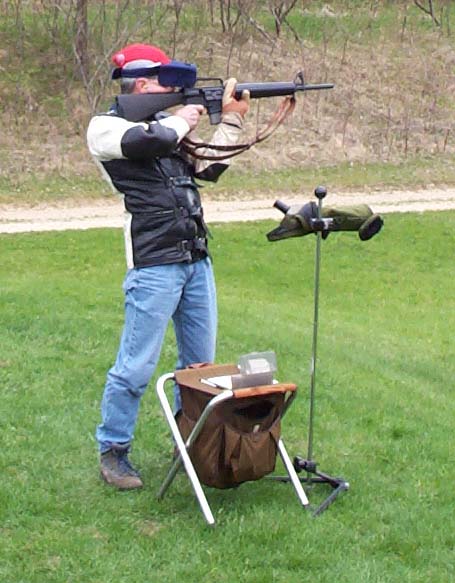
Which makes me wonder about other uses of the concept of partially restraining an individual in something that applies consistent, nonfocused pressure. A good shooting coat, for competitive high-power rifle shooting, provides stabilizing pressure when adjusted properly for any position the shooter takes; when in position, he is rigid and restrained, out of it, the pressure loosens. This is, of course, the point: the more stable a platform for the rifle the shooter’s body forms, the more precisely and consistently placed his shots can be.

This makes me wonder: rifle marksmen already practice self-calming techniques to counter the adrenaline of competition and make their heart rate and breathing steady and slow to better place shots, but are they getting more physiological benefit out of the jacket than just the stable platform? What would happen (other than a lot of fiddling trying to get the thing adjusted properly) if you stuck a much more novice rifle shooter in one, that had done essentially no work in independently self-calming before shooting?

Either way I suspect it would be easier to test the idea than it would be to test and popularize the concept of shooting prone while wrapped in a gymnastics mat.

*This is attributed to slightly impeded cerebellar development in the case of the autistic children. For what it’s worth, the cerebellum, which goes through a growth spurt during late gestation, is one of the areas a premature infant is most likely to have long-term problems with.

Never Shop When You're Hungry

March 14, 2011 - 5:36 pm Comments Off

And don’t try and come up with blogfodder when you’re hungry, either.

We had a fabulous time over the weekend and got in a much-needed blowoff and recharge, although the part where we traded more funtime for less sleeptime means we’re not *quite* fully caught up and running on all cylinders either.

I’ll never quite forgive a friend of ours for introducing us to A Hambuger Today, a branch of the Serious Eats site (itself quite the black hole for those for whom food is an interest as much as a need) devoted to one of America’s more universal sandwiches. Going there is usually a bad idea for my productivity, going there when hungry a near-fatal blow, as it tends to do things to me like generate a pointless desire to attempt to replicate things like an animal-style In-n-Out double-double.

So, in the spirit of an older post, AHT and Serious Eats’ guides to variations and themes on the sacred:

Burger Styles
Pizza styles
Hot dog styles
Barbecue styles
Heroes/Grinders/Submarine styles

Right this moment I would murder several preschool children for an oyster po-boy, but I will content myself with the buttermilk fried chicken and cornbread that’s actually for dinner.

Stuffing

March 10, 2011 - 6:48 pm Comments Off

Work: bad. You know it’s bad when you’re reduced to screaming variants of “CHRISTBALLS WHAT NOW??!!” every time the phone rings.

Play: ironically stressful. (For the Warcrack players among the readership that aren’t already with us, geared ranged DPS that can walk and chew gum, and are potentially willing to hop servers/faction, will be welcomed with big sloppy kisses. Apply within.)

Pets: being a collective furry pain in the ass, probably reflecting the tension back at us.

Blogging: therefore somewhat neglected. Sorry about that. Go here for at least one hearty laugh, which we sorely needed. Be sure to watch the video at the bottom for further and greater laugh. My favorite part is the way the guy freezes, as though being attacked by bees. The rest of the strips are funny too.

Upside: buddy coming down soon. We’ll drink a bathtub appropriately modest amount of gin, eat a bellyful of red meat (love having occasions to bust out that rib roast), and hit the range, which should do us a powerful amount of good.

Proper Application Of Science To Crush Dumbworms

March 9, 2011 - 6:04 pm Comments Off

I spent a good chunk of my afternoon reading a fascinating article at Yes Means Yes discussing a very large and complex set of studies done by Terri Conley, which is such a complete dissection and destruction of the famous Clark and Hatfield study- the one in which the researchers sent people in to cold-proposition college students of the opposite sex for casual sex and recorded the results by gender arrangement- that I want to frame it as an example of the art. The Yes Means Yes post is better than this will be, so you should go read it. I will, however, summarize.

The original Clark and Hatfield study is very frequently cited as an argument for why men are much more interested in sex than women are, or to support some sort of evo-psych argument that women are programmed to be choosy and men are programmed to be promiscuous. The result, if you’re not familiar, is that the female college students turned down the cold proposition from a strange man across the board, whereas the men accepted the proposition from a strange woman at much higher rates. Or, at least, this was the result that everyone talks about- much less discussed is that they had their propositioners offer three kinds of requests, one for a date, one to go back to their apartment, and one for sex, and that men and women were equally likely to accept an offer for a date with a complete stranger. But I digress.

Many people have pointed out the biggest logistical problem with their method, which is that accepting an offer for sex from a complete stranger is a totally different risk/reward scenario for women than it is for men; even a woman who is completely down with casual sex knows damn well that there is a not-insignificant chance that going somewhere private with a strange man who might theoretically think she’s a “slut” could result in her being in several pieces in his freezer by morning. Men propositioning strange women out of the blue for sex is not only unusual, its larger cultural context makes it potentially threatening to her, whereas the larger cultural context of being propositioned by a strange woman for sex is, for the man, largely encapsulated by the word “score!”.

Professor Conley goes way beyond this observation, and constructed four substudies to examine the scenario from different angles and controlling for different variables. The biggest difference was asking the participants of the study to imagine a propositioner rather than respond to one, then cite a likelihood on a scale of 1-7 they would accept the offer, and rating the imagined propositioner along several different kinds of variables, including warmth, likelihood of being good in bed, likelihood of carrying an STD, status, dangerousness, and so forth. Basically, they were grouped roughly into variables relating to desirability and relating to perceived risk. With this basic model in mind, the substudies offer further twists: whether the subject pool was all heterosexual or all homosexual, whether the offers came always from a member of the subjects’ preferred sex or randomly from either, whether the imagined scenario was a random stranger or a celebrity, and how attractive the celebrity was generally agreed to be. Again, for the complete breakdown of the results of each variation, read the YMY post; this is just a collection of some of the more interesting data points.

- From the department of the obvious: women rated the variables relating to dangerousness of strange men much higher than men rated the same variables in strange men. No shockers there, as it was obviously the biggest weakness of the original study, at least in the kinds of conclusions that can be usefully drawn about how much either gender likes sex.

- Women also rated their imaginary man much lower on the desirability variables- when trying to conjure a stranger asking her for sex in their heads, they pictured one that was low in status, warmth, unlikely to give gifts, and unlikely to be good in bed. Maybe not so surprising given that we don’t normally associate creepiness (threat) with attractiveness, especially when imagining things rather than evaluating real people. Men, in contrast, rated their imaginary women as about middle of the road on such variables.

- Here’s where it gets more interesting: in the substudy where the subjects were heterosexual but their offers were random as to which sex it came from, neither men nor women much wanted to sleep with the same sex- but heterosexual women were equally as unlikely to sleep with a strange man as with a strange woman. What’s more, they rated the imaginary female proposer as better on the desirability variables than the male proposer, and lower on the danger variables… as the men rated male proposers as lower on desirability variables and higher on danger. So heterosexual men and women apparently have the same general opinion of strange men proposing sex versus strange women*.

- When the subject pool changed to all bisexual women and the sex of the propositioner was random, prospective offers from women were significantly more likely to be taken up than offers from men. For some reason the perception questions weren’t included- perhaps Conley thought she had amply proved her point already about the differences in perception of risk and the imagined kind of man that would randomly ask for sex versus the kind of woman.

- When the proposition scenario changed from an offer from a stranger to an offer from a (carefully preselected by polling the subject pool beforehand) celebrity of the opposite sex meant to be attractive or unattractive, with the idea being that well-known faces are at least perceived to be less likely to make their partners into skin suits, the likelihood of accepting the offer suddenly attains parity between men and women- both unlikely to sleep with the unattractive celebrity, both about as likely as the other to sleep with the attractive one. The scenario with the stranger was run with the same group, and the gap between them reappeared.

- The celebrity model was repeated, with a different group and different celebrities, and the questions about perception of danger and desirability were added back in. The results from the first study reappeared- the gender gap either vanished or mostly vanished. Given that women’s response to the unattractive celebrity (in this instance Carrot Top, in the first Donald Trump) was only slightly lower than the response to the imaginary stranger, and the men’s response to the attractive celebrity is only slightly higher than to the stranger, Conley theorizes that the women are picturing the imaginary stranger as someone Carrot-Top like whereas the men are picturing theirs as someone unusually babelike. An interesting result in and of itself. YMY speculates about differences in optimism, or differences in “the kind of person” imaginings- I would also wonder if it weren’t partially experiential. Many women experience random sexual offers in terms of street harassment, and it doesn’t usually come from someone who reminds us of Brad Pitt.

-The next scenario tried on the next group replaced the stranger or celebrity with an offer from the recipient’s closest male or female friend, with the same perception questions. Women’s likelihood of agreeing went up a little, and men’s went down a little, compared to the stranger scenario. More interestingly, of the perception questions, the only one that had a gender gap was assessment of sexual prowess- women simply think less optimistically about a prospective man’s fun quotient in bed than men do of women, even ones they already know well. Ouch.

- The last one out of the cold-approach scenarios is the one that most interests me: instead of an all-heterosexual mixed group, or all-bisexual women, this group was homosexual men and women, and the offered scenario was one of propositions from strangers of their preferred sex. No gender gap at all- gay men and lesbians were about equally likely to accept an offer. And that likelihood was low- around 2.5 on that 1-7 scale. For the record the result for the straight guys imagining a strange woman was only 3.7- still a big jump over the women considering strange men, but far from “I’d absolutely hit that”**. From this Conley concludes that most people just plain aren’t very receptive to random cold propositions from strangers, which should not have required this amount of data to take as a reasonable assumption but really did anyway. Conley also theorizes that getting this result from gay men, who are generally accepted and found from research to be more open to casual sex, proves the offputtingness of the approach- I think there’s a lot more places to go with that. It doesn’t look like she included the questions about perceived threat; are gay men less likely to accept than straight because it’s really that much more offputting, because they too perceive a strange male partner to be more potentially dangerous than a female one, or because gay male college students maybe aren’t necessarily as promiscuous in 2011 as they might have been whenever previous research was done? I’d actually bet on the “perceived threat”, just because of the possibility that it’s a warped guy looking for a fag to beat the shit out of.

-Having gone to some lengths to prove that the cold approach of the original Clark and Hatfield is highly offputting to a lot of people and especially to women, Conley does one last survey relying on self-reported data about actual past propositions for casual sex. The accepted rate jumps significantly for both sexes, to 40% for women and 73% for men. YMY points out the unreliability of self-reported data, but either way the evaluations of dangerous and desirable traits reflect as they did for imaginary scenarios- women ranking men as more dangerous and less likely to be good in bad, men the opposite.

Takeaway conclusions: The biggest predictor of an accepted offer was whether the subject thought the offerer was going to be good in bed. When status was involved- as with the unattractive celebrities- people were even less likely to want to sleep with someone “safe” and very high-status, but ugly, than they were with an imagined total stranger, which as Conley points out knocks a big hole into “women are most attracted to status when seeking any mate”, a common trope of trashy evo-psych. There’s quite a bit more specifically going after that school- or, more formally, Sexual Strategies Theory, the idea that pretty much all sexual interaction is driven by strategies to reproduce well, as opposed to Pleasure Theory, the idea that most of it is driven by the search for pleasure rather than a strong direct unconscious reproductive effort. Unfortunately, much of it is behind the content wall, which after reading the rest I’m tempted to either pay for or find another way around.

*With of course the usual caveat that these are college students and not representative of all populations and cultures at all times, though it can be argued that as demographics go, college students are experts on casual sex.

**I’m not looking at the raw data, but if I had to make a bet before I did I’d bet the result was less a lot of answers in the 3-ish range than answers all over the map from “hell yes hold my beer” to “not with a stolen dick”.