Bears and Media of Very Little Brain
Irradiated by LabRat
Tam has foiled my plan for the day to continue being boring unless changes in the ether compelled me to be interesting, so I went off on a quick Google hunt to find sourcing material to write up the first “random interesting thing I haven’t posted about yet” that came to mind. When I first pulled up my trusty search engine, I had complete faith that the subject I was looking for would be the very first few results to come up, because as far as I know, it’s obscure information only likely to be interesting to people who find evolution or zoology interesting for its own sake. As it turned out, I was wrong. The odd little critters of interest have recently been recruited as the latest image of adorable suffering for the anti-global-warming cause.
I was rather annoyed about this until I realized it provides a beautiful textbook example of how accurate information can go from the lips of experts, through the filter of the media, and emerge as public “knowledge” that has very little to do with reality. I’m going to paste the lead-in paragraph, then we’ll apply a bit of context from plant biology, koala biology, the role of carbon in the ecosystem, and then we’ll go back to the article.
Koalas are threatened by the rising level of carbon dioxide pollution in the atmosphere because it saps nutrients from the eucalyptus leaves they feed on, a researcher said Wednesday.
Actually, that’s not what he said. What he said was:
Ian Hume, emeritus professor of biology at Sydney University, said he and his researchers also found that the amount of toxicity in the leaves of eucalyptus saplings rose when the level of carbon dioxide within a greenhouse was increased.
One the surface of it, this does not look like an important distinction, but it actually hides the near-complete inversion of causation that the article’s central thesis- human pollution causing a direct threat to a vulnerable (and most importantly, adorable) species- represents.
Carbon dioxide is not, despite the way that it has been treated in the media ever since the link between CO2 and warming was discovered, a pollutant. Pollutants are chemicals that throw a direct toxic monkey wrench into normal natural chemistry processes when they are introduced into an environment- things like methyl mercury in the water, sulfur dioxide in the air, or salt in the soil. They may have perfectly normal and functional roles elsewhere in the world, or in the very small amounts they normally occur in, but dumped into the wrong place, they cause havoc. Since pollutants are not normal products and participants in the local chemistry, they can usually be sourced to a few problem processes and, depending on the technological and economic strength and flexibility of the host nation or industry, reduced if not eliminated.
Carbon dioxide, on the other hand, is part of the carbon cycle, the exchange of carbon atoms through various- mainly biological- processes, between the soil, atmosphere, ocean, and every living thing inhabiting them. Carbon, as the major chemical basis for life on earth, is rather important to the biosphere. CO2’s main role is as the atmospheric gas that plants and other photosynthesizers (and a small minority of bacteria with exotic metabolisms) use to fix carbon- which is to say, pluck it from the atmosphere to put to use building more plant. Oxygen is a fuel for organisms; meant to be burned (with that CO2 byproduct- same basic process for burning calories or coal) in order to produce energy. In this case, carbon dioxide is not fuel but food- the source for more carbon to build more plant, just as a Frito is fuel to build more human. (In that particular case, mostly more human posterior, but I digress.)
Other nutrients are important, but the carbon IS the food and light is the fuel. CO2 is not everything they need by a long shot- and it’s so ubiquitous it’s almost never the primary limiting factor on growth- but it is the most important thing. The effects of the excess CO2 released by burning geological carbon sinks (fossil fuels as the remainder of all those dead plants) can and are being fairly argued, but treating a substance that all life on earth would immediately die without as a pollutant is a bit lunatic.
Herein lies the critical distinction between more CO2 causing the eucalyptus saplings to have fewer nutrients in their leaves and more CO2 causing eucalyptus to have more toxins in their leaves. This is relatively easy for most people to confuse, because most people are used to thinking of plants as objects, little biochemical machines that are unaccountably all over the landscape and useful for providing decoration and food- and not as active organisms with powerful evolutionary interests of their own. The nutrients in a eucalyptus leaf are not there for the benefit of koalas, they’re there for the benefit of the eucalyptus. Given that CO2 is only a nutrient to the eucalyptus, it would make absolutely no sense for more CO2 to limit the amounts of sugars, starches, and proteins the plant produces for itself that the koala wants to eat. However, it would make perfect sense for more CO2 to give the plant more resources to produce better defenses- which we think of merely as toxins because they’re inconvenient to us, the animals.
As it turns out, koalas have evolved specifically as fuzzy, adorable little packages of digestive hardware aimed at overcoming the eucalypt’s defensive chemicals. Ever wondered what’s going on behind this face?
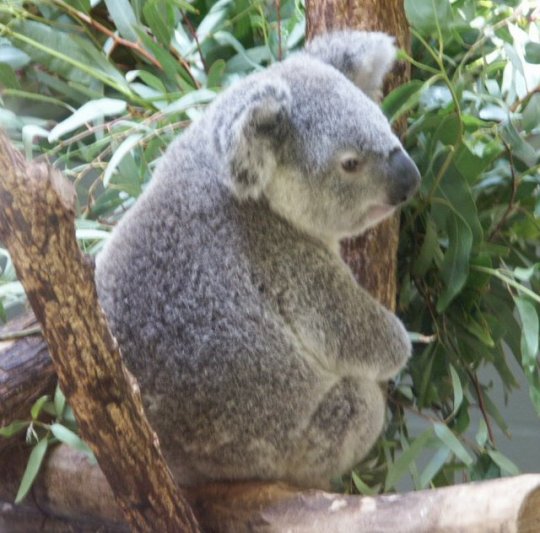
The answer is: not much, because he’s stoned right out of his little marsupial brain. Koalas minimize the number of poisons they have to eat by keeping their energy requirements low- sleeping twenty hours a day and spending most minimal effort possible on things like mating- and spending the rest of their energy on the biochemical processsing required to sort the toxins out and discard them. Some of the easiest defensive chemicals for plants to make interfere with digestion- things like tannins, which are the chemicals that make acorns inedible to humans without heavy processing- and a fair number of herbivores have evolved elaborate counter-measures to process them and get some nutrients out of the meal anyway. This, along with internal structures that exist purely to harbor colonies of bacteria with the chemical tools to break down substances- like cellulose- that are indigestible by all animals, is why herbivore digestive systems look like maps of Carlsbad Caverns. Should any vegetarian ever assert to you that vegetarianism is healthier because plant matter is easier to digest, you may inform them that they are completely full of shit.
Koalas are super-specialists in this regard, and they do it very well; however, the long-term consequences of putting all your energy into one specialty- especially a specialty that depends heavily on remaining cutting-edge in an intense evolutionary arms race- is extreme vulnerability to extinction should any aspect of the situation change. In this case, if increased CO2 really is producing sufficiently more toxic eucalyptus as to give the plants the clear upper hand in this particular arms race, this is not so much Yet Another Tragic Consequence of Human Hubris as the sort of natural process that goes on all the time with cycles of variation in climate and other environmental factors- the level of CO2 in the atmosphere has been much higher- along with the total amount of plant biomass- in the past, completely without human help*.
This is not to say that the potential extinction of the koala is or should be of no concern; one of the pleasant side effects of being human and having advanced consciousness and reasoning skills is that we can appreciate creatures that are strange and maybe not particularly fit just for being unique and interesting. Thus, the dodo as the poster child for the tragedy of human-caused extinction: a creature utterly unsuited for anything but life on an island with no predators and damned little competition of any kind. Nature might, given enough time, eliminate the genetic lineages of everything except that tough enough and generalist enough to survive into the next epoch, but humans have the ability to mourn the loss and try to preserve bits of it- especially those bits that we really do deserve the direct credit for threatening, however much a part of nature we ourselves are. We’re a self-aware part, which is why the discussion is worth having at all.
However, beating our breasts over killing the poor koalas by polluting the earth with CO2 is far too silly a stance to take for individuals that are not, presumably, whacked out on eucalyptus. Unfortunately, until we prioritize the kind of scientific education that allows us to understand the environment over education meant to raise environmental sensitivities, that’s just what we’ll get: clueless sensitivity that aggrandizes mankind’s power and privilege just as badly as the “dominion over the earth, we’ll take all we can” mindset.
*The actual argument among intelligent professionals is not over whether more CO2 is an omgkillergas, but rather over the degree of impact human-mediated releases of CO2- like the burning of fossil fuels- are having or could have on normal cycles of variation. I have not refuted “anthropogenic global warming”, just one piece of common media silliness stemming from the scientifically illiterate trying to report on science.

July 15th, 2008 at 4:50 pm
Another piece of scientific illiteracy is the use of “toxins” and “nutrients” generically, as if nature had everything sorted out into Good Stuff and Bad Stuff so cleanly. Trying to not consume or create “toxins” is pretty damn pointless considering how many totally organic clean plants are nonetheless chockablock with natural poisons.
Also, the biggest illiteracy in this is the surety that out of tons of studies about plants and atmostphere, this one made the news because koalas are such adorable little fwuffy teddy bears.
July 15th, 2008 at 4:52 pm
Yep. I considered launching off into that rant, then decided it was tangential. I always feel like such a ghoul watching someone very self-satisfiedly eating a salad…
Fun ecology fact: species that are cute enough to get the public’s attention and will to save their habitat (along with all the boring and ugly critters within it) are called “umbrella species”.
July 15th, 2008 at 5:09 pm
“Should any vegetarian ever assert to you that vegetarianism is healthier because plant matter is easier to digest, you may inform them that they are completely full of shit.”
I think I broke something when I fell off my chair.
You’ve been around cows before, haven’t you?
July 15th, 2008 at 5:16 pm
Yes. Cows, horses, rabbits, and self-righteous vegetarians with a severe case of Physics Superiority.
Just because you can mathematically describe a nuclear reaction doesn’t mean you know a goddamn thing about what it takes to turn a leaf into more animal…
July 15th, 2008 at 6:39 pm
That reminds me of the physics professor I had for physics 201 (I was taking it as a gen ed; I’m a multimedia major). One of his first lectures had to do with why milk was bad for you, and how it caused allergies and wasn’t really a good source of calcium. His evidence for the allergies was a series of anecdotes, and his evidence for milk not being a good source of calcium was to use a bull as an example. According to him, the full grown bull got all of his calcium from plant matter, and that we should to (though, I don’t think he was a vegetarian; he was just against milk for some bizarre reason).
I’m not exactly sure what the hell that had to do with physics; guy was a bit strange at times. In either case, I’m kind of a living example as to why his views were wrong. I have extremely thick bones, partly due to the fact that I like to drink milk like some folks like to drink soft drinks. I once sprained my ankle so badly, the doctors thought that the forces involved should have broken it. I’ve also never broken a bone, despite playing high-impact sports like football for seven years.
July 16th, 2008 at 1:34 am
It’s going to be an entertaining period in history. Just when we’re going to need science to actually, y’know, save the species we’re going to have huge hords of mis-informed but strident non-scientists bleating and honking to their vote-grubbers based on the writings of journalists who glazed over listening to properly informed opinion and unilaterally decreed it to be “too hard”.
Yep. Gonna be interesting.
July 16th, 2008 at 10:59 am
You may not have refuted AGW … but it for damned certain hasn’t been proven.
July 16th, 2008 at 1:51 pm
So, you could say Koalas are bad in the sack…
July 16th, 2008 at 2:24 pm
Regolith: Bashing on milk has become fashionable, and as usual those who think they know Everything (and that usually describes physicists to a T) have got most of it wrong. Also, may I just reiterate how much I FUCKING HATE people with a food agenda who compare us to herbivorous species and assert that we should be able to get along just as well on leaves and twigs? Herbivores HAVE to put almost all their energy into eating and shitting, because the nutrient content of their diet is so goddamn low. If that sounds like a fun lifestyle, others are free to be my guest, but the comparison is still disingenuous as all hell.
Kristopher: My general position is that extra CO2 generated by human-mediated activities does have an effect, but it’s not likely to be more than a degree or so, and other factors- like the sun and Earth’s own natural cycles of variation- are so much stronger than the man-made effect largely disappears next to them. Check out the blogroll and find Climate Skeptic- Warren Meyer has done a much better job than I ever could dissecting the science of climate catastrophism and teasing out the real work from the hysteria on BOTH sides.
Alcibiades: You could say that. I suppose it might be SOMEbody’s idea of a good time to find their mate by following shrieks that can be heard from kilometers away and then knowing they’re getting closer by the amazing stink, but outside of radical leftists I think it’s safe to say it’s not a common taste.
July 23rd, 2008 at 10:17 pm
I’m also told that koalas go up in a flash when exposed to high temperatures, because of all the eucalyptus oil in their fur…I’m not sure why I found that funny, but I did and do.
J