Victor/Victoria Bio Bleg
Irradiated by LabRat
Normally, when people talk about or play with the concept of someone being half male and half female, they’re either talking about (nonfictional) intersexed genitalia, or (fictional) an individual with a fully working set of both. They don’t usually mean that literally- someone split half and half down the middle, male on one side and female on the other. That seems more fantastic than even the two-sets-of-genitals idea.
Reality is stranger than fiction.
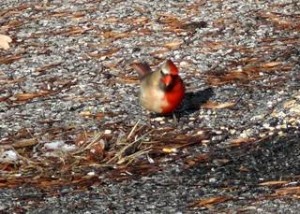
While everyone is familiar with the bright red male cardinals, those who don’t bird-watch often don’t realize that only half of all cardinals are red like that- the females are a rather drab grey color with a few red accents here and there. Except in the case of this cardinal*, which is quite literally half of each. The bird is a gynandromorph.
Now, this is where what was intended to be a fun science post turns into a brief accounting of my personal descent into embryology hell with perhaps a side of fun science post for people who are not me. (Embryology was… not my strongest suit in school.) As a warning for those who are shaky on science, this is not going to be one of my more readable posts; I’ve simplified and explained as much as I can, but there’s a reason embryology in general is such a bear of a subject.
See, when I looked up what seems to be the web-standard explanation of gynandromorphy- which I had honestly never heard of before that cardinal picture started its journey around the interweb of geeky birdwatchers, it comes up as a nice, neat explanation- for arthropods.
Once you get into the taxonomic Kingdom Animalia, the next taxonomic line before we get into phylums is based on embryological development: how an embryo of a given organism develops depends on whether it is a deuterostome or a protostome. While there are several distinctions between the way the two types of organisms develop- for example, whether the very first opening created by the very first cell cleavage is destined to become your mouth or your anus**- the important one for this discussion is that protostome cell cleavages are determinate, and deuterostome cleavages are indeterminate. A deuterostome cell can still become pretty much any kind of cell up until much later developmental events, whereas the protostome cell’s fate is narrowed down cell division by cell division from the very first one. The first division determines the right and left sides in a protostome cell; if you were to then separate the two, they’d die, because from the first division on each one is essentially half an organism. In a deuterostome, they would still have the potential to develop into two complete organisms. This is why identical twins are possible for humans and other deuterostomes- that indeterminate system of development becomes important when the developing mass of cells splits completely apart instead of folding normally. You’d never get identical insects or starfish through the same mechanism- the different developmental system wouldn’t allow it.
Arthropods are protostomes, and the two other places I can find examples of gynandromorphy are arthropods; in Lepidopterans- moths and butterflies- and crustaceans (crabs and lobster). While I don’t know how crab and lobster sex chromosomes work and attempting to find out netted me the seductive promise of spending another hour driving myself slowly insane, I’m going to assume they work pretty much as Lepidopteran sex chromosomes do and involve a pair of different chromosomes whose combination determines sex, and in which getting only one of the most “necessary” one- in Lepidopterans and mammals, X, in birds Z***- is not lethal but instead produces a male or female as a sort of default setting. For humans and other mammals, XX produces a female, XY a male, and X-nothing an infertile female. For Lepidopterans, XY produces a female, XX a male, and X-nothing a female.
The way you can get an X-nothing (and a corresponding XXX or XYY) is during a “non-disjunction event”. During cellular division, just before the actual divide, the two complete copies of DNA- all the chromosomes- are lined up and attached to each other. During a non-disjunction event, rather than properly coming apart before each cell goes its separate way, the two copies of a particular chromosome will stay stuck together and leave the other cell missing a chromosome. This is usually fatal to the cell with the missing chromosome and carries various potential consequences (including a total lack of them) for the cell with an extra one. In the case of extra or missing sex chromosomes, results vary- just having one X or an XYY is nonfatal for mammals and Lepidopterans, but just a single Y is fatal.
So, a gynandromorph is therefore (according to all I’ve been able to read) what happens when a non-disjunction event involving the sex chromosomes happen during the earliest cell divisions in an organism with determinate cell development. Since that first division determined left and right sides, if the non-disjunction event occurred then, the result would be an organism that was male (for a butterfly, XXX) on one side and female (X-nothing) on the other- a bilateral gynandromorph. (It’s possible for the same accident to happen a few cell divisions later, and in an insect that’s called a mosaic gynandromorph. They have one side that is clearly one sex and are a mosaic of both on the other, like this:
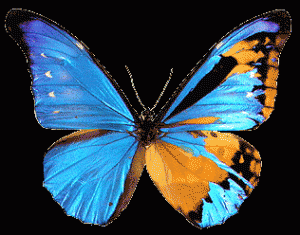
…However, I’ve never seen pictures or reports of any gynandromorphic bird that was a mosaic rather than bilateral.
Anyway, the problem I’m having is this: birds aren’t protostomes, like crabs and butterflies. They’re deuterostomes like the rest of the vertebrates. I know their early cell development is indeterminate rather than determinate because the same thing that leads to identical twins in mammals can happen in bird development- that’s what’s happenes when you get a double-yolked egg. The “twin” almost never survives because there’s simply not room within an eggshell for two embryos to develop fully, but the same basic event has happened, and can’t happen if the earliest cell divisions are determinate.
So how the hell do bilateral bird gynandromorphs develop, then? When another deuterostomate animal has a chromosomal non-disjunction event during early cell development like that, the results are a complete mosaic****; instead of being split down the side like that, the critter is outwardly male- and normal to all appearances- but its cells are a jumble of X, XY, and XYY, with the X-only cells being essentially female cells.
Why wouldn’t exactly the same thing happen to birds after an early non-disjunction event? If there’s another mechanism that produces gynandromorphs that I’m not aware of, why do birds seem to be the only deuterostomes affected? If it’s something about the unique development that embryos of land-based egg-laying creatures go through to deal with the yolk, then why don’t reptiles seem to produce these individuals? They’re rare, but not THAT rare, and there are plenty of reptiles with enough sexual dimorphism to produce a visible effect.
If you’re one of those readers that understands embryology better than I do, an answer before I finish going round the bend would be deeply appreciated.
*Credit for the photo goes to Jim Frink, and I found the thing through Minnesota Bird Nerd.
**I find it cosmically fitting that humans, along with all other vertebrates, begin as assholes.
***Yes, birds have totally different sex chromosomes, W and Z. ZW is female, ZZ is male.
****I’ve talked about mosaics before.

January 27th, 2009 at 6:43 pm
Could it be that two different sex embryos fused?
January 28th, 2009 at 7:27 am
I don’t know how it works but it may have ben studied in domestic pigeons, where a gynandromorpic condition similar to the cardinal’s exists- may have pix. I think ones with one side mosaic exist too. I may have even had one but passed it on, not liking the effect- looks like it might have been hard to breed
January 28th, 2009 at 8:57 am
I’m with Bugs: I think that’s a Chimera.
January 28th, 2009 at 9:37 am
Yep … chimera. Think “severely conjoined fraternal twins”.
So conjoined that one half makes up the other’s half.
With a critter that lays eggs, any such conjoining will either end up as a single chimera, or get spontaneously aborted.
January 28th, 2009 at 10:13 am
Very well thought out, but you’re missing something further up the chain. Namely, there can be XY genotypical phenotypical females (I’m more used to humans, so I’ll go with that). The Y chromosome carries testis determining factor, which causes the testes to develop. BUT, if an organism does not have the receptors for the testosterone, they’ll have androgen insensitivity and be a phenotypic female with mullarian duct development and uterus/fallopian tubes yet internal testes.
I think something like that might have happened with this cardinal-it’s a genetic mosaic, yes, but it might have happened further along the endocrine pathways. I’m not totally sure, as I’m weak on human reproductive endocrinology and don’t pretend to know anything about avian endocrinology.
January 28th, 2009 at 11:20 am
Chimera is the most plausible theory so far, but what’s still hanging me up is why the individuals involved have such a strict bilateralism between the male and female “parts”; chimeras are usually much more messily put-together than that. That, and the phenomena is common enough in birds (but apparently not reptiles) that I can find several examples of them referred to as “gynandromorphs” and studied as such when I went digging through the literature. Either the researchers themselves don’t know what exactly they have on their hands, or we’re still missing something.
William: I’m familiar with androgen insensitivity syndrome, but these birds don’t fit the pattern- when dissected, they have a fully developed testis on one side and a fully developed ovary with a complete set of tubes on the other. And, again, this is still rare but seems to be a pattern in birds; there’s the pigeons Steve mentioned, and when I went looking I found quite a few more pictures from various species; I just used the cardinal photo because it captures the bilateralism so well. Androgen insensitivity plus mosaic would seem to be too much of a freak genetic accident for that.
January 28th, 2009 at 11:28 am
Apparently it has been studied a bit in pigeons, which is why I was able to dig up this paper on a blue-throated warbler that seems to have been of the mosaic gynandromorph sort.
….I am not any less confused but apparently need to locate this Crew and Munro paper from 1932. I’m sure that’ll be readily Googleable.
January 28th, 2009 at 11:30 am
Even knowing the difference in coloration between the male and female cardinal, I can’t say I would have thought to look into it if I’d seen that bird. I certainly would have thought it was interesting, but I’ve been noticing the females becoming more red around here for the past few years. So I probably would have mistaken it for that, rather than thinking it could be intersexed. Of course, this brings me back to wondering why our female cardinals have been popping up with quite a bit of red on them.
January 28th, 2009 at 3:05 pm
Not all chimera’s are mosaics, like calicos.
A few are bilateral ( or even checkerboarded, if you want really strange ). It all depends on how early or late the two genetic individuals conjoin.
January 28th, 2009 at 3:36 pm
This is true, but I’m still having issues with first how (relatively) common it seems to be in birds and birds alone out of deuterostomes, and second how closely the pattern follows the arthropod gynandromorphs. The 1932 paper classifies the bilateral gynandromorphs as “passerine” type and the mosaic gynandromorphs as “pheasant” type, but it’s not hard to find cites since then indicating this was a false distinction born of sample size and conjecture rather than actually making an accurate guess about what caused it.
January 31st, 2009 at 1:15 am
I seem to recall that falcon hybrids result in a higher-than-normal number of bilaterally asymmetrical oddballs.
So, another vote for it being a bird thing… for whatever reason.
December 3rd, 2009 at 1:55 pm
Cheers for the fantastic information - I loved reading it! I always love reading this blog.