Archive for November, 2011

Huddle

November 10, 2011 - 5:45 pm Comments Off

So, it seems that a popular and successful past Penn State University football coach Gerald Sandusky was basically a serial child molestor who used his positions both at the university and as part of a charity for “at-risk boys”* to groom one prepubescent and recently adolescent boy after another to be his sexual playthings. Creating additional scandal is that the university authorities, including the head football coach who happens to be a bit of a legend in his field, were active participants in covering up his crimes- and Sandusky was not subtle, being caught red-handed more than once in acts of unmistakable violation of kids who were unmistakably, well, kids.

It’s all there in the Grand Jury’s findings of fact (thanks Matt), although if you’re a parent of young children, I caution you against reading the whole thing unless you want to answer questions from your kid about why you’re always at least three feet away from them carrying a rifle these days. Suffice to say, the reason why Joe Paterno, the head football coach in question, wound up fired was that the course of action he took when informed by a graduate assistant who witnessed Sandusky screwing a ten-year-old boy in the locker room showers was to report this to his own immediate superiors, who subsequently decided that the best course of action would be to confisticate Sandusky’s keys to the locker room, seeing as how this would clearly solve the problem.

To the outside observer, it stands out as “interesting” that at no point along a chain of witnesses and report-hearers did it occur to anyone to involve the police rather than the university authorities, or to go to the police when the university authority response was to simply paper over the incident rather than do anything to bring Sandusky’s crimes to light or even to significantly limit his access to children. (Even they admitted under oath, which they spent quite a bit of time lying during, that given his status and privileges banning Sandusky from the locker room was essentially unenforceable.) In the rather long history of his victims that were actually known about (it’s likely he had many more, who never reported and where he was never caught), the only people that ever went to the police were parents.

In response to this, some of the students of Penn State have rioted to protest the grave outrage that is Paterno being fired for shrugging his shoulders and turning his back on one of his underlings being caught molesting a kid in the shower- which was actually the second time, as a janitor caught him two years earlier and we simply don’t know how high up the chain of command THAT reporting stopped. To be fair, some of the students are more upset about finding out about what was going on under the auspices of the university football program than they are about losing their coach, but the rioters’ argument seems to be that he shouldn’t be fired for someone else’s “deviance”.

How on earth could these people be thinking and behaving like this?

1) An adult that isn’t a scary-looking man who has a van with no windows and a bag of candy raping little boys is so far outside of their experience it isn’t quite real to them. This applies especially to the students. That’s just not something they’re prepared to wrap their minds around and admit into their personal realities, so they focus on what they DO know, losing their beloved coach. Since “child molestation” covers everything from “creepy touching” to “anal rape”, unless they actually HAVE read the details (which you do need to go out of your way to get), it’s easy for them to make an unconscious leap that it must not have been all that bad because Good Ol’ Coach would never have permitted anything truly bad. Therefore, Paterno is being railroaded so Penn can cover its ass. You’ll note that they’re attacking news vans, implying that they’re responsible for his downfall- even though the details of the case are actually much worse than what the media broadly reported. They didn’t sensationalize, they minimized.

2) Related to 1, the disconnect in many people’s minds between their abstract mental pictures of people who rape and assault and people they actually know. It’s actually relatively common for predatory pedophiles to receive family and institutional cover; I couldn’t fully explain why this is so, but it’s ludicrously common both for victims to report that this is so and for investigations to find when they finally crack the top off a stinking mess like the Sandusky one. My best guess is that it’s combination of the first factor- the unreality of the awfulness- greater familiarity and attachment to the member of the circle than to whoever the victim is, and the horror of the prospect of public shame, which would both make it all more real and reflect some of the awfulness of the predator’s associates. Intolerable. So much easier to try and stave off the shame, when the guilt may be more easily repressed. If everyone around you is denying something that always felt a bit unreal to start with, it’s much easier to treat it as an abstract.

3) Combined with 1 and 2, there’s the culture of the institution, and the family- the tribe. There is a very deep undercurrent that groups should handle their problems internally; doing an end run to an outside higher authority is widely viewed as finking, snitching, tattling, you name the word for it you learned on the playground. It is very often our first instinct to go to the institutional authority rather than the criminal authority for anything that isn’t immediately life-threatening- and it is in the instinct of those authorities to keep it all in-house, and to delude themselves that it’s within their power to deal with the problem.

It’s worth revisiting Peter’s articles on the Catholic Church sexual abuse scandals. A great deal of it is specific to the Church, but a great deal more is the universal psychology of the institution, and our problems in general in dealing with sexual abuse.

*Every single article about this, including the court documents, use this terminology. I don’t know if it’s just a really standard term in the charity industry or a bit of unconscious literalism, given the nature of the case.
Movie Review: Paul

November 8, 2011 - 6:32 pm Comments Off

The short version of the review: If you are a geek, especially a science fiction geek, put down the internet and go see it right now. If you are not a geek of any type, you’ll probably still get a kick out of it, but not quite as much of one.

The long version: Paul is Simon Pegg and Nick Frost’s third movie together, the first two being Shaun of the Dead and Hot Fuzz. I am rapidly becoming convinced that they are either the most brilliant comedy writers of the current generation in movies, or they were tailor-made by God specifically for the purpose of entertaining Stingray and I. I was a fan going in, I’m a bigger fan now. Be warned this will accordingly contain a certain amount of gushing.

What really amazes me about their movies is that while they are all hysterically funny, they are funny in completely different ways. Shaun of the Dead is slow-paced and subtle, with most of the humor prior to the action sequences at the end only being apparent if you have managed to twig that it’s a movie about the zombie apocalypse featuring people who are too self-absorbed to have noticed it. Hot Fuzz is a deconstruction and reconstruction of action and buddy-cop movies. Paul is a buddy road trip movie, and affectionate tributes to geeks and geek culture, with incidental science fiction. It’s very much like Galaxy Quest in that it is an extremely affectionate parody of its subject, so much so that you want to give the cast and crew a big hug at the end. About the only things the three movies really have in common with each other are Pegg and Frost and the pacing- they all take their time setting up their elements before the laughs really start rolling in. Twenty minutes into Paul I commented that it wasn’t all that funny, but it was adorable; twenty minutes before the end we had had to pause the movie twice and rewind because we were laughing too hard to have caught the last few minutes of events.

The only characters who are exactly what they appear to be on the packaging are Pegg and Frost’s characters, and they manage to do this in refreshing ways rather than prepackaged characterization twists, which is a nice change of pace from the norm. We groaned when we saw Arrested Development star Jason Bateman- we are the only two geeks in America who did not find that show remotely funny- but he turned out to be one of the best parts of the movie. The overall plot of the movie should be pretty familiar to anyone who’s seen either a road trip movie or a movie about aliens, but they manage to throw a sufficient number of curveballs within that structure to keep the audience alert and amused.

The other thing we really appreciated is that while there are plenty of references and shout-outs, they are either there as a background, easily missed thing, or they have a very specific plot purpose, or else they exist to be a wire-guided Humor Missile. It’s too often that movies that have some self-awareness use references whether they’re actually funny or not; the point is to spot them and acknowledge that, yes, you and whoever made the movie/show/comic/whatever share the same pop culture pool, not necessarily to be funny. These are, when you catch them, funny beyond just their recognition.

It’s a great movie by and about geeks who obviously love movies and love geeks, as laughable as we often are. You should see it. The end.

Crossf****ed

November 7, 2011 - 9:00 pm Comments Off

So, we finally spent enough time making noise about wanting to get more serious about the whole getting fitter thing and wanting some sort of coaching and accountability aside from whatever we could pull out of our own asses, so we went down to one of the Crossfit boxes in Santa Fe to see about that. Because they like know when to stop before an important internal organ shoots out your nose, their policy is to give you an individual session first before they attempt to pitch you into anything else and establish a bottom baseline.

(My animated gifs don’t seem to be animating on their own. You may have to click the middle three to make the funny part happen.)

(more…)

Time Warp

November 6, 2011 - 11:35 pm Comments Off

The dogs get fed at 6 pm. Today at 5:45 pm Tank went into his crate, picked up his food bowl, carried it over to me, and flung it forcefully at my ankles. It fell to the floor in a clatter of accusation.

Someone was unamused his dinner was 45 minutes late by his count. I feel this is an adequate summation of how all of us here feel about DST…

How To Get There From Here

November 4, 2011 - 4:42 pm Comments Off

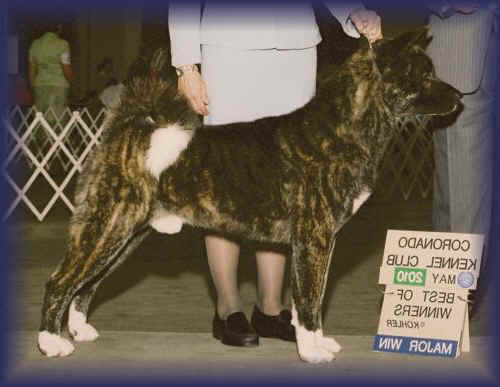
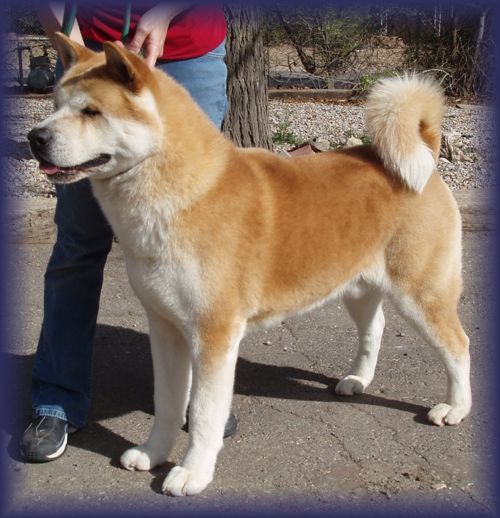
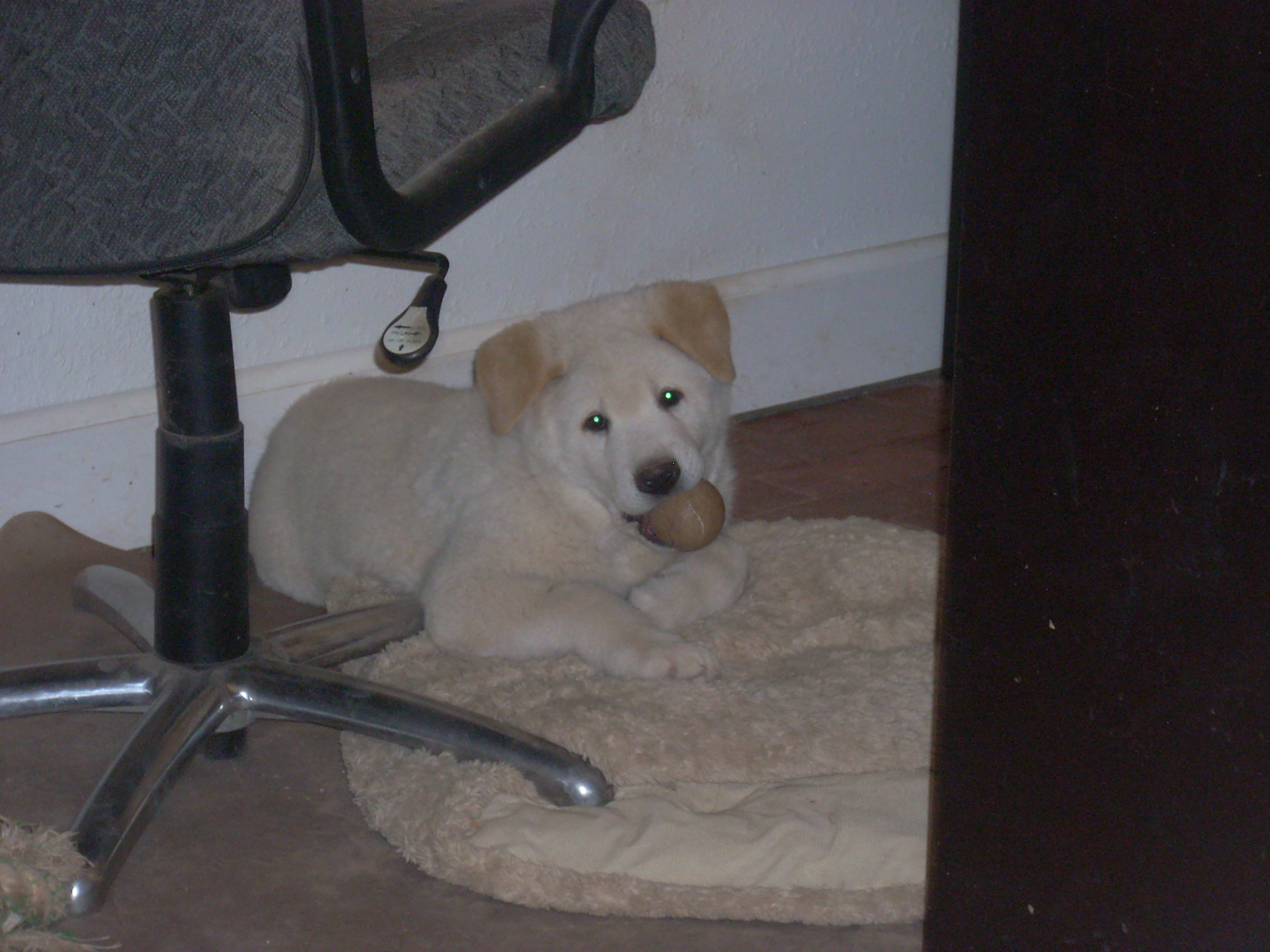
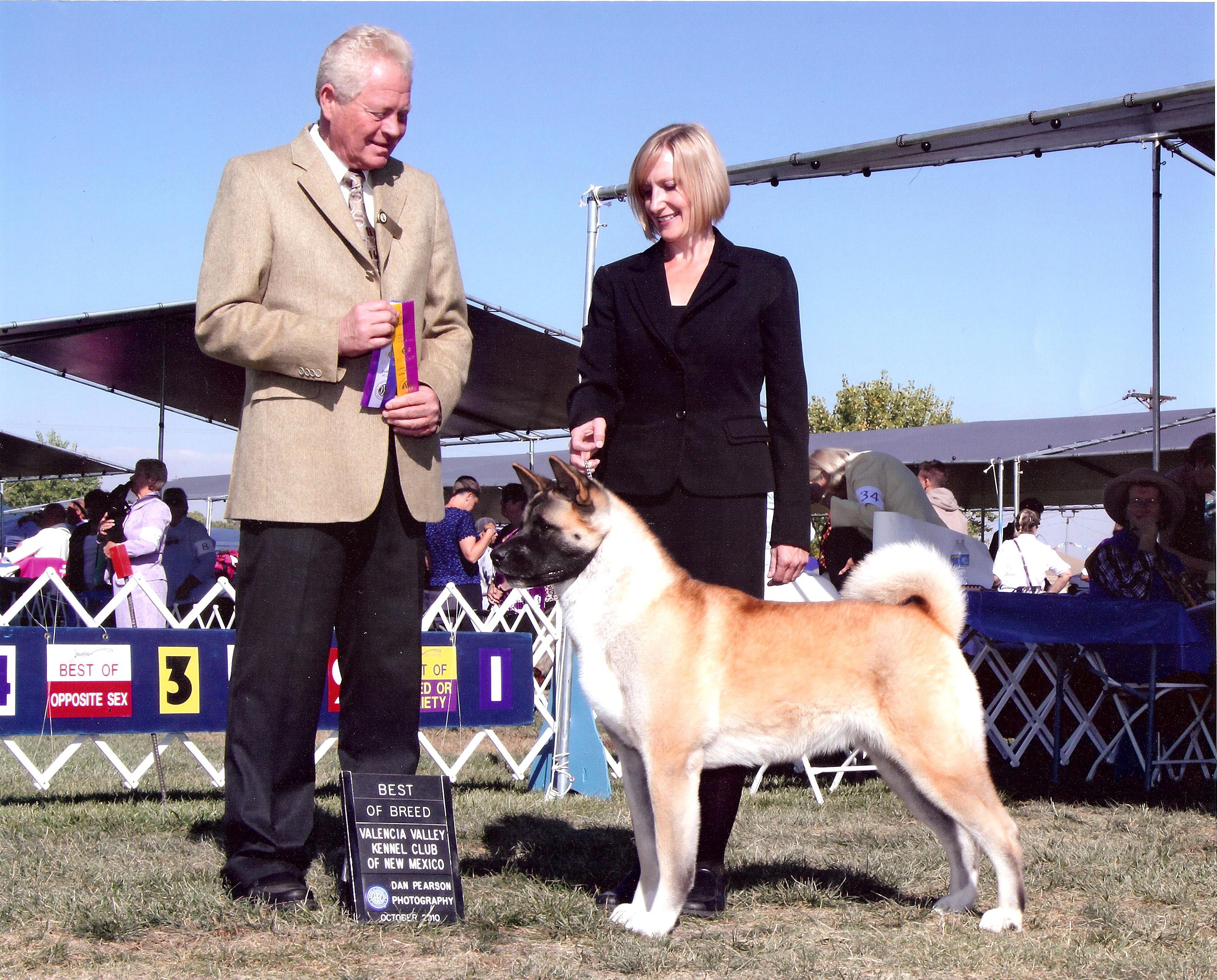
Tank is a ten-week-old Akita puppy, a breed in which all colors are permitted. His littermate is the same color as he is. He looks like this:

His mother looks like this:

His father looks like this:

There are no white dogs anywhere up to five generations back in his pedigree, although there is one that shares a grandsire with him out there. How, genetically speaking, do you get a result like this?

The answer begins with an epistatic effect. To explain how it works, we’ll go to a genetically simpler breed, in which only three colors are permitted instead of all of them.

All Labrador retrievers are, genotypically, black dogs. There is a genetic locus in dogs, the K locus, that determines whether a dog will be black, brindle, or whether some other color will be allowed to express; every single Labrador has the dominant gene at the top of the series, K. There are no kbr or k dogs in the breed- K is fixed.

The starting color for each and every Lab puppy is black, but other genes can modify it; one way is for the dog to have a recessive at the B locus. Big-B is normal black, but several alleles that are recessive to it will turn all black pigment to brown; one way to recognize its presence in a dog whose coat color is something other than black is that these genes also affect the skin on the nose and around the eyes, so that their noses turn from black to liver. A Labrador with one of the browning recessives at that locus will be modified to chocolate rather than black- at least genetically speaking.

I say “at least” because the other locus of concern in terms of what you get out of a litter of Lab puppies is the E locus. The E locus has four alleles in the series, but only two of them are present in Labs- E and e. Big E allows normal production of eumelanin, the pigment that produces shades of brown and black, and is dominant to little e. When there are two e’s at that locus, it acts as an epistatic switch: all eumelanin production is turned off in the hair shafts. Whatever black pigment would have been otherwise present in the coat goes away, and the only thing left is phaeomelanin, the pigment that produces yellow and red shades. Phaeomelanin is present anyway in a black dog’s coat, and can sometimes be seen as reddish highlights, but normally it isn’t very visible. A yellow Lab with a black nose is a dog that would have been black otherwise; a yellow Lab with a brown nose is one that would otherwise have been chocolate, sometimes called a Dudley. The ee switch only affects the hair shafts, not the skin, so the normal black pigmenting or modified brown still happens.

Tank’s grandsire on his sire’s side looks like this:

Neither this male’s sire nor his mother are clear red like this- his mother is a shaded grey, and his father is a red brindle. It’s impossible to know whether he himself is a brindle, because this dog is ee; all the black pigment in his coat has been turned off. This pattern- “white faced red”- is much more common in Japanese dogs than American ones, but ee Akitas from either country will usually look like this. There is a white-faced red in Kang’s pedigree as well, but that dog is four generations back.

So, we get a red Akita with white markings and no black hairs with the ee epistatic shutdown of all black pigment. The other half of Tank’s creamy complexion comes from a different gene that also modifies normal expression of coat color, but presents different appearances based on the starting base color.

The dog that sired Tank has the ee red sire and a black brindle dam, but both of his grand-dams are the same black-shaded grey color, referred to in this breed as silver. Genetically, they are most likely red, like Kang; the reason they appear silver instead is another locus, which has not yet been found in the laboratory but whose behavior is clear in a lot of breeds- the hypothetical I series affects phaeomelanin, rather than eumelanin. The dominant I lets phaemelanin express at normal intensity, one copy of the i recessive will cause phaeomelanin to lighten, and two i’s will bleach all red pigment in the coat. A black and tan pointed dog with a double i will have silver or white points instead of tan- and a red dog with black shading will appear greyish, silver, instead. The more black in the dog’s coat, the darker the overall visual effect.

What happens to a dog with no black pigment in its coat at all? The only pigment present in the coat, phaeomelanin, is all bleached- giving a white or nearly white dog, as the bleaching effect can be incomplete- which is why Tank’s ears are a pale peach color rather than fully white, and he has very faint red shading on the areas of his coat where the unmodified red would normally be most intense as well.

This is how you get a white dog from two lines with no white dogs in them: start with one recessive that removes all black, and then add in another recessive that bleaches all red. Since there are only two kinds of pigment in the coat, black and red, the result is white by default.

I mentioned when I talked about piebald that there is more than one way to get white onto an animal or to get an all-white animal- this would be one of the others. Since the genes in the piebald series stop pigment-producing cells from fully migrating out of the neural crest in the first place and the two genes responsible for Tank’s color only affect the hair shaft, his eyes and nose are normally colored and there is no risk of deafness; under the fur, he is pigmented normally, including the nerves that require it to develop properly.

Beasts Around Us

November 3, 2011 - 7:07 pm Comments Off

Short on time today. Took Tank to the vet for his next round of boosters and checkup (he was very good for the vet, and he is fine), did some other chores, got a raid tonight. Tomorrow we’ll do some genetics fun.

Today, I’d like to put some more eyeballs onto Slavering Beast Theory, because it’s very good and very much food for thought. Holly is writing about how we think about rape and rapists, which as I’ve touched on before is a crime we have a lot of difficulty thinking about without hindsight like a funhouse mirror, but it’s an applicable theory to a lot of different scenarios of crime and violence. We tend to categorize bad behavior as bad things that bad people do because they’re bad and they enjoy doing bad things the same way good people enjoy doing good things, but what predatory behavior usually boils down to is the temptation to gain some form of satisfaction despite its being at someone else’s direct cost, and that IS something normal ordinary people we know can and do do. If you can imagine someone else lying to others and also to themself about something selfish and maybe just kinda bad they did… this is a more logical extension of thought than trying to imagine them being monstrous. Very few people actually enjoy being cruel, but a lot more people will ignore the cruelty of their own behavior, or minimize it, if the satisfaction is big enough and the cost in facing up to it great enough.

Send In The…

November 2, 2011 - 9:18 pm Comments Off

So. There’s a compelling argument that both zombies and mall ninjas have jumped the shark. This leaves us as a society currently without a socially acceptable Monster Du Jour.

I believe I have found a replacement.

Now if you’ll excuse me, I have to go make sure all the doors and windows are locked before Christina tries to thank me for posting that with a baseball bat. ;)

Why I Am An Atheist

November 2, 2011 - 5:29 pm Comments Off

The House of Representatives of the congress with 9% of the American people’s approval passes a resolution reaffirming that “In God We Trust” is the national motto. The roof of the Capitol building fails to collapse, there are no earthquakes in DC, locusts fail to appear, and not a single person is struck by lightning.

The President responds by asserting God wants his jobs bill passed. The President is not struck by lightning or plague, the earth fails to swallow him, and does not show the slightest sign of being turned into a pillar of salt or any sort of wretched beast.

God is either not there or not anything like so protective of His name as he used to be.

You're Safe- For Now

November 1, 2011 - 4:35 pm Comments Off

Friend Matt tracked me down earlier today to ask me a simple question, and if it was worth answering, it’s worth writing down here as well, seeing as I’ve no brighter ideas today.

So, the question is: Why are there no flying spiders?

The glib answer is that there certainly are, and they travel hundreds of miles, but that’s only flight in the sense that they travel distances by air- they have no control at all over where or how far they go, and they’re using their webbing to catch air rather than any other part of themselves for more-or-less controlled flight, the way flying squirrels, snakes, or lizards do.

The real answer is that, while far from outside the space of the evolutionarily possible, flight is an unlikely path for a spider to evolve along. Arachnids in general and spiders in particular are ground-dwelling specialists; their territories are small, with the definition of “small” ranging from a burrow covering a few square inches to a territory of a few hundred square feet for the most adventurous of wolf spiders. While wolf spiders and jumping spiders do range and stalk prey, the vast majority of the group puts a great deal of investment into a single home location, with many good hiding places for concealment from prey and predators alike, and lets their food come to them. When they do “fly”, it’s to set up a new territory to make a home of. While there are plenty of flying animals with permanent to semipermanent homes, they do far more wide ranging in search of food during their active hours than a typical spider ever will or would ever need to.

Aside from this, there’s not much in the arachnid body plan that provides good material to adapt into flight surfaces. Flying squirrels have membranes of skin between their limbs, bats have membranes of skin between what began as fingers, birds have long, layered feathers making up a flight surface, flying snakes and lizards have elongated ribs with yet more skin making up flaps between them, and insect wings… are complicated. Arthropods don’t have loose skin or scales that can be readily exapted to serve other purposes, and their legs are extremely robustly and well adapted to being legs. The most mobile of spiders, the jumping spiders, rely on control of the blood pressure in their legs to approximate hydraulic pressure, and add safety to their leaps with a drag line- high mobility that can even be used to catch flying prey, but relying on the historical spider strengths in their webbing and legs rather than going for flight*.

Evolution offers almost limitless possibilities for animals, but in practice some possibilities are much easier and likelier to access than others. If you think of a given critter as sitting on a surface representing its possibilities, things that are logical extensions of the critter’s current lifestyle and specializations are “downhill” on this surface- easy, likely paths of evolution. Options that are neither extensions of its current lifestyle nor particularly in opposition to it are on the same plane- neither the path of least resistance nor greater, still relatively easy paths but not necessarily likely without some additional advantage, like a new niche opening up or a lateral move from a niche that is collapsing. Options that are possible but in some ways opposed to its current lifestyle are “uphill”- they’re developmental possibilities, but would require development along ways that contradict its current specializations and body plan; like flight for an animal that has specialized in ground dwelling, concealment, and capture for millions of years. They’re technical possibilities, but before they became a likely path for evolution that animal’s current solutions to problems- like escape from predators by going for immediate concealment rather than flying or draglining away- would have to become non-options, and the animal would have to escape extinction in the interim, so the selective pressure could not be *too* strong.

We don’t have any flying spiders, even though we theoretically could, because flight is uphill for a spider.

*There is one species of jumping spider that has abdominal flaps whose first descriptor claimed were like the flaps on a flying squirrel or lizard and enabled it to lengthen and control its leaps. On further study, it appears they’re only used by males in courtship and it jumps about just like every other jumping spider, no flight involved. In any event it appears spiders CAN develop something akin to a proper control surface, but they still don’t use it in that fashion.