Archive for the ‘Cooking Noob’ Category

Cooking Noob, Guest Special Edition: Easter Feasting

April 6, 2010 - 4:12 pm Comments Off

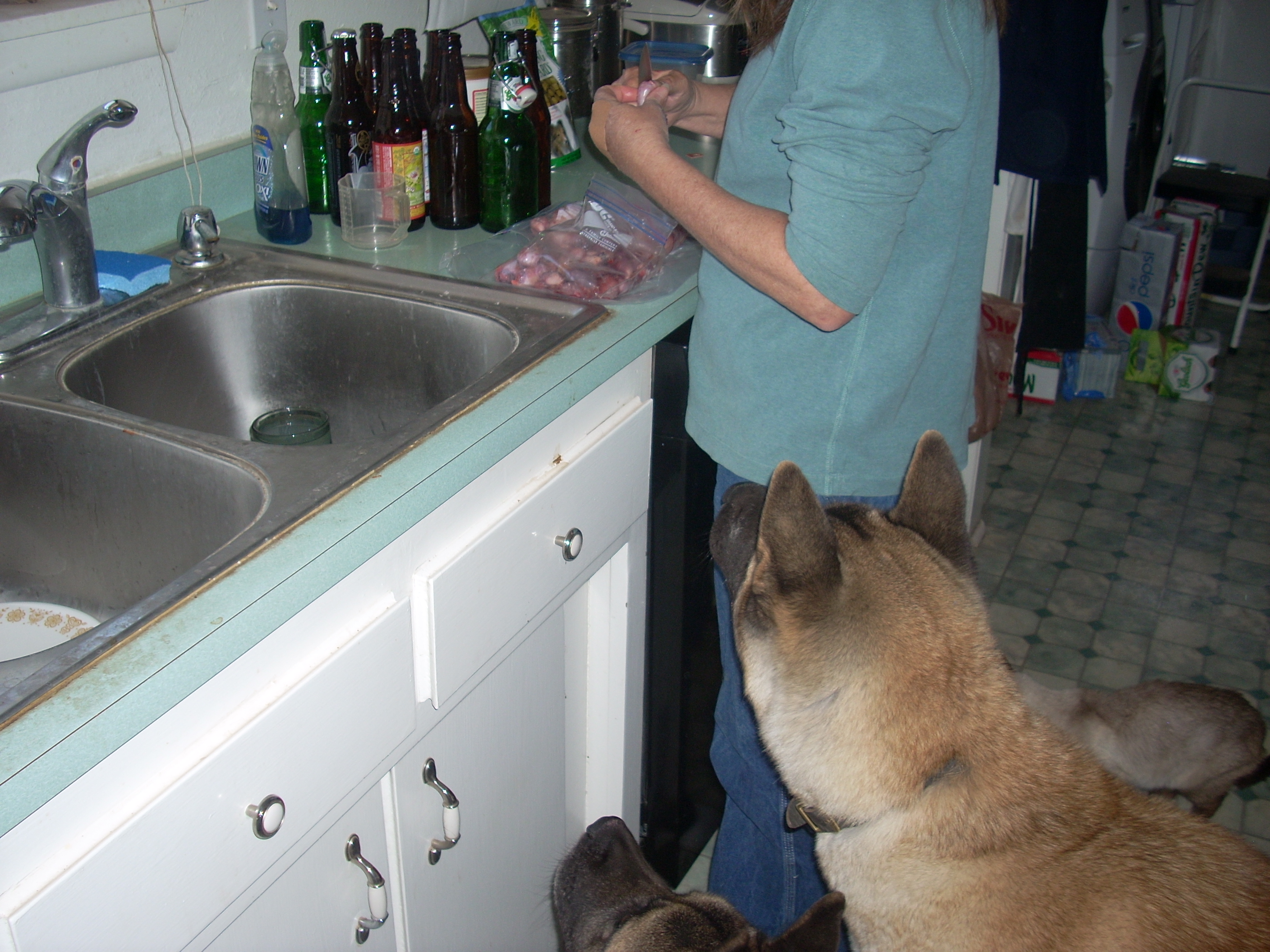
As you are aware from the last post, this last weekend we hosted FarmMom and FarmDad while they helped us with the fence. As long as they were coming down anyway and bringing us the half a cow we had purchased from them, they also hauled down a load of the season’s product of the annual creation of steers from calves, of scrappy nibbles fame. Yes, we knew what they were when we ate them the first time at Blogorado. Yes, they brought the raw materials down for us because they know we like them, as food, rather than as novelty or prank value. Yes, they are pretty tasty if you’re not revolted by the idea of eating calf nuts. Honestly I don’t understand why that gets the reactions it does, beyond more “ordinary” offal like liver; it’s meat. Why eating testicles should be so very much more disgusting than eating something’s ass (aka beef round), or biceps, or bone marrow, is utterly and completely beyond my ken. At least with calf fries, you can lay even odds that the animal that owned the raw material is still alive and well.

It was, however, my idea to eat them on Easter, and to expand the menu to also include eggs in some form. Originally the pagan celebration that the Christian one co-opted aspects of (like the eggs and the rabbits as symbology) was an unabashed fertility celebration, so it seemed fitting. Thus, the final menu wound up as calf fries, deviled eggs (which I love), and fried okra since we needed some sort of concession to fiber and were going to be frying things anyway.

This is going to be a little different from the usual genre of these posts, since FarmMom is an old-school cook who uses the venerable measurements “some”, “a bit of”, “enough”, and “to taste” rather than teaspoons and cups. I took a few pictures, of which few turned out, and will attempt to haphazardly set down what I learned. Rather a fair amount of the process, I’m afraid, has been lost to the temptation to fall into chatting about unrelated subjects while FarmMom did her thing.

Kitchen Bitch

Caution: do not attempt cooking without your Kitchen Bitch unless your house lacks one entirely. The bad karma will cause years of failed cakes, over-done steaks, and collapsed souffles.

1. The night before, take your frozen calf nuts and place them on the uppermost shelf of your fridge, or whichever shelf of your fridge on which soda cannot be stored without turning into slush. You want things to be half-thawed, leaning more toward still frozen, rather than entirely thawed, as they make the first step of preparing the nuts for consumption much easier. Hard-boil a dozen eggs and stick them in the fridge, they’ll be easier to peel if they’ve had some time cold first.

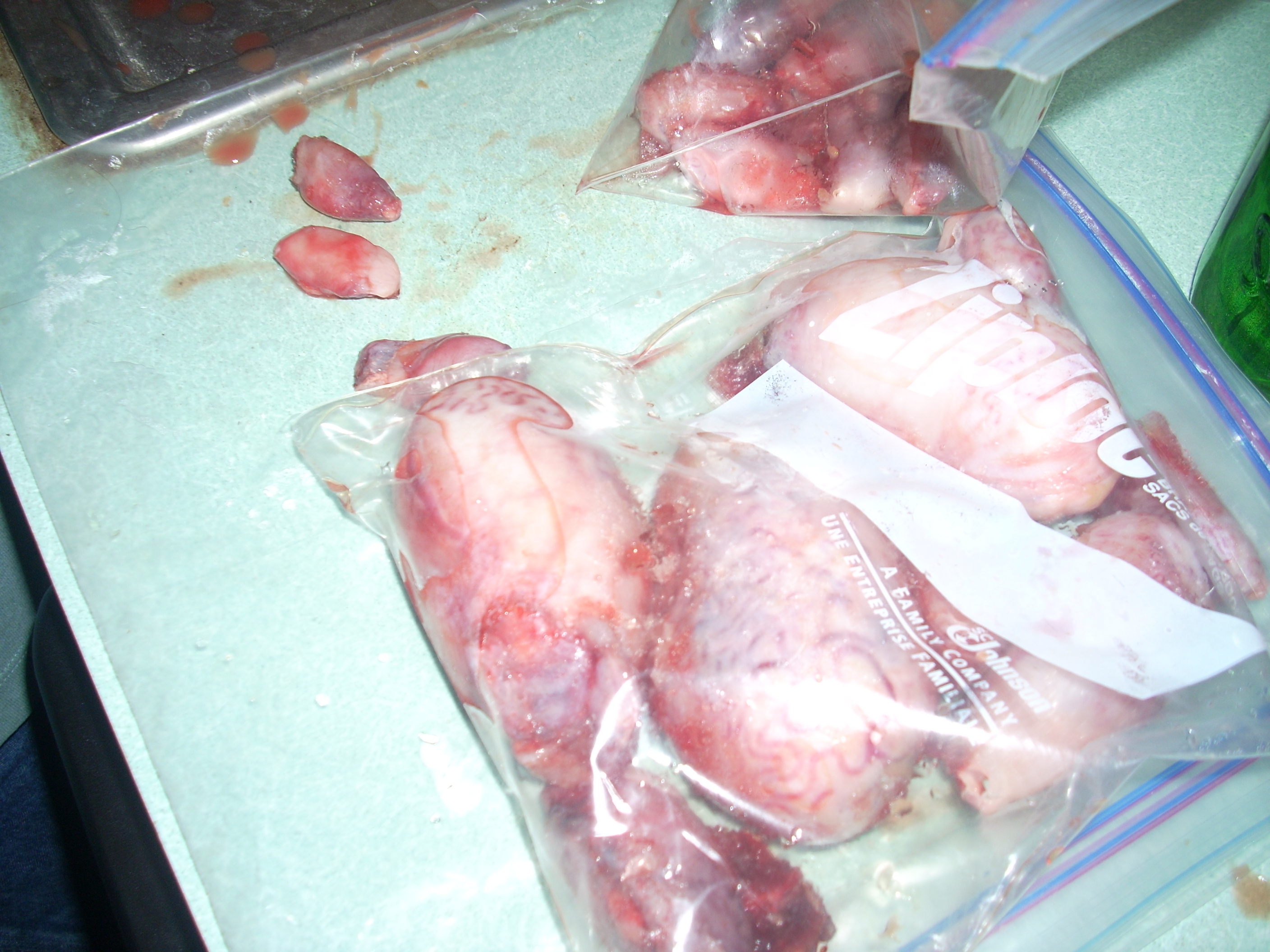
varied balls

2. Before you can do anything with the nuts, you need to take off the tough skin. This stuff will resist chewing and can’t even be put down the garbage disposal; if it has any use at all, it’s as canine chewing gum. We elected not to give any to ours and simply disposed of them in the outside trash. Slice down the convex side with a sharp paring knife and peel off the outer skin. This is where the half-frozen part comes in; the skin is much easier to remove if the edible tissue within has not yet had a chance to soften. You want to start with the smaller ones, as they will thaw faster. This is also an excellent way to slice your hand open if you are at all clumsy or careless, so proceed with caution and perhaps a Kevlar glove. Skin all balls. Optional: if any squeamish males are in the house, when you are finished, chase him through the house with your bloody hands shrieking “VAGINA DENTATA!” Bonus points if you can run him into a wall.

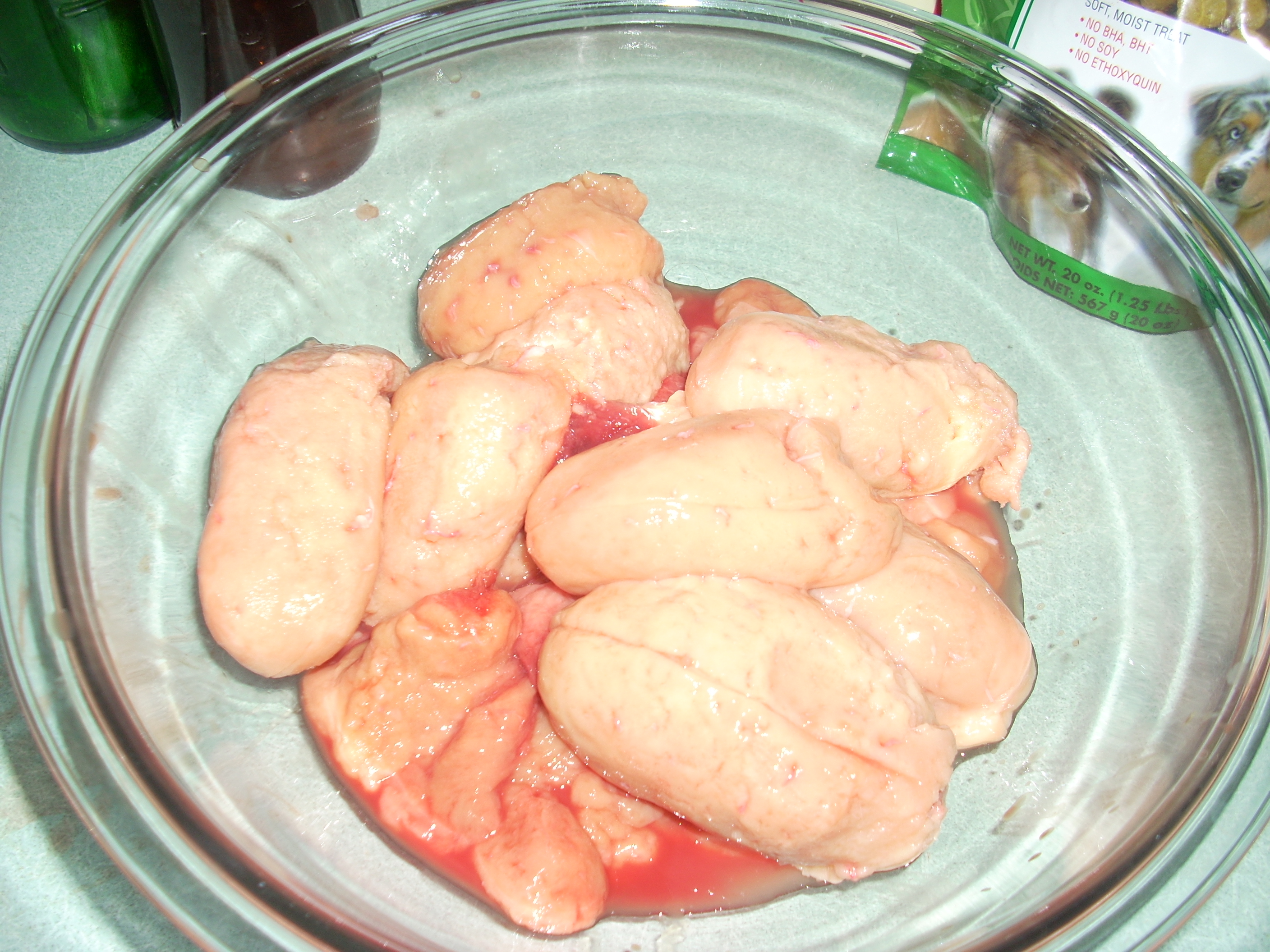
Naked balls

This is what they’ll look like when you’re done. As they thaw you’ll lose more of that edible tissue along with your skin, so try to work as quickly as you can without being careless. Set your bowl of balls aside until we’re ready for the frying phase. Now would also be a good time to take your sliced and frozen okra out of the freezer and set somewhere to thaw. (Or, if your local store actually carries fresh okra… slice it up however you do that with okra.)

3. Extract your bowl of hard-boiled eggs from the refrigerator. Start peeling. This is one of those interesting cooking chores in which freshness actually punishes you a bit; as eggs age the whites shrink and peel away from the shell some, making older eggs much easier to peel than fresh ones. Peel until you’re out of shelled eggs.

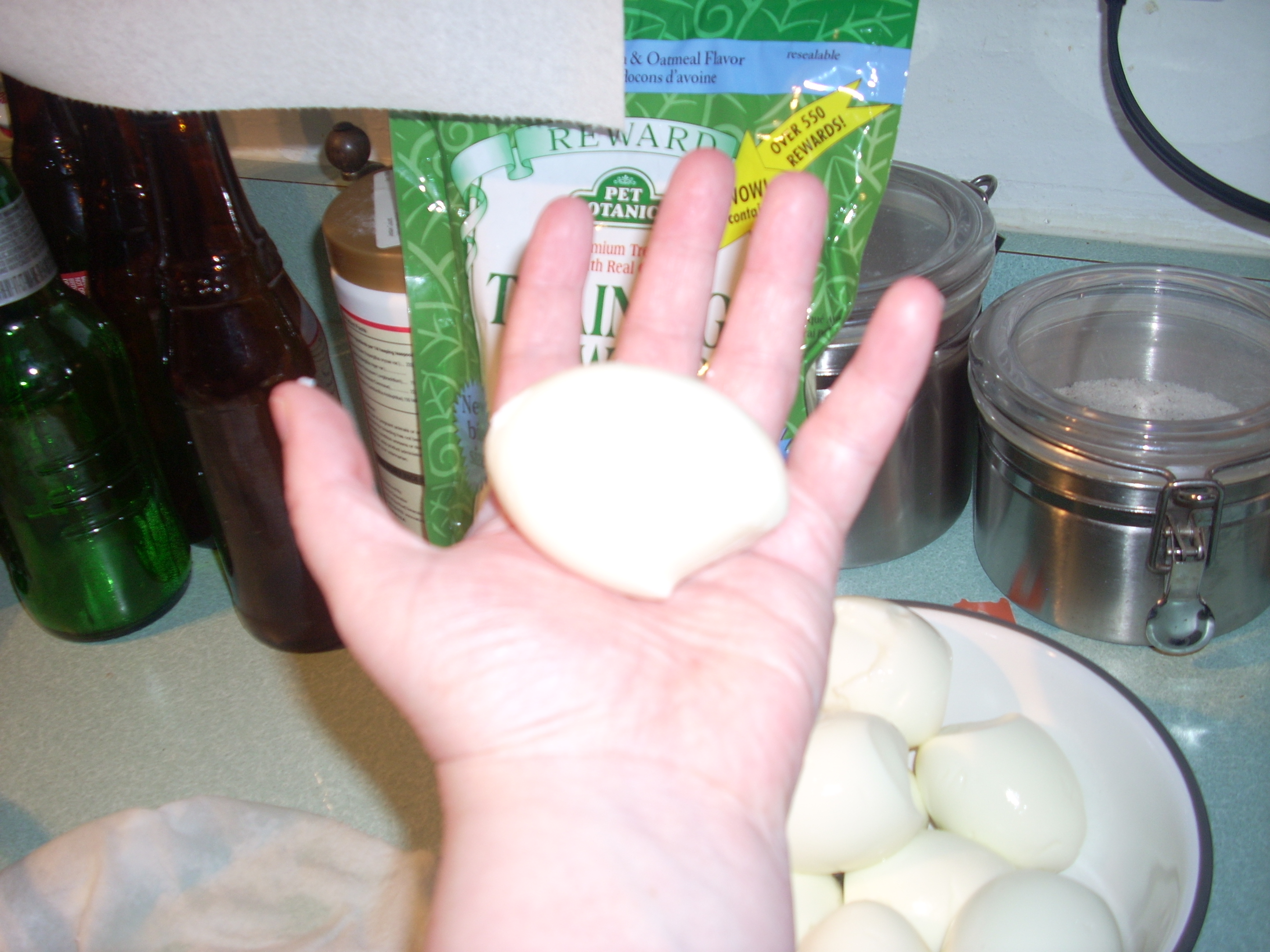
Grip your egg

Interestingly, the peeled eggs feel far more like one would imagine a naked testicle to feel in one’s hands than the actual testicles do. Guess that’s why Spanish speakers call ‘em “huevos”.

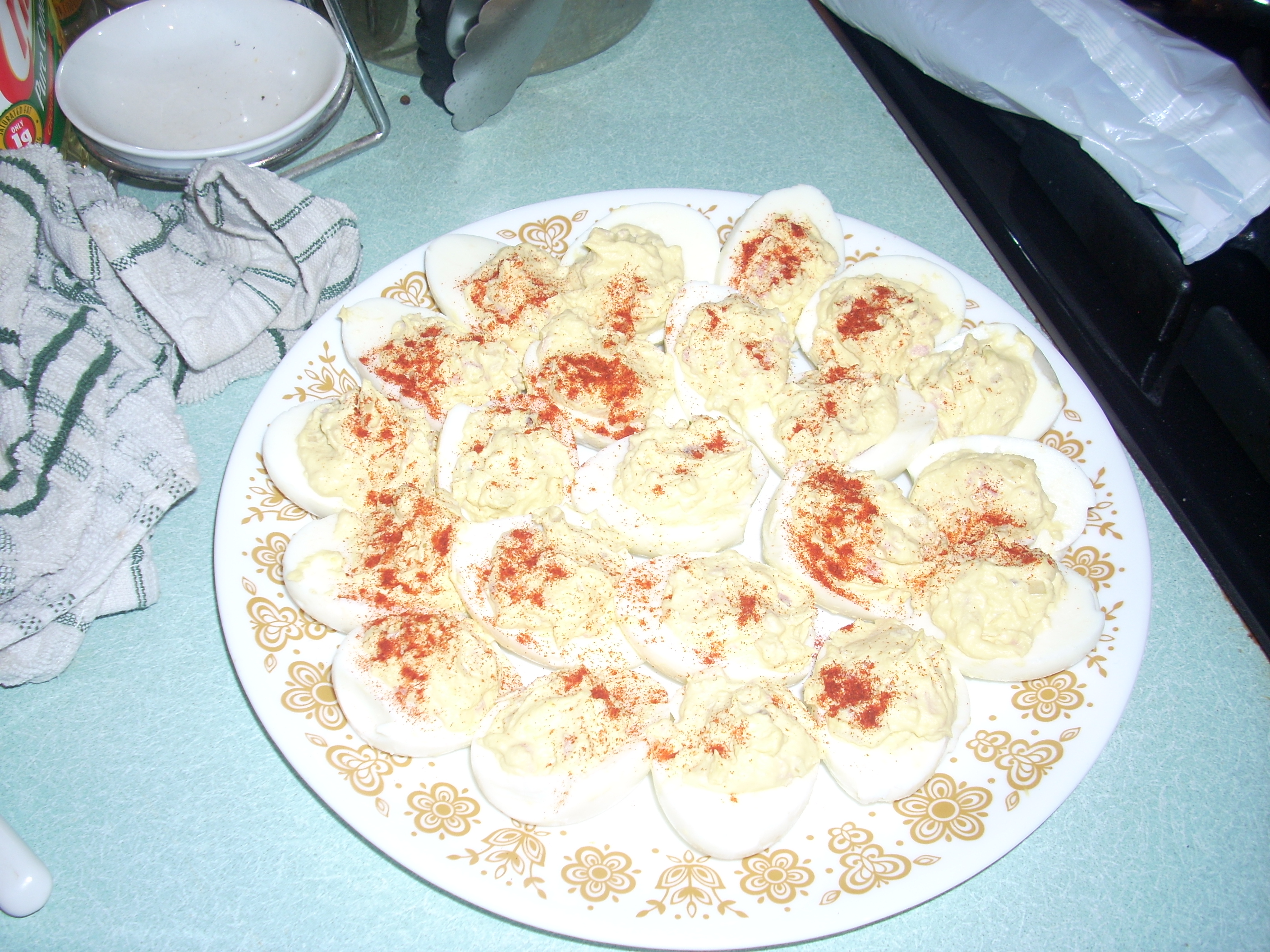
4. Slice the eggs in half longitudinally. Deposit the yolks in one bowl and the whites on a large plate or platter. Once you have de-yolked all your eggs, it is now time to contemplate ingredients. You are definitely going to be using some mustard (we used dijon, though the deli kind with the horseradish might have been interesting), some apple cider vinegar, and some mayo; in this case, we also extracted an odd quarter of white onion from the fridge and the sole surviving slice of deli ham and diced them finely and added them to the mix. Throw in some salt and pepper, then mash everything together vigorously until you’ve produced a more or less smooth mixture that can be spooned into the halves of white. Spoon everything into the white halves and arrange on the platter before hitting them all with paprika.

The scene

Interesting side note: it is impossible to evenly distribute shaken paprika. Results will resemble a blood spatter pattern from a bludgeoning murder scene no matter what you do. Set platter aside somewhere out of your way and out of dog-muzzle reach.

5. Go grab some saltines. Suggested amount: “a bunch”. Crush them finely; a food processor works better for this than just putting them under wax paper and hitting them with a rolling pin. Mix the results in a small mixing bowl with an appropriate estimation of “some” flour, and somewhat smaller proportions of cayenne pepper, seasoning salt, and regular salt and pepper.

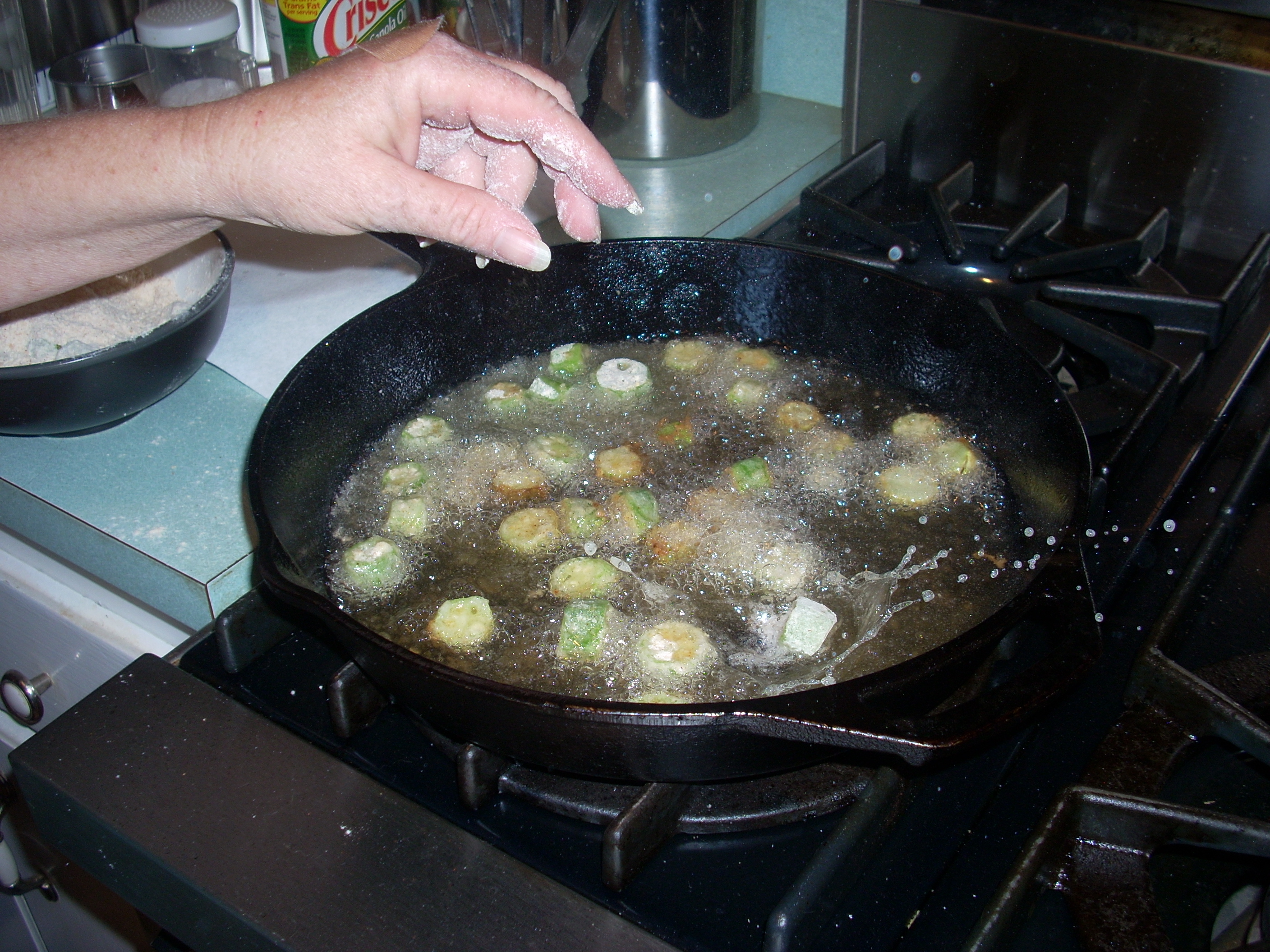
6. Haul out a large cast-iron skillet, or deep fryer if you have such a thing. Pour in an appropriately deep layer of neutral cooking oil with a high smoke point, such as canola or peanut oil. Heat until a pinch of the flour/cracker coating mix immediately starts to fry when dropped in. Get a plate and line it with a paper towel. Grab your okra and roll it around in batches in the coating mixture, then fry it, likewise in batches, turning if it needs it. Okra is ready when it’s more or less dark brown.

This okra is not ready yet.

Once you’ve cycled all your okra from coating to frying to resting on the plate, stick it in the microwave to retain heat until you’re done with your nuts. Since the coating is light and not thick and greasy like many frying batters, they will reheat in the microwave just fine without getting soggy, should they need it.

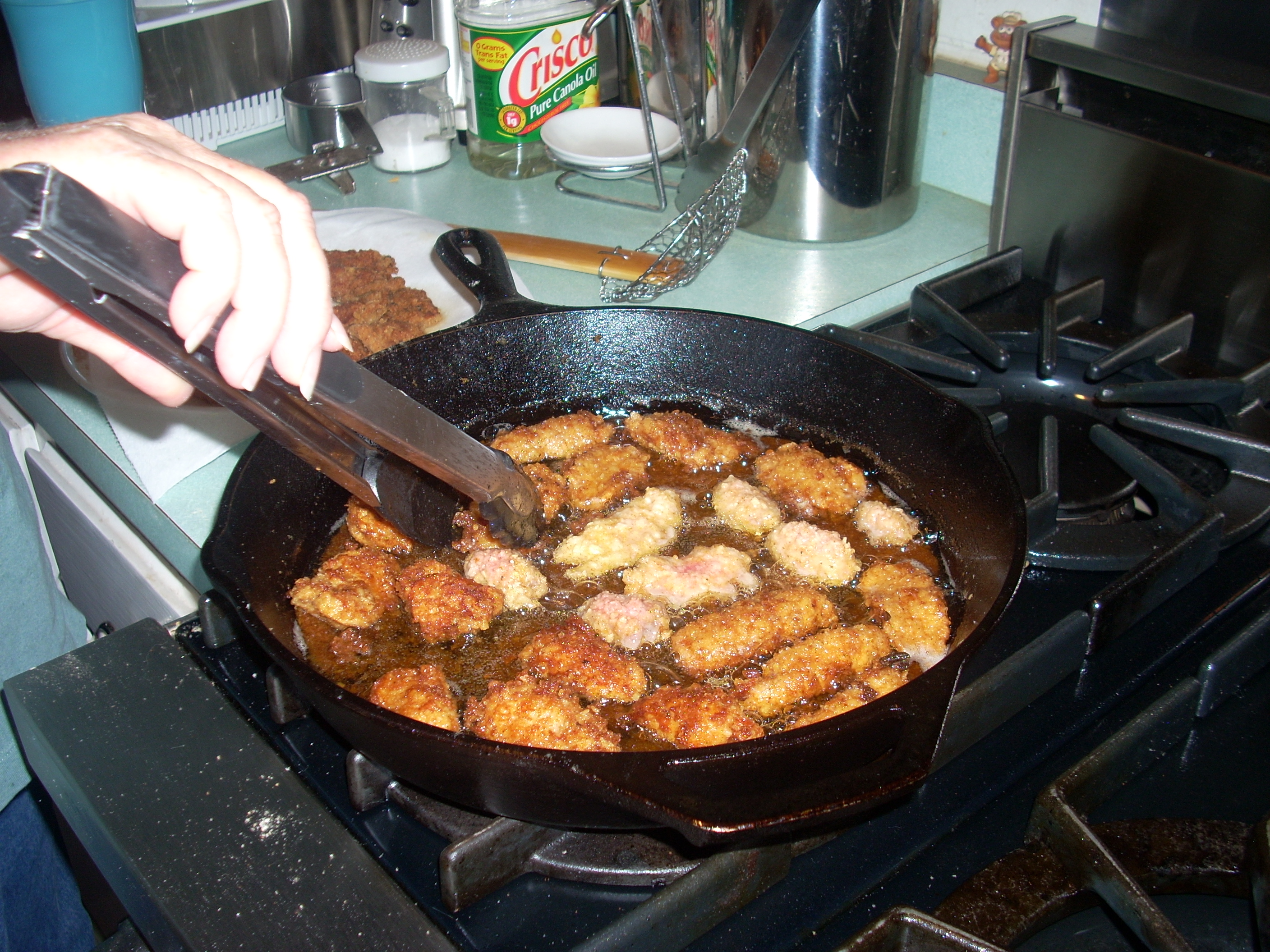
7. Repeat the procedure with your calf nuts. Any particularly large ones should be sliced first, as otherwise they will overcook and get tough. Pieces should be within a very rough and ready estimation of evenly sized. The naked nuts are sticky enough that you won’t need an egg wash to get the coating to stick. Fry in batches as you did with the okra; they will need longer to cook than the veggies and will need turning more, especially for the slices.

The darker nuts will be ready as soon as the other side matches.

As with the okra, cycle all the meat through until everything’s cooling on the plate with the paper towel.

Optional: We’re going to have ranch for dipping just because fried things are always better with ranch, but we had good results with a mixture composed mainly of dry mustard, sour cream, and more salt and pepper. If I had to do it over again I’d probably add a dose of the sweet Tabasco I didn’t remember at the time was in the fridge. The okra goes better with ranch, but the spicy/sour mustard sauce went wonderfully with the calf fries.

Eat until you are somewhere between happily full, and sick. Hoist a glass of milk or beer to Eostre and try not to get near anything you’d mind impregnating, at least without precautions.

Cooking Noob: Fettucine And Bacon-Wrapped Shrimp

March 31, 2010 - 4:55 pm Comments Off

So, I learned a new thing this past week, which is that when I point to a recipe that says “that looks good, we should do that”, what this actually means is that I have volunteered to make the whatever and write it up. So instead of continuing to dither between making a yeast bread or trying crab cakes, this time you get a saucy pasta topped with bacon-wrapped shrimp.

This is actually Breda’s fault. She pointed Stingray at a recipe for ancho chile lemonade on a foodie site, he was intrigued and I was dubious, and I said the recipe for chipotle pasta cream sauce with bacon-wrapped shrimp sounded much more appealing. Inadvertent volunteerism in place, ingredients were procured at the grocery store. Here, with credit to the folks at feasting.in, is the entire monster:

Chipotle Cream Sauce
ingredients (makes 4-6 portions):

* 1-1/2 c. milk
* 1-1/2 c. heavy cream
* 1 c. aged parmesan, shredded (or other hard, sharp cheese such as Irish Cheddar or Asiago)
* 3 tbs. butter
* 6 egg yolks
* 1/4 tsp. chipotle powder (add more to taste)
* 1 c. frozen peas
* 1 c. mushrooms, sliced
* (4) cloves garlic, chopped
* 1 tbs. olive oil
* salt and pepper
* fettucini, prepared al dente

directions:

1. In a medium saucepan, melt butter over medium heat and then add milk and cream. Bring to a light boil, when small bubbles just begin to form, and then turn off heat. Stir in shredded cheese until melted and thoroughly combined.
2. Separate egg yolks into a small mixing bowl. Ladle in a small amount of the hot cream mixture and whisk to temper the eggs. Add to the pot of sauce and continue to whisk to prevent the yolks from cooking into a solid mass. Stir in chipotle powder and then cover pot to retain heat.
3. Heat olive oil in a skillet over medium-high heat. Add garlic and fry briefly, and then add mushrooms. Cook until soft and then add frozen peas. Sprinkle with a pinch of salt and pepper, and stir until peas are hot and cooked through, about 3 to 5 minutes. Stir vegetable mix into prepared cream sauce. Serve over bed of fettucini, and top with bacon wrapped shrimp.

Bacon Wrapped Shrimp
ingredients:

* 2 dozen shell-on shrimp, peeled
* 6 slices center cut bacon, cut in fourths
* 1 tsp. seafood seasoning
* 2 tbs. butter
* pinch of salt and pepper

directions:

1. Wrap shrimp with bacon. Use a wooden toothpick to skewer bacon onto the body of the shrimp horizontally, starting where the legs were and pushing through to the other side. The body of the shrimp should be wrapped in bacon, and the shrimp should be able to rest on its side for cooking.
2. Add shrimp to non-stick skillet and place over medium to medium-high heat. Add butter to pan and sprinkle everything with seafood seasoning. Cook on one side until bacon and shrimp start to cook, and then flip over. Lift skillet and shake to distribute the butter and bacon fat evenly while cooking. Turn over shrimp to cook both sides.
3. When the shrimp is cooked (the shrimp will start developing bright red hues and the bacon will start to get crispy) remove from heat and set on a paper towel to cool. When shrimp has cooled enough to handle, remove toothpicks and arrange over pasta.

Our grocery store inexplicably does not carry powdered chipotle, just every other chile product under the sun, so I scrounged around and came up with a can of “chipotle seasoning” that I figured would work as long as I went easy on the salt. We also lack seafood seasoning since getting fresh seafood is such a dicey proposition up here, so I went with something from Stingray’s seasoning collection called “mural of flavor” mainly because it had a lot of bits of aromatic green things and no salt. The shrimp were frozen due to the aforementioned death of acceptably fresh seafood on the top of a mountain in the middle of a landlocked desert state. On to the cooking.

1. Track down the fettucine. No information is given in the recipe as to how long to cook it for “al dente” or how much to use, so just grab a third or so of the pasta in the package and go by the instructions on the side. Kick a pot of water up to a vigorous boil, squirt in some olive oil to tame foam, add salt, and then add the pasta, half of which will protrude awkwardly from the pot. Wait until softened enough to press down into a taut bow shape at the bottom of the pot, set the timer for “al dente” (twelve minutes, allegedly), and attend to your sauce.

In a medium saucepan, melt butter over medium heat and then add milk and cream. Bring to a light boil, when small bubbles just begin to form, and then turn off heat. Stir in shredded cheese until melted and thoroughly combined.

2. The original recipe is for four and we’re bigger fans of the meat portions of pasta than the pasta itself, so halve everything in the sauce portion of the recipe. Flick on the burner, set to medium, and toss in the butter, which will melt while you’re pulling the milk and cream out of the fridge. Add the milk, then promptly back down the heat a bit because it achieves a light boil instantly. Add cream. Turn off the heat and add the cheese and stir. Optional: attempt to calculate in your head the percentage of the sauce composed of milkfat.

Separate egg yolks into a small mixing bowl. Ladle in a small amount of the hot cream mixture and whisk to temper the eggs. Add to the pot of sauce and continue to whisk to prevent the yolks from cooking into a solid mass. Stir in chipotle powder and then cover pot to retain heat.

3. Time to learn how to separate eggs! Since we’re not using the egg whites, this turns out to be mostly a matter of being willing to coat your hands in slime without breaking the yolk on the edges of the eggshell. Pass the yolk from hand to hand until most of the slime has departed. Place in mixing bowl. Try a second time. Reason that since there’s not exactly any such easily measured thing as half an egg yolk, losing some of it because you broke it won’t be too serious an issue.

4. Discover that, owing to heat departing food at accelerated rates at seven thousand feet, the hot cream is no longer hot. Turn the burner to simmer until it is again, then spoon some in with the egg yolks and whisk together. Do it again just to be on the safe side. Turn the egg yolks into the sauce and whisk frantically as the whole mixture goes through some existential identity issues regarding whether it is a thick sauce or thin scrambled eggs. Things will settle on the side of sauce- barely. Turn the heat off again, stir in whatever seems like a reasonable amount of “chipotle seasoning” (now with chunks!) and cover the pot.

5. The fettucine’s done by now, so grab your colander and drain the pasta in it. You can make some sort of concession to insulation if you like, but unless you put it in a thermos, at this altitude it’s going to be ice-cold by the time you’re ready to serve regardless.

Heat olive oil in a skillet over medium-high heat. Add garlic and fry briefly, and then add mushrooms. Cook until soft and then add frozen peas. Sprinkle with a pinch of salt and pepper, and stir until peas are hot and cooked through, about 3 to 5 minutes. Stir vegetable mix into prepared cream sauce. Serve over bed of fettucini, and top with bacon wrapped shrimp.

6. By this time we have learned to disregard measurements regarding how much fat to add to the pan to cook something, so squirt in whatever looks like a healthy amount to saute some vegetables with. Extract the bag of frozen peas from the freezer and bludgeon it mercilessly in order to encourage the peas to separate some from their unitary block, which will only work up to the point of producing a fist-sized collective that we might as well call half a cup. Now is an opportune time to discover that nobody bothered to put mushrooms on the grocery list. Swear.

7. Mince up a couple of cloves of garlic, throw into the pan, and turn on the heat. Cook briefly as instructed. Introduce the Pea Collective and introduce coercion to their little union.

8. Wow, the melting water really makes that olive oil spit! At this point, cooking becomes a race to separate and cook the peas before the garlic goes from “brown and slightly crispy” to “burned”, as burnt garlic will require you to start all over again. Next time maybe we better just take a damn hammer to the peas before we try cooking them with something that goes from flavorful to bitter vileness when over-heated. Transfer the whole mess as soon as seems reasonable to the cream sauce, stir in and cover.

Wrap shrimp with bacon. Use a wooden toothpick to skewer bacon onto the body of the shrimp horizontally, starting where the legs were and pushing through to the other side. The body of the shrimp should be wrapped in bacon, and the shrimp should be able to rest on its side for cooking.

9. You know what we didn’t think to do because the ingredients specifically call for shell-on shrimp? Peel the shrimp. You know what we really should have done before applying heat to anything at all? Peel the shrimp. Peel the shrimp, noobsauce. they are already deveined, so starting from the top and unwrapping in a single motion proves to be the most efficient method.

10. Slice the bacon into fourths. At this point you will have attracted every four-legged member of the household. Watch where you step, some of them are just dying to have their wounded paw recompensed with anything you have up there. Try not to slip in the drool.

11. Ransack the kitchen for toothpicks. Discover a mostly-empty box. Groan. Use these to pin shrimp as instructed. Discover that, the bacon being nearly as wide as it is long, this is actually much more difficult to do neatly than it looks. At some point you may abandon “neat” as long as everything operates as a single unit when manipulated by the toothpick. A pause to locate more toothpicks, possibly materialized by a merciful God, in the back of a junk drawer may be required. Optional: distribute excess shrimp to the madding horde. Watch your toes.

Add shrimp to non-stick skillet and place over medium to medium-high heat. Add butter to pan and sprinkle everything with seafood seasoning. Cook on one side until bacon and shrimp start to cook, and then flip over. Lift skillet and shake to distribute the butter and bacon fat evenly while cooking. Turn over shrimp to cook both sides.

12. No point in dirtying another pan, so add the butter to the skillet which contained the vegetables and kick on the heat. Even a quite large cast iron skillet won’t fit a full two dozen bacon-wrapped shrimp, so we’re going to have to do this in two batches. Distribute the first dozen and sprinkle on your salt, pepper, and “mural of flavor”. As you contemplate the potential doneness of the shrimp, you will begin to notice that a combination of butter, olive oil, and rapidly rendering bacon fat both smells very good and creates extremely vigorous pan grease, something that you will only come to fully appreciate when it comes time to flip the shrimp to the other side. Long sleeves are good, welding gloves would be better.

13. Transfer the cooked shrimp and bacon to a plate next to the stove you already thoughtfully lined with a paper towel. Put in the raw shrimp and bacon and arrange. Given all the bacon fat from the last batch, this one should cook quite a bit faster.

14. FIRE! FIRE! FUEGO! HOLY FUCK PUT IT OUT PUT IT OUT!

15. It is strongly recommended to extinguish the paper towel on the plate before the fire reaches the greasy parts. Then move the hot cast iron pan and the plate further apart from one another. Assure your spouse, when he comes in inquiring about the bloodcurdling screech and huffing noises, that the fire is out and you have everything under control. He may look a little dubious but there’s really nothing much more comforting you can say at this point.

16. Turn the shrimp. Assure spouse, yet again coming in about the noise, that it was merely a reaction to the very vigorous grease giving an ambitious leap and tagging the side of your neck and not another fire, burn requiring medical treatment, or other variety of inadvertent self-mutilation.

17. Remove the cooked shrimp and bacon to the somewhat charred plate, turn off the heat, and return your attention the pasta, which is not only predictably cold, but also somewhat congealed. Turn on the sink until you get good hot water, then wash and warm the pasta at once before distributing it more or less evenly between plates. Turn the likewise cold cream sauce and vegetables to simmer for a bit while you remove the toothpicks from the already-cooling bacon-wrapped shrimp. Contemplate moving to sea level.

18. Ladle the sauce, which is already starting to question its identity again, over the noodles, and arrange the shrimp over that. Forlornly poke at everything now achieving varying states of “chilly to room temperature” on its way from counter to table. Consume.

This was actually really tasty, even if I did have to serve it cold. (I somehow doubt this sauce would get along with a microwave.) Flavor-wise it was a complete success even if some of the shrimp from the first batch were a bit overdone. If/when we do it again, we’ll use the mushrooms, and probably things would go much better in terms of delivering hot food to table if two people were working on it- one person assembling the already-peeled shrimp and bacon while the other made the sauce, or else entirely constructing the shrimp before even starting on the sauce and noodles.

The bacon-wrapped shrimp, or likely bacon-wrapped anything, would be very good on their own.

Cooking Noob: Dirty Rice Dressing

February 11, 2010 - 7:24 pm Comments Off

Awhile back, I asked my mother for some of the recipes she made when I was younger; she CAN cook, but didn’t much care to for just two people after my father left, and I wanted to make sure that some of the things she used to make would be preserved. Having done so, I promptly filed the recipes and largely left them alone, not because I didn’t want to eat any of them, but due to a combination of my not being such a great cook myself and the most doable of them relying on an ingredient I can’t get. (Fresh shell-on shrimp.)

Now that I’m making a project out of improving my own skills, it makes sense to revisit these recipes. I picked one that Mom always made for holiday dinners like Thanksgiving and Christmas; it was a surprise to me to discover that not only do most American families not eat dirty rice on holidays, it’s actually highly specific to the central Louisiana region Mom grew up in. I didn’t think much of it as a kid, but then my palate was pretty limited at the time to “things that taste much like things I eat regularly”, as it tends to be with kids. So I decided to dust off the recipe and have a crack at it.

Transcribed from Mom’s notes, the recipe:

Tish’s Dirty Rice Dressing

1 container chicken livers (8-10 livers)
1/2 lb hot, ground sausage
1 large onion, minced
1/2 large bell pepper, minced
1 tsp celery seeds
2 cloves garlic, minced
1/4 tsp red pepper (optional)
1-2 tsps salt
1/2 tsp dried thyme
2 cups uncooked brown rice
1/4 cup chopped parsley

Boil livers until done. Remove livers and set aside to cool. Add to the remaining liquid enough water to make 2.5 cups of stock. Add the rice, bring to a boil, and then simmer covered for half an hour. Meanwhile, pan-fry the sausage until brown, breaking it into small pieces. Stir fry the onion, garlic, bell pepper, and celery seeds for 7 minutes. Chop the livers finely and add them and all remaining ingredients to the rice and cook on low for 6-7 minutes. Add salt and pepper to taste. It should be mildly spicy and very salty. Cover and refrigerate 12-24 hours to let the seasonings blend and mellow. Heat at 350 degrees in an oven for half an hour before serving.

Looking over the ingredients, I decided to throw out the green bell pepper. I’ve managed to largely cure myself of my screaming aversion to them, and they no longer ruin a dish for me, but I’m still not fond of them in and of themselves, so out they go if I’m making this for me. I also decided that, since I’m no longer a spice-aversive little wuss, I’d swap out the small amount of red pepper (heat only) for some good New Mexican chile powder (heat and flavor). So this is now more of a New-Mex-Cajun dish. I also have no idea how many livers actually went into the dish, since all I did was buy a container of them and didn’t bother to count. On with the cooking!

1. “Cook until done”? Seriously? Time to hit Google. Search “how long to cook chicken livers”. Get lots of results regarding giving them a quick fry in bacon grease. Contemplate how good that sounds and consider drastically changing the plan. But, no; reading the recipe, we need the liquid we’re going to be boiling the chicken livers in as a rough and ready stock to cook the rice in. Google “chicken livers dirty rice” and go with a general estimate of half an hour. Write the revision into your handwritten version.

2. Marshal your cast of characters. Livers, sausage, onion, garlic, brown rice… now put Benny Hill’s “Yakety Sax” on your MP3 player while you play yet another round of Seasoning Scavenger Hunt. Naturally, your spouse will have chosen the most obscure cabinet with the most things out of your visual range to stick the celery seed, and that is of course where the chile powder always lives.

3. Ponder the direction “add to the remaining liquid enough water to make 2.5 cups of stock”. Reason that some of the liquid must boil off over the course of half an hour, and there is no practical way to measure the remaining liquid without needlessly dirtying a measuring cup. Draw up 2.5 cups of water and eyeball the water level in your chosen pot.

4. Remove your livers from the fridge. (Note: this action will cause Kitchen Bitch to dematerialize from wherever she is in the house and rematerialize in the center of the kitchen.) Carefully remove the lid and contemplate the contents. Since the directions don’t include “add the liquid” or a more frank “add a bunch of blood and dubious fluids”, use a fork to carefully transfer each of the livers from container to pot, saving the odd bits and pieces for Kitchen Bitch, who hasn’t been getting much in the way of scraps lately. Studiously eyeball the new water level. Throw the container in the outside trash where the dogs can’t get at it.

5. Turn the heat to high until you get a good boil going, then back the heat back down to medium high. Since not losing much if any water would make things easier, cover the pan and set your kitchen timer. Time to disassemble the vegetables.

6. Cut the top and bottom from your onion, then pause and stare at it for a bit. Go confirm with your spouse that there is nothing wrong with an onion whose juices run milky white instead of clear. Go back and try to put it out of your mind that it looks very much like the onion is secreting a certain fluid associated with human reproduction. Be sure to toss an eye toward the stove on your path.

7. HOLY CRAP THAT’S A LOT OF FOAMY LIVER JUICE. Back the heat down to medium from medium high and remove the cover, just in case that contributed rather than the higher heat alone.

8. Continue carefully taking apart the onion. Since the initial cuts gave you a hint that this is another weaponized onion as well as a vaguely obscene one, stand well back and go slowly with a good sharp knife. Putting this thing in the food processor would probably attract the attentions of Homeland Security. Reduce your usually frenetic onion-chopping pace to a stately one suitable for a waltz beat. Take a few breaks when your mucuous membranes get close to being overwhelmed. Transfer the onions to a bowl and wash the knife and board mostly clean of the dangerous juices.

9. Select as many garlic cloves as you damn well please and whack them with the flat side of your blade to get them out of their paper. Mince. There’s not really a lot to this process these days. By this point, given the pace imposed by the onion, your livers should be done cooking.

10. …Yuck. The foamup created a really unappealing green scum. Resolve to see if you can’t clean the livers up a bit when you chop them and transfer to a bowl, using a spider to skim off the worst of the scum, then move the livers.

11. Eyeball the pot and pour in enough water to reach what looks like the first watermark created during the first stage of cooking. Measure out two cups of rice, pour into the “stock”, and resume the high-boil-medium pattern.

12. Haul out a skillet, then grab the one-pound package of hot sausage out of the fridge. Snip off the end and squeeze at roughly the halfway point; once enough has squeezed forward of your pinching point, twist the package up to force the first half out and keep the rest firmly in. Best done over the skillet.

13. Kick the heat up to medium-high and choose an implement to break the sausage into small pieces as it cooks. Discover that using your barbecue fork, if that is your implement of choice, is only a good idea after the sausage has cooked enough not to pack firmly between the tines. Cook until everything is pretty much browned and more or less in small pieces.

14. Discover that two is an insufficient number of hands to gracefully transfer greasy bits of sausage from a greasy pan into a smallish bowl. Snap off the burner while you ponder what to do. Improvise with a balance point created by the middle spine of the kitchen sink and a towel under the handle. At least the dogs will be grateful for the strays.

15. Replace the pan on the burner and restore the heat. Dump in the onions and garlic and spread them evenly, then apply the celery seed and sautee in the fat left from the sausage. As you work on keeping everything evenly distributed, wonder in a vague sort of way why it seems like a lot longer than four minutes you observed left remaining on the timer when you put the vegetables to heat. At some point it will dawn on you that you never started a new timer for the rice, and the “four minutes and ten seconds” you saw left on the microwave display was actually the time. Fortunately, onions and garlic are one thing we do know how to “cook until done”, likewise rice. Cook the onions until soft and translucent, then remove from heat.

16. Return your attention to the livers. Since early experimentation reveals it’s going to take roughly ten years to wash each liver carefully enough to remove scum without it falling apart, reason that it’s called “dirty rice dressing” anyway and hope it isn’t noticeable. Chop the hell out of them, then scrape carefully from the cutting board into the pot of rice, which has absorbed all the stock and looks pretty well done. Stir in livers. Retrieve sausage and stir that in. Stir in vegetables.

17. Add the chile powder. This is pretty mild stuff and 1/4 tsp is a pretty wimpy amount. Add about a tablespoon and a half of pepper-and-salt mix. Add the thyme. Recall that you never did get around to buying fresh parsley because it always amounts to getting a small tree of which you will only use a few sprigs, and add some amount of dried chopped parsley between “none” and “1/4 cup”. Stir everything in again and cook another 6-7 minutes.

18. Cover the pot and pop into the refrigerator. Since you have now spent two hours cooking something you cannot eat until tomorrow, go out for sushi.

19. Discover that, due to your spouse making roast duck to go with your dressing, it is not possible to reheat in an oven at 350 because the one and only oven is occupied and is chugging along at 475. Swear. Improvise by spreading out the dressing in a layer in a baking dish and giving it a quick warmthrough while the duck is browning. Serve and consume.

This turned out “meh”, due to my mistakes rather than due to the recipe; between the lack of kitchen timer on the rice cooking, my being rushed to make a dinner reservation, and my not bothering to taste for doneness, the rice was undercooked and unpleasantly crunchy. No doubt the browning it got didn’t help either. We think we’ll try to salvage the rest (and there’s a lot of rest) by pouring in about a cup of chicken stock as it reheats the standard way next time. There’s nothing wrong with the flavor profile, however, and I can easily see myself making it again. I think next time I’d also add some green onion, and possibly some peas to replace the “green” role left unfilled by the absence of the green peppers.

Cooking Noob: Saucy Baked Pork Chops

January 15, 2010 - 8:59 pm Comments Off

I like reading good food writing nearly as much as I like eating good food (if not more because I can’t leave a top-notch relleno in my coat pocket to whip out whenever I’m in the mood), and have a thing for regional American cuisines, so Jane and Michael Stern’s books are a natural fit for me. They’re responsible for the Roadfood books and forums, and center around the American eating experience outside of standardized chains and franchises, tuned to national tastes rather than what the locals in a given area have come up with. One of their books, Two For The Road, is mostly essays about the experience of eating for a living and contains several recipes emblematic of the more interesting regions and foodways they’ve travelled through. One, a recipe for baked pork chops from a radio personality in Iowa, made me drool reading the description of eating them, so I determined they’d be next on the list.

Virginia Miller’s Elegant Pork Chops

The marinade:
2 cups soy sauce
1 cup water
1/2 cup dark brown sugar
1 tablespoon molasses
3/4 teaspoon salt

The sauce:
1/3 cup water
1 3/4 cup ketchup
1 1/2 cups chili sauce
1/2 cup light brown sugar
1 tablespoon dry mustard
2 tablespoons Russian salad dressing

The meat:
6-8 pork chops cut as thick as you can find

Combine the marinade ingredients in a baking pan large enough to hold the pork chops in a single layer, add the meat, and marinate for several hours or overnight.

Preheat the oven to 350 degrees. Remove the chops from the marinade and place in a 9 x 13 inch baking pan. Put the pan in the oven, uncovered. Combine all the ingredients for the sauce in a medium saucepan and bring to a boil. After the chops have been in the oven about ten minutes, turn them and cover with the hot baking sauce.

Cover the pan and bake the chops for about 1 hour, until they are tender, turning them several times as they cook. Serve hot, with the sauce spooned over them.

Okay, well, we can throw the light and dark brown sugars out the door and just use whatever’s in the pantry as far as the brown-sugar family goes. Otherwise this looks doable as-is.

1. As soon as you remember that you intended to make these that night, assemble your marinade ingredients. Soy sauce: check. Water: still accessible via sink. Brown sugar: check. Salt: accessible from at least three different sources. Molasses: um.

2. Ask your spouse where the molasses lives. In the pantry, apparently. Open the pantry, which is floor to ceiling crammed with things, with several shelves above eye level, and organized in absolutely no fashion whatsoever. Optional: hum the score from the last scene of Raiders of the Lost Ark, the one with the warehouse.

3. We don’t need Top Men to find the damn molasses and for once we’re going to find something for ourselves without having to hassle Spouse into coming in and digging it up for you. Rummage through the flour, sugar, cocoa mix, honey, canned oysters, canned chipotles, unopened jar of clotted cream, elk jerky, dried squid flakes (?!), chocolate chips, leftover Halloween candy, dill pickles, sauerkraut, canned beans, grits, quinoa, tea, Thousand Island dressing, tomato paste, tahini, and sesame oil as time passes and the disturbed dust in the air mounts.

4. Split the difference and ask Spouse for a hint. On one of the middle two shelves, in a container with a yellow cap. Rummage several times through the middle two shelves, cursing vigorously at various jars of Spouse’s local honey collection, which are all dark as molasses and all capped in yellow.

5. Expand your definition of “the middle two shelves” to include the one one slot up from the bottom. Extract the molasses from the very back of the shelf. Success!

6. We’re halving this recipe as 6-8 pork chops is a bit much for two people, so a gallon freezer bag will do as a marinade-and-chop container. Do some quick (by which I mean laborious) kitchen math and dump the requisite proportions of dry ingredients into the bag. Open the molasses jar and enjoy the incredibly appetizing scent of blended sugar and sulfur. Try to keep as much of the molasses possible inside either the jar, the bag, or the tablespoon, although this will be challenging. Pour in the liquid ingredients and add pork chops. Seal the Ziplock.

7. Make the discovery that the chops and marinade bag require two hands to hold flat and handle, as you want to rest the chops on a refrigerator shelf so that they are both covered and in a single layer. Open the refrigerator door. Curse under your breath as the door closes itself when you turn around to fetch the chops. Repeat. Resolve by balancing on one foot while you hold the door open with the other until you can get your elbow up as you transfer the chops. Now bugger off and go read blogs or something until closer to dinnertime, turning the chops once sometime in the midpoint and wandering in to start the oven preheating twenty minutes or so before nomoclock.

8. Extract the chops and a smallish baking dish and drain the marinade from the bag after you put the chops in the dish. Explain to Kitchen Bitch that we’re not using anything that can really be shared with even very patient dogs. Toss the chops in the oven, find a small saucepan, and start pulling stuff out of the fridge and pantry for the sauce.

9. Ketchup: check. Water: check. Sugar: check. Mustard: check. Russian dressing: check. Chili sauce… well, the only thing we have in the fridge labeled “chili sauce” is Sriracha, since Real New Mexicans make their own chile sauces-qua-sauces as the dish that requires them is made, rather than keeping it around bottled or canned. The recipe calls for 3/4 of a cup of the stuff, once halved. Raise an eyebrow at your Sriracha, which exists to add a dash at a time.

10. Dab a bit of Sriracha on your fingertip and lick it off. Notice the way your tongue tingles vigorously for minutes afterward? Compared to what Iowa housewives had in mind, this may be just a mite aggressive. Glop in an amount that looks like enough to add zing without being considered an assault weapon in Massachusetts.

11. Make up for the lowered volume with extra water and ketchup. Add the rest of the ingredients, kick the burner up to high, and stir continuously until it boils. Remove the pork chops from the oven, glop on the sauce, pop the whole thing back in the oven, and wander off for twenty minutes.

12. Return and turn the chops, then set the timer for another twenty. Sit down and start writing the whole thing up. Type in the part about covering the chops once the sauce goes on, which we did not do. Mother goatfucker.

13. Note glumly the rather reduced state of the sauce when you return to turn again, then makeshift cover with a stockpot lid. Leave it for the last twenty minutes of cook time.

14. Pull it out of the oven, add pork chops to plates, spoon on some sauce over each chop, and serve with the corn Spouse grilled in foil packets over the gas burners. Nom.

These tasted really interesting, though they came out a little bit dry; I don’t know if it was because I neglected to cover for the first two-thirds of the cook time or if an hour was simply too much for only two chops, but either way next time I’d use a meat thermometer and go by internal temperature rather than time. The flavor was good and I tuned the proportion of Sriracha well- it turned out to work quite nicely with the rest of the ingredients in the sauce. I’d like to try this again with bigger chops, cooked for less time. The overall sweet, savory, spicy flavor profile turned out really nice.

Cooking Noob Addendum

December 30, 2009 - 6:09 pm Comments Off

After Stingray made up some mashed potatoes to have with the leftover stuffed cabbage casserole, apparently the mashed potatoes are mandatory. It is a much different dish when served with them, and the sauerkraut goes from overwhelming to a pleasant tangy part of a much more blended flavor. Should have listened to Breda in the first place.

Cooking Noob: Stuffed Cabbage Casserole

December 23, 2009 - 10:49 pm Comments Off

So, awhile back Breda stopped over with us on her way to Blogorado, and had enough time and generosity to haul down a cooler full of Irish breakfast goodies as well as a loaf of brown Irish soda bread she’d made for us. She cooked us up breakfast and some bread and butter, we raved and devoured everything, and after she got home her mom* was nice enough to send along a few other recipes from the family tree. I happily noted the presence of an interesting cabbagey looking thing; while America does love its casseroles, sometimes to death, it looked different than anything I’d ever eaten. So I flagged the recipe to try next time around a casserole sounded good and I actually remembered to pull it out of my e-mail, since I tend to flag all other recipes I’m thinking about using either literally with a post-it flag in the book they live in, or in a dedicated Scrapbook folder in my browser.

So, it is most definitely hot-casserole season, and we were buying cabbage anyway to use in one of Stingray’s standards (beer, beef, and cheese soup since you didn’t ask), I gave the recipe a once-over and told Stingray to buy the ingredients on his last run to the grocery store. Here we go, Bredamom Stuffed Cabbage Cassserole:

Stuffed Cabbage Casserole

1 med. head of cabbage (shredded & cooked)

1 jar sauerkraut

Meat Layer

2 lbs ground meat

1 onion chopped

2 cloves of garlic minced

½ c minute rice

Salt & pepper to taste

Sauce

1 can tomato soup

1 can (#2) diced tomatoes

2 small cans tomato sauce

3 tbsp sugar

Layer a 13×9 pan with sauce (just enough to cover the bottom), ½ of cabbage, some sauerkraut, the meat layer, remaining cabbage, sauerkraut, sauce.

Bake covered: 275 for 3 ½ hrs

OR

350 for 1 ½hrs

The ingredients are pretty straightforward; I’d say that I made an executive decision to omit the sugar because I felt the tomato-based components had enough natural sugars not to need sweetening, but the truth is that it’s just one of those things I flat forgot while cooking. I also took a long look at two cloves of garlic per two pounds of meat and was thinking along the lines of “…well, I can’t alter an old family recipe right out the gate, that would be disrespectful…” when Breda added unprompted that we could use more garlic if we wanted. So this is what stuffed cabbage casserole would be if the immigrants in whatever time and location originally comprised it had had an Italian grandmother somewhere along the line. And no access to pasta.

1. Read recipe back-to-front a couple of times. Bug your eyes out. THREE FREAKIN HOUR- ONE AND A HALF FREAKING HOURS? We really should have started about two hours ago if we wanted dinner at dinnertime and were generally as smart as we like to fake sometimes.

2. Stop hyperventilating, clear the surface of dishtowels, mail, and any other detritus. Preheat the oven to 350 degrees. (Fahrenheit. Of course. We always double-check these days, we do.)

3. Assemble your vegetative ingredients. The rest of the cabbage from the soup- check. (Instead of one medium head, we got one gigantic head and figured it equaled out to about one medium with the chunk gone that Spouse would take.) An onion- check. Two Five cloves of garlic- check. Give your garlic a good smack with the flat of the cleaver and skin them out of their paper.

4. Might as well get the minute rice out of the way. Pull the box out of the cupboard and consult the instructions on the packaging. Apparently two servings of minute rice is one cup of water and one cup rice, and one serving is half a cup, so it’s a direct ratio. Sling half a cup of water into a small saucepan, turn the burner up, and sling half a cup of the rice into it, as with that thin a layer of water it’s going to start to boil almost immediately. Useful tidbit to know: if you’re only cooking one serving’s worth, Minute Rice really does take just about a minute flat to cook completely once the water boils. Cool! The rice is going into the meat mixture, so haul out a mixing bowl to put the rice in.

5. Mince the garlic. Turns out it really is easier to just suck it up and use the big kitchen knife than it is to haul out and use the weird little widget we bought specifically for the purpose. (It looks like Pac-Man on wheels with a gutful of razors. Really.) Scrape the garlic in on top of the rice.

6. Eye the onion. Eye the food processor. We’re going to be using it anyway to process the cabbage, so why not save ourselves a little chopping work? Come on, we can do it, it’s the holy grail at this point: use the food processor to actually save yourself net time spent with the vegetables. The food processor might gleam slightly at this point, but it’s probably your imagination.

7. Lop the top and bottom off the onion, skin it, and quarter it into sizes suitable to be fed to the food processor with its normal blade attachment. At this point it appears to be a completely normal onion suitable for flavor purposes. Carefully feed the onion pieces into the food processor so that they drop more or less evenly distributed around the bowl. Pulse until the onion has been transformed from chunks into something more like a loosely associated onion gestalt.

8. Open up the food processor and AAAGGGGGGGHHHHHHH THAT HURTS OH GOD WHY RUN AWAY

9. Important safety lesson: transforming an onion from quarters into a chunky puree of onion inside a food processor will release every caustic compound that onion has within a confined environment. Do not lean over the food processor as you open it. Optional: it’s too late for Christmas this year, but maybe next year ask Spouse for an eyewash station in the kitchen. Maybe a fume hood too, if we’re feeling flush.

10. Slink back up to the food processor, detach the bowl, and attempt to scrape the onion into the bowl with the rice and garlic while holding it at arm’s length at the same time. Reach whatever compromise your anatomy allows and just get the onion in the mixing bowl. Toss the chopping blade in the sink and thoroughly wash out the bowl of the food processor, since we’re about to use it again for round two.

11. Haul out the grating disc. The recipe calls for “shredded” cabbage, so the grating disc seems like the most logical thing to pick out. Pull out the giraffe-neck doohickey that attaches to the central motor that attaches to the disc. We saw Spouse do this last time, so it should be cake this time, right?

12. It is not cake. Nonetheless, persevere; this time we ARE NOT going to call him in at any point just to deal with a fucking Cuisinart. Not for the third goddamn time. Fiddle with switches and the bizarre design of the giraffe-neck, the disc, and their respective genitalia until you finally find the way to mate the one to the other. Optional: imagine the Legend of Zelda “puzzle solved!” sound effect once you do. I did.

13. Fit the bowl onto the base. Fit the doohickey and its disc onto the motor spindle. Attempt to fit the lid onto the food processor. Try again. Look to see what’s stopping it from locking down. THAT DOESN’T EVEN LOOK LIKE IT WAS DESIGNED TO MOVE EVER OH GOD WHAT. Jam at it in frustration a few times.

14. Oh, the lid locks down in the opposite direction that the bowl locks onto the base, not the same one. Makes sense, really.

15. Start breaking down the cabbage. Abandon your attempts to cut shapes that will easily and in a space-saving way fit in the feed tube; this vegetable is not going to cooperate with your anthropoid ideas of geometry and efficiency. You’re going to be feeding this stuff into the processor awkward fistfuls at a time, jamming it through with the thoughtfully provided jammer like a Japanese subway attendant at rush hour.

16. Repeat some eleventy-jillion times. Notice midway through that the disc you chose isn’t so much producing “shredded’ cabbage the way you imagined as it is “bits” of cabbage and that the slicing disc would probably have been a much better choice, given the way the surface areas of the cabbage would have worked out. Of course halfway is the ideal time to have this revelation; no choice now but to proceed with your cabbage confetti. Pause a few times to unload masses of confetti into the largest mixing bowl you own; that really was a very large head of cabbage, and Spouse turned out not to need much.

17. Address the meat. There’s two pounds of it. You know, somewhere in between that little factoid and the entire head of cabbage mandated, you’d think it might have occurred to you that you are one half of a childless married couple and not, say, a family of eight- and halved the damn recipe at some point. We need to make a mix of what’s already in the bowl and the meat, and putting the meat on top fills the bowl to threatening to overflow.

18. There’s really only one solution to this problem; we need to get in there and give that meat and those vegetables a deep-tissue, really personal massage. By the time you’re through you’re going to be up to your wrists in raw meat and the meat will be more-or-less mixed- you’re probably going to need to massage it more as you apply the meat layer later. Wash your hands. Really, really thoroughly.

19. Remember belatedly you were supposed to mix in the salt and pepper too. Cry. Go back and do it. Wash your hands again.

20. Ransack the cabinet for the tomato soup, diced tomatoes, and tomato sauce, all of which just sort of appear in the average American cupboard regardless of deliberate purchase. Canned tomato products may well be an unstudied migratory species. Nocturnal travel? From where?

21. Mix together the various canned products until they become more or less unitarily saucelike to the eye.

22. OH MY FUCKING BLEEDING GOD IT’S WHAT TIME AND I HAVEN’T EVEN GOT IN THE OVEN YET?

23. Haul out your biggest casserole dish. Look at your giant bowl of cabbage and your not giant enough bowl of meat stuff and your giant pan of sauce. Twitch slightly. Family of six, maybe. Family of eight, no way.

Layer a 13×9 pan with sauce (just enough to cover the bottom), ½ of cabbage, some sauerkraut, the meat layer, remaining cabbage, sauerkraut, sauce.

24. Put down a healthy layer of sauce. Put down a layer of roughly one half of your cabbage. Eye the level already reached in the pan with concern. Extract a jar of sauerkraut from the cupboard and layer down what turns out to be roughly half of that, too. Take out your meat and give it another intimate massage remixing it in the process of layering it. (There will be roughly one hamburger’s worth left.) Wash your hands again.

25. Layer down the next cabbage and sauerkraut as best you can. You’re going to have too much cabbage, but oddly enough that giant jar of sauerkraut will wind up mostly spent. Trepiditiously brush on some of the sauce- we don’t want spillover in the oven. Carefully slide it into the oven. Optional: while you are blogging later, realize you forgot to cover it with tinfoil. Oh well, I’m sure the… tomato sauced cabbage will brown nicely and… fuck.

26. Just before you consider eating your pets, it will be ready and you can pull the bubbling concoction out of the oven to serve. Grab a big serving spoon, because it’s very brothy. Get a generous slice, because you ain’t making too big a dent in this tonight, and nom.

Now, Breda had told me that the thing to serve this with was mashed potatoes, which I got some sort of an Irish-stereotype chuckle out of to myself about how potatoes didn’t have to be served with every meal. Later I realized (after she told Stingray outright mid-bake) that it’s because it really needs a starchy side of SOME kind that’s relatively neutral in flavor to absorb the broth, the way French bread is often used. I arranged some Saltines around the plate as broth-absorbers just to have the contrast.

As it turned out, that was a really good idea, because it tastes surprisingly different with a starchy background than strictly on its own. Just on its own, the tartness of the sauerkraut is rather overwhelming; not a BAD taste, but certainly a strong one. With the starchy “shock absorber” the flavor mellows and blends a lot better. Given that we have so much in the way of leftovers to work with, I think at some point when I have time this week I’m going to do what Breda told me to do in the first place and whip up some mashed potatoes to serve it over. After that, I’ll decide if I want to back significantly off the sauerkraut (I DID use nearly a whole damn jar) or keep it as-is when making in the future. I also want to see what happens when I don’t forget the sugar. Either way hearty portions disappeared.

Oh, and being uncovered didn’t hurt it that I could perceive. Thankfully. Wonder how it’d be with some parmesan sprinkled over the sauce on top, as long as I’m giving in to Italian ancestors I don’t even have…

*Who has a first name like regular people- it’s Ellen- but because we are eight years old, we constantly refer to her solely as “Breda’s mom” or just “the Bredamom” anyway. We also refer to the slow-cooker pulled pork recipe she gave the world as “Bredapork”. We don’t know why her name becomes an adjective so easily, but it does.**

**Yes, yes, my footnotes will actually be hyperlinked next time. I’m just kinda frazzled and not up to absorbing HTML way beyond my usual level right this moment. I’ll probably be lazy and install a plugin before next time.

Cooking Noob: Turnip Gratin

December 15, 2009 - 8:57 pm Comments Off

I’ve mentioned before that I like turnips, and the only real upside of winter in general, food-wise, is that I have an excellent excuse to make all the root vegetable-centric stuff I want, as I tend to love them all. Beets, rutabagas, turnips, parsnips, jicama, sweet potatoes, radishes- if it used to be covered in dirt, odds are I’ll like it braised or roasted. (Not boiled, please.) This seems to be a personal peculiarity of mine, as in America the only broadly acceptable root vegetable is the relatively boring and flavorless white potato.

So I’ve wanted to make the Pioneer Woman’s turnip gratin ever since I saw the recipe, but never could find a convincing argument to add it as my contribution to the holiday table, as Stingray and I are, as typical, the only people in the family that are remotely enthused about turnips. I’ve floated the idea of just saying it’s “gratin” and letting people figure out for themselves whether they like it, but Stingray assures me this will not work. So, even though we’re going to wind up with a metric ton of leftovers, I came to the conclusion that if I ever want to try it, it’ll have to be for just the two of us. Even though I maintain that with that much cheese, butter, and garlic, it could be sliced softball in there and just about anybody would give it a rave.

The nice thing about Pioneer Woman is that she illustrates her recipes photo by photo and step by step; no Minimalist Chef for her. So if you want an actual easy-to-follow recipe and not a record of my fumblings, follow the link and use that. The brief, printer-friendly recipe is at the bottom and is the one I’ll be quoting.

Ingredients

* 4 whole Turnips
* 3 cloves (to 4 Cloves) Garlic
* 2 cups Gruyere Cheese
* 4 Tablespoons (to 6 Tablespoons) Butter
* Chicken Broth
* Heavy Cream
* Salt And Pepper (to Taste)
* Fresh Herbs (to Taste)

Stingray refused to buy a fresh brick of Gruyere for the occasion, as the stuff is twenty bucks a brick, so I had to rely on whatever was left of the one he used to make french onion soup two weeks ago plus whatever amount of mozzarella I felt it needed to fill out the cheese requirements. I also used no fresh herbs, as our outdoor garden is dormant for the winter, our indoor herb garden is quite, quite dead as we both have a black thumb when it comes to keeping plants alive anywhere but outside, and I didn’t think to get any at the grocery store. That place has been like the fall of Saigon all holiday season, and we tend to be trying to get the hell out of there as quickly as possible.

Preparation Instructions

Preheat the oven to 375º.

Start by peeling and thinly slicing the turnips and mincing the cloves of garlic. Grate about 2 cups of Gruyere cheese.

In a large oven-proof skillet melt 2-3 tablespoons of butter over medium-low heat. Place a single layer of turnips on top of the butter. Next, sprinkle a little of the garlic on top, then – and this is purely optional and really not all that necessary – add a couple of tablespoons of butter. Next drizzle a healthy splash of chicken broth over the turnips. Next, do the same with the cream. Now add a nice layer of Gruyere – about ½ cup. Sprinkle a bit of salt, but not much as the cheese is already salty.

Repeat these layers twice more. Sprinkle on some freshly ground black pepper.

Now pop the whole thing into the over and bake for about 20 minutes or until the top is hot, brown and bubbly.

1. Preheat the oven. Start assembling your lab station mise. Get the turnips and- wow, that’s quite a healthy growth. Guess it’s been a little while since we brought these home. No worries; turnips keep pretty well even sprouted. They’ll just be not quite as sweet, is all. Lop off the tops and discard; the spouse probably won’t eat turnip greens even if we keep ‘em. Cast a critical eye over your collection of turnips and fret a bit; the recipe says “four turnips”, but turnips are about as uniform in size and shape as hailstones. Too much? Not enough? Shove it out of your mind; it’s gratin, not baking.

2. Peel the turnips over the garbage can. Fortunately, they don’t produce slime in quite the same inimitable fashion as potatoes do, so there’s no worries about fumbling the damn things like a greased football. Don’t worry about fliers, Kitchen Bitch will keep the floor clean for you, as she’s the only other family member besides Stingray that shares your affection for turnips.

3. Haul out the mandoline and blink at it for awhile, as it is only slightly less mysterious-looking than an obsidian monolith, and we all know our track record with kitchen gadgets with spotty doucmentation. Stare at it for a bit until you notice the sharp blade in the center; try dragging a peeled turnip over it with a bit of force. It produces a slice. Apparently all these other grooves are to keep the vegetable moving easily. That was easier than it looked.

4. Let the thought that what you’re doing seems slightly dangerous pass through your mind like a fleeting summer cloud as you drag the turnip over the blade again and again. Repeat until the inevitable happens and you slice open one of your fingers. As you stanch the bleeding, your concerned spouse will fish the handguard that came with the mandoline out of a drawer for you. Allow him to demonstrate, as the thing looks like a gynecology device from the Hellraiser series. As it turns out, it works by spiking the turnips so that you can drag the turnip over the blade with several inches of spike and black plastic between your flesh and the blade.

5. Begin the somewhat boring task of turning all four of your turnips into thin slices. Work out that you can keep the slicing going as the turnip gets thinner by rotating the turnip and re-spiking it more shallowly; nonetheless you’re still going to wind up with a bastard slice at the end that is much thicker than the others and yet completely impossible to safely slice thinner. Optional: let your mind wander over the fates of the various singers on the nineties alternative station you’ve taken to listening to while cooking. Cobain: suicide. Gwen Stefani: batshit. Fiona Apple: technically still has a career, but nobody seems to have noticed. Courtney Love: undead.

6. Once you’ve arranged your sliced turnips in haphazard stacks to save room on the cutting board, retrieve your partial brick of Gruyere. Raise an eyebrow at it; no way that’s going to be two cups. Fish the shredded mozzarella out of the fridge and set aside to supplement when needed. Start grating the Gruyere. Wish you had a handguard for the grater as you scrape your fingers several times as the cheese whittles down closer and closer to the rind. Optional: Kitchen Bitch thinks she deserves the entire rind. She’s wrong. Call your other dog and give him half. Now you have double the Akita to step around, as he won’t leave.

7. Wow. That worked out to exactly two cups of Gruyere. It’s the Miracle of the Leftover European Cheese.

8. Select four cloves of garlic, press with a cleaver to get them out of their skins, and remind yourself that mincing the garlic with a big sharp knife and using the dedicated garlic-mincing devices are roughly equal in degrees of pain in the ass factor, but the knife is at least easier to clean. Wash your hands and the knife once through. Damn sticky delicious garlic.

In a large oven-proof skillet melt 2-3 tablespoons of butter over medium-low heat.

9. Haul out the giant cast iron skillet and whack three tablespoons’ worth of butter in there. Turn the heat up to medium low. Amuse yourself by twisting the pan around like a handheld pinball game to get the melting knob of butter evenly coating the skillet. Admire the pretty white snowflake patterns the milk sugars make.

Place a single layer of turnips on top of the butter. Next, sprinkle a little of the garlic on top, then – and this is purely optional and really not all that necessary – add a couple of tablespoons of butter. Next drizzle a healthy splash of chicken broth over the turnips. Next, do the same with the cream. Now add a nice layer of Gruyere – about ½ cup. Sprinkle a bit of salt, but not much as the cheese is already salty.

10. Gather up what looks like roughly one-third of the turnips and start arranging. Put the thickest slices, and the ones with one thick edge and one thin, so that they cover the edges of the pan, and thinner slices and edges toward the middle. The most mangled, mutant slices can be fed to Kitchen Bitch and to your other dog, who is apparently into turnips as well. Take roughly one-third of the garlic and sprinkle. Wash your hands of the sticky garlic. Slice off another tablespoon of butter and break it up to drop pieces over the turnip. Wash your hands again. This could get old. Splash the chicken broth and the cream.

11. Sprinkle about one-third of the Gruyere over your layer. That… doesn’t look like enough cheese, recipe be damned. We’re already piling on the milkfat, so whatever. Supplement with a generous handful of the mozzarella, which you never got around to putting back in the fridge anyway. Dash a little salt-and-pepper mix over the whole thing.

12. Repeat with the remaining thirds of everything. Hand-washing including, which does indeed get old.

Now pop the whole thing into the over and bake for about 20 minutes or until the top is hot, brown and bubbly.

13. Tweak the oven dial irritably as it never did come up all the way to 375 and shove it in. Set the kitchen timer for twenty minutes and retreat with a cold beer to go start writing or whatever it is you do during cooking interludes.

14. That is not brown, although it is bubbly. Give it another five minutes.

15. It’s at least brown in places, the steak still needs cooking, and everybody’s hungry. Pull it out and leave it to sit there in the cast iron and retain heat while your spouse puts meat to fire. Once he’s done with that, spoon it up and chow down.

This was as tasty as it sounded, although it would indeed have been better with turnips as sweet as I know turnips are capable of becoming when cooked. Next time I’ll also let it brown more- the brownest portions of the crust were the best part. I’ll also use quite a bit more cheese; it could have used more Gruyere, more mozzarella, both, or even a third white cheese for variety. I should have taken it as a hint when Pioneer Woman mentioned she used a lot more than three cups; Stingray tends to double cheese portions in dishes like this. Still, all of this would merely be further refinement of something that is already very good as-is.

Cooking Noob: Biscuits and Grits

November 25, 2009 - 8:26 pm Comments Off

Continuing the theme of cooking things that I’m generally much more enthusiastic about than Stingray, eating the fabulous cat’s-head biscuits at the Longhorn cafe at Blogorado re-awakened in me a ravening craving for some of the grub I used to breakfast on when I was living in New Orleans. My other half is, as a whole, not nearly as enamored with Cajun-creole fare as I am, but as biscuits and grits are more of a general Southern theme of the overall school of “everything the American Heart Association doesn’t want you to eat”, I figured they would probably get a thumbs-up if prepared well. I felt both things were a bit too simple to get an entire post out of- especially grits, which require about one more order of skill to make than making toast in a toaster- I’d do both at once, stick Stingray with the protein for the evening, and write them both up.

I would have used Farmmom’s recipe, but I am a blushing virgin to the arcane world that is biscuits- which are a short and simple ingredient list whose results are almost entirely up to the maker’s technique- and I figured it was time to put to use the huge DVD library of Good Eats episodes we have on hand. (I gave pretty much every set ever released to Stingray as a Christmas gift one year. They’ve gone to good use.) So after I went back over that episode, here’s the recipe to use: Alton Brown’s southern biscuits.

Ingredients

* 2 cups flour
* 4 teaspoons baking powder
* 1/4 teaspoon baking soda
* 3/4 teaspoon salt
* 2 tablespoons butter
* 2 tablespoons shortening
* 1 cup buttermilk, chilled

Directions

Preheat oven to 450 degrees.

In a large mixing bowl, combine flour, baking powder, baking soda and salt. Using your fingertips, rub butter and shortening into dry ingredients until mixture looks like crumbs. (The faster the better, you don’t want the fats to melt.) Make a well in the center and pour in the chilled buttermilk. Stir just until the dough comes together. The dough will be very sticky.

Turn dough onto floured surface, dust top with flour and gently fold dough over on itself 5 or 6 times. Press into a 1-inch thick round. Cut out biscuits with a 2-inch cutter, being sure to push straight down through the dough. Place biscuits on baking sheet so that they just touch. Reform scrap dough, working it as little as possible and continue cutting. (Biscuits from the second pass will not be quite as light as those from the first, but hey, that’s life.)

Bake until biscuits are tall and light gold on top, 15 to 20 minutes.

For the grits, I went ahead and snagged a recipe for shrimp and grits; since they don’t combine until served, I figured Stingray could handle the seafood and I’d make the grits. Here’s the entire thing, for those of you that actually want to use the recipe rather than laugh at my flailings. Shrimp and Grits:

Ingredients

* 4 cups water
* Salt and pepper
* 1 cup stone-ground grits
* 3 tablespoons butter
* 2 cups shredded sharp cheddar cheese
* 1 pound shrimp, peeled and deveined
* 6 slices bacon, chopped
* 4 teaspoons lemon juice
* 2 tablespoons chopped parsley
* 1 cup thinly sliced scallions
* 1 large clove garlic, minced

Directions

Bring water to a boil. Add salt and pepper. Add grits and cook until water is absorbed, about 20 to 25 minutes. Remove from heat and stir in butter and cheese.

Rinse shrimp and pat dry. Fry the bacon in a large skillet until browned; drain well. In grease, add shrimp. Cook until shrimp turn pink. Add lemon juice, chopped bacon, parsley, scallions and garlic. Saute for 3 minutes.

Spoon grits into a serving bowl. Add shrimp mixture and mix well. Serve immediately.

Since the grits procedure that I’d actually be responsible for amounted to about three steps if you count boiling the water as a separate step, and no one really minds eating room-temperature biscuits as opposed to room-temperature grits, I started with the biscuits.

1. Preheat oven to 450 degrees. This time, double check that this instruction is in degrees Fahrenheit. Then double check that there is nothing in the oven and all the racks are in the correct position to admit a tray of baked goods. Remove the roasting pan from the oven and proceed with your preheating.

2. Assemble your cast of characters. Mixing bowl, baking sheet, cutting board, flour, baking soda, baking powder, salt. Butter and shortening and buttermilk stay in the fridge until needed. Squint worriedly at the “double action” notation on the baking powder can. Does that mean it acts as both baking powder and baking soda? The recipe didn’t say “double action”. Retire to Google to check. You still need both, you may proceed without fear that the biscuits might react like the baking soda volcano you made when you were little.

3. Explain to your chef’s knife that you are very sorry, but you won’t be needing it today, but this doesn’t mean anything, and you’ll get back together real soon. Explain to your Kitchen Bitch that we’re baking, which means no dropped peels or pieces of vegetable or fat scraps.

4. Locate your donut/biscuit cutter and attempt to remove the “hole” portion of the cutter. At this point it’s really not worth wasting time wrestling with recalcitrant kitchen gadgets like a monkey with a puzzle board; hand it to your spouse and let him deal with it with the giant Leatherman that lives on his belt. (Along with enough other hardware to conduct a successful NASA orbital mission.)

In a large mixing bowl, combine flour, baking powder, baking soda and salt. Using your fingertips, rub butter and shortening into dry ingredients until mixture looks like crumbs. (The faster the better, you don’t want the fats to melt.)

5. Dump flour into the mixing bowl. Note that doing anything with a quantity of flour larger than a teaspoon will largely take care of flouring surfaces that need to be floured, as well as all other surfaces, you, and Kitchen Bitch. Add the other white powders. Remove the butter and shortening sticks from the fridge. Slice off about two tablespoon’s worth of butter. That’s a pretty big hunk of butter, and we’re supposed to distribute it among the dry goods until it forms very small balls surrounded by dry good. As your spouse passes you in the process of whittling chips of butter off the hunk and into the bowl with a paring knife, you’re allowed to stab him if he makes a crack about misunderstanding “cut the butter into the dough”.

6. Scoop out two tablespoons of shortening and attempt to distribute them into the dough. Now is a good time to meditate on the strange paradox that while all other fats act as lubricants even when solid, shortening in its unmelted form sticks to everyfuckingthing. Resist the urge to wash your hands again since now you have to give your fats and dry goods a massage.

7. Prod, rub, and fiddle your fats into your dough. Stop sometime in between “oh god it has chunks some of the biscuits won’t have butter and the others’ll be greasy” and “oh fuck I think it might be melting what if it’s melting”.

Make a well in the center and pour in the chilled buttermilk. Stir just until the dough comes together. The dough will be very sticky.

8. Dig a little well. Now at this point you have to reach into your clean refrigerator to get your clean bottle of buttermilk, but… we need floured hands for the step after this, and wasting this thorough coat of flour (with extra fat) would be kind of a waste. Deal with the handprints later and hope you didn’t get too many grains of flour in the buttermilk itself later. Dispense your cup of buttermilk into the well in the center.

9. Stir. Stop at some point in between “it’s mostly just powder” and “so much gluten forms that the dough refuses to give back your spoon”. Try to err on the side of too unmixed and not fret too much about unincorporated flour, because it turns out you’re going to have to cover the whole mess and everything else in about as much flour as you used for the dough just to stop it sticking.

Turn dough onto floured surface, dust top with flour and gently fold dough over on itself 5 or 6 times. Press into a 1-inch thick round.

10. Scrape the sticky-as-advertised dough onto your floured cutting board. Sprinkle the top with flour. Start pressing it into a roughly round, flat shape. Stop pressing when you realize either your right hand or the surface of that side of the dough was inadequately floured and a substantial amount of dough is now stuck to your hand and will stick most vigorously to any further dough you apply that dough to. ABORT, RETRY, FAIL?

11. Sacrifice the dough bonded most thoroughly to your hand and your previous flour coat and wash it. Re-flour your hand. Cover the surface of the dough with more flour. Resume attempting to turn the thing into a roughly one-inch thick round flat shape. Briefly pause and wonder something along the lines of “wasn’t there another step?”* before shrugging and retrieving your biscuit cutter.

Place biscuits on baking sheet so that they just touch. Reform scrap dough, working it as little as possible and continue cutting.

12. Start slicing out rounds of biscuits. As you attempt to remove them from the cutting board and transfer them to the baking sheet, discover that the cutting board, despite being covered in flour, was still somehow inadequately floured. Develop a trick of twisting the biscuit cutter up and out so that the rounds come with the cutter rather than staying on the cutting board. Deposit biscuits directly from cutter to sheet.

13. Reform a dough ball from the scrap material with all and care and delicacy as if you were bathing an infant. Re-smoosh and cut rounds out of the remaining dough. You’ll still have a few stray scraps; you can give at least one to Kitchen Bitch if you like. More would probably have unfortunate digestive consequences. As a side note, if you’re using our cutter, this recipe makes a baker’s dozen of biscuits rather than a dozen.

14. Wash your hands and dump your baking stuff into the sink. Wash the measuring cup and get down a saucepot for the grits. Dispense the water and start that boiling. Dry off the measuring cup and fill with a cup of grits. Get the pepper-and-salt mix out. Finally, stick the biscuits into the oven and set the timer.

Bring water to a boil. Add salt and pepper. Add grits and cook until water is absorbed, about 20 to 25 minutes.

15. Once the water is boiling, throw in three generous pinches of salt mix, then add the grits. Back the heat down from high to somewhere between medium-high and medium after the grits attempt to climb right back out of the pot.

16. We’ve only got the one kitchen timer and you have no idea if the grits are going to attempt another escape, so… it’s time to stand around aimlessly for awhile. Stir the grits every once in awhile and wonder what, exactly, constitutes “done” with grits, since you’ve been served them at almost every consistency from “nearly liquid” to “wallpaper paste” in the past. Optional: do as the radio suggests and “jump, jump, jump to tha rhythm”.

17. Extract the biscuits once twenty minutes have passed and tack another five minutes onto the timer. Occupy yourself for the next five doing dances around your spouse and handing him things as you both attempt to work at the same time. Decide the grits have achieved a sufficient unitary quality after the five minutes and stir in the butter and salt, being sure that all the butter melts. Bugger off for a few minutes so Spouse can finish up with the shrimp and bacon. Let him serve, why not. Add a biscuit to the side of your plate. Nom.

The grits turned out very tasty indeed, and made a rapid convert out of Stingray, though he opined that crab might actually have been a better accompaniment than shrimp. The biscuits mostly turned out curiously flat, and to my puzzlement, the ones from the second pass rose much more than the first row and were lighter. Then it occurred to me as I was sitting down to write this that I’d never given it the initial “5-6 folds” mandated in the recipe; I’d gotten distracted by the dough sticking to my hand and skipped a step unconsciously. The thing about biscuits is that working the dough at all forms gluten; in order to get the big, light, fluffy biscuits that are the best kind, you have to get enough gluten that the dough has some strength and can rise, but not so much that it becomes too dense to rise much, let alone give to tooth. My biscuits were certainly not dense, but they hadn’t been worked enough to be of proper dimension. This is easy to fix next time, fortunately.

*Yes**.
**Yes, TD, my footnotes are still not hyperlinked. I’ll figure it out later. Or NEVER. Muahahahaa so there.

Cooking Noob: Lamb Pasties

November 3, 2009 - 8:18 pm Comments Off

Winter started this week. I don’t care what the calendar says, here we had a sudden, hard, cold snap, complete with snow. I’m dancing for joy since this means a lot of plants that had been tormenting me with their gametes are now dead or dormant, but either way it’s shifted my food desires from meat with lots of fresh vegetables to the sort of kitchen-warming, rib-sticking dishes o’ density that go perfectly with a fire outside and a frost out.

I have a thing for meat pies. I really don’t know what it is; it’s not like my immediate family are from anywhere they’re commonly made, so my entire childhood food memory of meat pies consists of the heavily spiced mystery-meat creations I could get when the Ren Faire came to town. I knew they were made with the cheapest things available (which is traditional), but there was something subersive to me about putting meat in a pie, and I always passed up the giant turkey legs and skewered steak for the meat pie and ate every last bite. No one else I know shares this bent, so until now the house has been large meat pie-free. Now that I’m in the driver’s seat, I can scratch this itch with impunity.

So, this week I decided to go for a traditional kind of meat pie: the pasty. I like lamb and there’s pretty much no point at which I get tired of it, so I wanted lamb pasties.

ingredients
350g lean lamb, diced
1 tablespoon butter
1 onion, finely chopped
1 stalk celery, finely chopped
1 carrot, finely chopped
1 potatoes, diced
2 tablespoons chopped mint
salt
pepper
1 tablespoon plain flour
375ml beef stock
1 tablespoon Worcestershire sauce
¼ cup frozen peas
6 sheets puff pastry
1 egg, beaten

method
Brown the lamb on all sides in the butter. Add the onion, celery, carrot, potatoes and mint. Cover and cook for 10 minutes. Season with salt and pepper.

Add the flour and continue to cook for a few minutes.

Add 1 cup of the beef stock and cook covered for 30 minutes, or until tender. Gradually add the rest of the stock as required during cooking.

Add the Worcestershire sauce and peas. Take off the heat and allow to cool. If the meat mixture is warm it will melt the pastry.

Take a sheet of pastry and cut out a round the size of a saucer. Place a large spoonful of mixture in the centre of the pastry. Brush the edges of the pastry with beaten egg and fold over. Pinch with thumb and forefinger all the way round the edges to seal. Brush the top with beaten egg and put onto a greased baking sheet. Repeat with remaining pastry and filling to make 6 pasties.

Bake in a preheated oven 200°C for 20-30 minutes until crisp and golden.

Makes 6

At this point doing things strictly by the book would be boring, plus if I’m going to make meat pies they’re going to have exactly what I want in them.

350g lean lamb, diced

Yeeeaaah. How ’bout we just get ground? It’ll save a step and also save me from having to select a cut of lamb from the limited selection in the grocery store that’s suitable. Seeing as how we still don’t have access to lamb necks and all. This calculates out to about three quarters of a pound, but seeing as how we’re not poor tenant farmers I think having a little extra lamb is just not going to hurt us any.

1 stalk celery, finely chopped

No. I have no objections to the flavor of celery, but I have a fundamental issue with the texture of cooked celery, so unless I’m making soup or a cajun-creole dish with trinity I always skip this step.

1 carrot, finely chopped

This part I just plain forgot while I was at the grocery store. Eh, whatever; part of the point of these kinds of dishes are using up odds and ends. Buying extra odds and ends to conform to the recipe is optional.

1 potatoes, diced

Sure, why not? Also, because I like it, especially in winter stews and braises, I decided to throw some turnip in there too.

2 tablespoons chopped mint

See also, “forgot while I was at the store”. This omission I regret more than the carrot, since it would have added more/more interesting flavor.

6 sheets puff pastry

I bought two packages while I was at the grocery store just to be sure I had enough… and then discovered that each package only contains two sheets of puff pastry. While this still wound up being more than enough food for two hungry adults (we wound up splitting one pie and saving the fourth for the next day’s lunch), here my mental nightmare of trying to calculate the subsequent adjustments for two fewer pies with no carrots and extra turnip and lamb began. I also learned a very important lesson, which is that I can do only one kind of math in my head at a time, but more on that later. On to the cooking!

1. Remove all sheets of frozen puff pastry from their packaging and find them a cutting board to rest on while they thaw. Preheat your oven to 200*. Find the essentials: another cutting board to sunder the vegetables on, a vegetable peeler, your trusty Santoku, and an acceptable XM channel to listen to while you work. Suggested: 90’s alternative. The metal has been a little too brutal and that’s a hazard to the fingers. The blues just encourage you to drink more while you cook than is healthy for the cook or the meal.

2. Start peeling the potato. Do as much as you can while hanging onto the skin-on end before you have to switch.

3. Retrieve the potato from the garbage can. Good thing you changed the bag right before you started. Right, important lesson: raw peeled potato is very, very slippery.

4. Have a serious internal debate about the volume of the potato. Potatoes don’t come in standardized unit-sizes and reducing by one third therefore doesn’t seem sensible; there’s also the troubling question of the turnip and just how much volume it will add and how much you should therefore reduce the potato by, since they’re both serving the same “root vegetable” category of flavor and volume. Additionally there’s the equally perturbing question of the carrots, which also do not come in standardized sizes, and how much volume their elimination leaves open; we are, after all, going to have to fit all of this into four sheets of puff pastry. Plus there’s also the matter of the lamb, which we have an extra quarter pound of even before considering two pies’ less of volume total…

5. Fuck it! Are we mice, or are we cooks? So there might be leftover filling! So what! Cooking is easy! ONE POTATO, ONE TURNIP, and DAMN THE TORPEDOES.

6. Dice the potato. Another new discovery: raw potato contains a tremendous amount of sticky starch-slime that might as well be like school glue when it comes to adhering the bits of potato to your knife, your board, and anything else not made of ceramic or glass. Optional: let your Kitchen Bitch have the fliers produced by the combination of blade-sticking and vigorous chopping. She probably won’t eat them, but she might, and either way you’re going to have to clean those bits off one surface or another later anyway. Deposit the diced potato in an appropriate vessel.

7. Peel the turnip, which fortunately contains less slime. Dice, which for this reason will take quite a bit less time than the potato did. Optional: add turnip next to brussels sprouts on the list of “vegetables that Kitchen Bitch is mysteriously enthusiastic about”.

8. Contemplate your onion. It’s a pretty big onion, so we’ll call half of it a proportionate amount to add to our filling. Peel it, then hack it in half and take a healthy step back to see if this is a Weaponized Onion. We’re pretty sure the responsible farmer has been stopped, but you never know.

9. This onion is compliant with UN guidelines regarding vegetables and chemical warfare, so sling half into a plastic bag and into the fridge, then set about the other half. Take a few moments to revel in this being the one preparation-related task where knife skills are irrelevant, since if you just hit it enough times with the knife you’ll achieve the recommended fine chop.

Brown the lamb on all sides in the butter. Add the onion, celery, carrot, potatoes and mint. Cover and cook for 10 minutes. Season with salt and pepper.

10. Chop a tablespoon’s worth of butter off the stick on the principle that we should almost never skimp on cooking fats, turn the burner to an acceptably middle-groundish “medium”, and start melting the butter. Fish around in the fridge for the pack of ground lamb. Locate a pair of scissors to open the top. Attempt to extrude the meat into the pan. Wait a few minutes with the upended pack of meat and wonder if they turned gravity down today.

11. Squeeze the package like a recalcitrant tube of toothpaste, getting most of the meat out. Scrape the rest out with your fingers while you try to stir the rest of the meat at the same time. Wash your hands and the handle of your stirring implement. Wonder what the fuck was wrong with the “plastic-wrapped meat in a diaper on a styrofoam dish” model of meat-packing that they had to go to this version. Toss the meat around until it’s mostly browned on most pieces on most sides.

12. Dump the vegetables into the pan and mix as vigorously as possible without losing an unacceptable number of casualties to the burner. Cover and cook for ten minutes. Waste the time at your favorite internet time-wasting location. Or second favorite- porn is a bad choice for right now, as it will invigorate entirely the wrong appetite.

Add the flour and continue to cook for a few minutes.

13. This step is so simple even you can’t screw it up. Just stir it in with the browned meat until it’s merged with the fat from the butter and lamb.

14. Cheat: take advantage of your spouse, who for once is not distracted trying to get work done, argue on the internet, drinking scotch, or fiddling with the AR, and is in a helpful mood. Have spouse take the now-thawed sheets of puff pastry, and cut a large round from each, put the stack of rounds in the fridge, and likewise put a bowl of the scraps into the fridge.

Add 1 cup of the beef stock and cook covered for 30 minutes, or until tender. Gradually add the rest of the stock as required during cooking.

15. Realize you never bothered to do the conversion from milliliters to cups of stock and therefore have no idea how much was ultimately supposed to be added, wonder if the hypothetical amount of stock should be reduced for two fewer pies anyway, then shrug and pour in a cup. “Until tender” is a given for the lamb, given as you’re using ground rather than a tough stewing cut, so cook until the turnips and potatoes are tender, which is pretty much now. There’s thirty minutes saved.

Add the Worcestershire sauce and peas. Take off the heat and allow to cool. If the meat mixture is warm it will melt the pastry.

16. Remove the bag of frozen peas in your freezer, which are currently behaving as a unitary bloc. Violently bludgeon the bag against the counter until you’ve shattered their resistance, then extract a quarter-cup of the victims and add them to the filling mixture. Splash in the Worcestershire and mix well. Throw in several dashes of salt-and-pepper mix, since you forgot to season back in step twelve. Remove the meat from the heat, leave it to cool down for ten or fifteen minutes, and ignore your helpful spouse’s hairy eyeball at your unanticipated excess of free time, where making rounds out of the puff pastry sheet would logically have gone. (If you don’t have a helpful spouse, this would really be a good time to do that, don’t you think?)

Place a large spoonful of mixture in the centre of the pastry. Brush the edges of the pastry with beaten egg and fold over. Pinch with thumb and forefinger all the way round the edges to seal. Brush the top with beaten egg and put onto a greased baking sheet. Repeat with remaining pastry and filling to make 6 pasties.

17. Poke the filling, which is, all right, still warm, but it’s not HOT anymore and you figure it’ll probably not melt your pastry. Grease up a baking pan and find a clear surface to put it. Crack an egg into a bowl, whose yolk will remain annoyingly intact during one of the few occasions that’s not a goal, and beat it savagely with a fork. Remove the pastry from the fridge and carefully arrange it in the center of a plate along the lines it was previously folded.

18. Spoon filling into the center until it looks like you’ve used roughly a quarter of that which is in the pan. Brush beaten egg around the edges of the pastry. Carefully tug the left edge up and let the filling slide rightward a bit as you fold the thing over and pinch the edges firmly to seal. Brush the top all over with the egg.

19. Adopting a careful and measured manner common to bomb-squad members and people holding thoroughly used diapers, transfer the resulting pasty from the plate to the baking sheet. Edge it over as far to one side as you can, given it’s apparent that all four pasties are only barely going to fit in one pan. Repeat twice more.

20. Discover your inability to judge volumes by eye is perfectly intact as it becomes undeniable that there is about half a pie’s worth more filling than there is space inside pastry sheets. Transfer as much as you can get away with to the last pastry round, give a few bits of lamb to your Kitchen Bitch if you have one, and feed the rest to your garbage disposal or equivalent family member. Fold, brush, and transfer your last pasty. Insert the pan into the pre-heated oven.

21. The original recipe suggested turning the scraps into little rolled pastries coated with sugar and cinnamon. We don’t have much of a sweet tooth, so instead roll cheddar cheese into the scraps and squeeze the whole awkward knot as tightly together as you can. Add them to their own pan. Curse vigorously as it develops that, when you moved the oven racks last time to accommodate a dutch oven, you did not leave room for two baking sheets.

22. Borrow your spouse’s welding gloves to correct the problem. Insert the little pastry-cheese-biscuit things ten minutes out from when the pies are supposed to be done and return to your time-wasting.

23. Something is wrong. Nothing is golden, brown, or puffed. Although step one would have been a much, much better time to realize this, two hundred degrees Celsius is about four hundred degrees Fahrenheit, which is what your oven is marked in.

24. FFFFFFFFFFUUUUUUUUUUUUUUUUUUUUUUUUUUUUUU-

25. Reset the oven temperature. As it turns out both of you are hungry enough, and the filling tasty enough, to consume meat pie with raw dough, though the biscuit-things barely even bear looking at. As you uncomfortably attempt to digest this, put the remaining two pies and biscuit-things back in the now at-temperature oven.

26. Everything is now golden brown and puffed to three times its original size. Split a pie with cooked pastry (which is much, much better), put the remaining one in the fridge for later consumption, and try the biscuit-things, which are fairly tasty and would be much more appealing if you didn’t suspect the raw puff pastry in your stomach was assuming its intended cooked dimensions.

So, not one of my finest hours in the kitchen, but at least I can claim I’m in the same error class as NASA. The filling was quite tasty even if there was too much of it, and we might make these again once I live it down. I think I might actually prefer a different kind of dough overall than puff pastry, and I’ll be investigating those options next time I get a craving for meat pie. Which will probably be around the same time I forget what trying to digest uncooked dough feels like.

*If you’re insane enough to be using this as an actual guide to cooking lamb pasties rather than entertainment, it would be a good idea for you to bear in mind right about now that the original recipe was written for an Australian audience, and their ovens, unlike American ovens, are marked in degrees Celsius rather than Fahrenheit.

Cooking Noob: Beer-Braised Beef With Dumplings

October 19, 2009 - 8:41 pm Comments Off

So of course, since Vertel sent it to me all the way from Oz, I had to do something from the One-Pot book the next available opportunity. After paging through the book and figuring out what was actually possible to make, what looked good, and what seemed like an appropriate challenge for my skill level, I selected “Beef In Beer With Herb Dumplings”. Complete meal in a single pot just as promised, and a nice beef stew as fall finally starts to get good and cool for us sounded like just the thing.

So here’s the recipe as printed, from “All In One”, by… no author given. Apparently some sort of committee, called “Love Food”.

Ingredients:

1 tbsp sunflower oil
2 large onions, thinly sliced
8 carrots, sliced
4 tbsp plain flour
salt and pepper
1.25 kg/2 lb/12 oz stewing steak, cut into cubes
425ml/15 fl oz stout
2 tsp muscovado sugar
2 bay leaves
1 tbsp chopped fresh thyme

For the herb dumplings:
115 g/4 oz self-rising flour
pinch of salt
55 g/2 oz shredded suet
2 tbsp chopped fresh parsley, plus extra to garnish
about 4 tbsp water

Instructions:
Preheat the oven to 160 C/325 F/Gas Mark 3. Heat the oil in a flameproof casserole. Add the onions and the carrots and cook over a low heat, stirring occasionally, for 5 minutes, or until the onions soften. Meanwhile, place the flour in a polythene bag and season with salt and pepper. Add the stewing steak to the bag, tie the top, and shake well to coat. Do this in batches, if necessary.

Remove the vegetables from the casserole with a slotted spoon and reserve. Add the stewing steak to the casserole, in batches, and cook, stirring frequently, until browned all over. Return all the meat and the onions and carrots to the casserole and sprinkle in any remaining seasoned flour. Pour in the stout and add the sugar, bay leaves, and thyme. Bring to the boil, cover and transfer to the preheated oven to bake for 1 3/4 hours.

To make the herb dumplings, sift the flour and salt into a bowl. Stir in the suet and parsley and add enough of the water to make a soft dough. Shape into small balls between the palms of your hands. Add to the casserole and return to the oven for 30 minutes. Remove and discard the bay leaves. Serve immediately, sprinkled with chopped parsley.

Okay, every dinner starts in the grocery store, so we’ll start with ingredients. Two tablespoons of sunflower oil… which we do not have and I have never seen in the store. Googling up the properties of various cooking oils, it looks like the closest match that’s available in the grocery store is probably sesame oil. Okay, check.

2 tsp muscovado sugar

…That’s another new one on me. Running Google some more, it appears it’s some sort of unrefined molasses-like sugar. We’ll grab the brown sugar and call that close enough.

55 g/2 oz shredded suet

The only place I’ve ever seen suet in the store was in the aisle with the birdseed, and I’m fairly certain the stuff isn’t considered food-grade for humans, however intriguing the prospect of using the stuff with the premixed fruit and nuts is. Searching some more, apparently it’s some sort of treated beef tallow from just above the kidneys, and my odds of seeing it in a rural American grocery store are slim and none. Given the properties it’s listed as being used for, I’m thinking Crisco will be our go-to substitute.

Okay, ingredients covered, let’s move on to the cooking!

Preheat the oven to 160 C/325 F/Gas Mark 3. Heat the oil in a flameproof casserole. Add the onions and the carrots and cook over a low heat, stirring occasionally, for 5 minutes, or until the onions soften.

1. As amusing as spectators may find the sight of you frantically tearing apart the kitchen while some cranky and burnable ingredient undergoes its cooking time on the stove, this time it would be a good idea to make sure we have absolutely everything we’ll ever need in the course of making this recipe, out, visible, and ready to hand. The onion and carrots are easy, as is the stew beef, regular flour, salt, and pepper. Given that the household herbs and spices are organized on a basis of the fifteen most frequently used in a nice little spice rack and the rest stuffed into random pantries and cabinets around the kitchen, almost all of which are well above your head and require a stepstool to entirely see, it’s time for another incredibly fun game of SEASONING SCAVENGER HUNT!

2. Thyme first. We don’t have any fresh and it will have to be dried. Start by searching the lefthand cabinet above the food processor where you dimly recall stuffing it last. Try the cabinet over the spice rack. Try the accidental spice rack, which has a nicely marked and completely empty bottle labelled “thyme”. Try the other cabinet that requires half-climbing into the counter to search, just in case. This will fail to make thyme materialize where there was none, but it will at least make you feel like you tried.

3. Back to Google*. According to Yahoo Answers, marjoram and tarragon make workable substitutes for thyme in beef dishes. Now go look for the tarragon. You won’t find it, but that bottle of bouquet garni you stumble across will probably be even better, especially given as the ingredients given don’t include a huge variety of flavors.

4. Now for your oil. Ransack the cabinets and make the belated discovery that while you have plenty of peanut oil, you don’t have a drop of sesame to be found. Looks like vegetable oil will have to do, as the olive and coconut aren’t really heat-stable enough, and the peanut will probably bring flavors we don’t want**.

5. Gut the cabinets searching for the self-rising flour. Whine to your increasingly unamused spouse, who will just tell you that it’s “in the pantry”. Spot the mostly cashed-out bag hiding behind and under a few other things as you gloomily contemplate the prospect of the Bisquick boxes that haven’t been touched in at least two years and probably longer.

6. Snag your Santoku and a cutting board and start merrily chopping up the carrots. Give the trimmed-off ends to your Kitchen Bitch, who has developed the mysterious power to instantly vanish from whatever location in the house or yard she’s in and re-materialize curled up politely at the feet of anyone wielding a chef’s knife.

7. Well well, Mr. Onion, we meet again. Gingerly trim the ends and peel, then start slicing. Fortunately, the farmer responsible for the biological weapon that routed you last time has apparently been caught, as this one can be cut with minimal ill effects to the cook. Midway through slicing, remember that you have a food processor, which has a slicing disc- which would be absolutely perfect for the slicing requirements (must be thin enough to release maximum flavor over a long braise, but thick enough to be catchable with a slotted spoon) without depending on your questionable knife skills.

8. Unearth the food processor from the wall of cocoa mix and cocoa mix ingredients your spouse has been going through in response to some sort of autumn nesting instinct. Extract the old blade and go after the slicing disc. As this is a new food processor, you’re going to have to learn how to insert a disc-based attachment, which is a larger challenge than it would seem because the disc has absolutely no apparent holes, clips, or other devices to attach to any part of the food processor’s interior. Wrestle with it for awhile just in case it will somehow morph itself to the interior- you never know with these new gadgets.

9. Resort to reading the manual. After combing through the entire thing three times, it appears the one and only instruction related to the slicing disc, after extensive and overwrought warnings about not cutting yourself with it, is “insert disc”. Helpful. Make a mental note to send a thank-you gift to the manufacturer, possibly some sliced dead squirrel.

10. Once again, enlist spouse. After the obligatory attempts to see if the physical nature of the disc will somehow alter when put inside the food processor bowl, a search of the cabinet the slicing disc was found in turns up another component, shaped vaguely like a giraffe neck, whose apparent purpose is to attach to the motor spindle inside the bowl and bring the surface of the disc up to just below the feed tube. Naturally, how it attaches to said disc is as arcane and counterintuitive as possible. Between both your efforts, the food processor will have once again proved far more a time-sucking implement than a time-saving one.

11. Reassemble the food processor with disc in place. Insert onion pieces into feed tube. Push “on” and watch as nothing happens. Push “on” several more times just in case, as the machine remains completely inert. Consider submitting this to F My Life. Optional: discover that Kitchen Bitch was merely being polite taking the carrot pieces and has spit them out and scattered them around the floor, preferably with your bare feet.

12. Re-summon the spouse, who points out that, in order to protect you from you, the food processor will not activate unless all pieces are completely locked down, and your lid is .0006 millimeters away from “locked”. Now it works. Fortunately for the future of the food processor as anything but a reactive target, it works quite well for the original purpose you had in mind and the onion gets nicely thinly sliced in a heartbeat- so long as you don’t count all the leadup.

13. Slice the stew beef into smaller pieces. Ah, sweet uncomplicated beef, I love you so.

14. Pour the tablespoon of oil in the dutch oven and turn the burner to “low”. Insert sliced onions and carrots. Stir for five minutes. Note that nothing really has happened, least of all softening of onions; the cookbook and the Viking corporation evidently differ on what qualifies as “low”. Turn to medium low and repeat.

Meanwhile, place the flour in a polythene bag and season with salt and pepper.

15. …A what? After some contemplation, a freezer-sized Ziplock probably qualifies as a polythene bag of the correct dimensions. Put in the flour and half a teaspoon of the premixed pepper and salt you and spouse have taken to keeping around for this kind of step in cooking.

Add the stewing steak to the bag, tie the top, and shake well to coat. Do this in batches, if necessary.

16. Zip the top and shake. Make a note to write the Prime Minister of Britain with news of amazing technological breakthroughs in the former colonies.

Remove the vegetables from the casserole with a slotted spoon and reserve. Add the stewing steak to the casserole, in batches, and cook, stirring frequently, until browned all over.

17. Fish out as much of the vegetables as you can get, since you don’t really want any of the onions burning while you brown the meat. Put in about half the bag of floured beef pieces, then lunge for the oil as they promptly stick to the bottom of the dutch oven and begin forming the sort of crust you can easily see requiring steel wool to remove later. Either this is a case where the cooking oil is an ingredient that really shouldn’t have been halved when halving the rest of the recipe, or the book is just plain stingy about needed fats.

18. Toss around until browned. If you want you can spend the first part of cooking keeping each piece carefully separate and turning each when one side is browned, but it turns out it’s a lot less of a pain in the ass just to keep stirring and tossing them until they’re all more-or-less evenly browned. Extract this batch and put it with the vegetables.

19. Add remaining beef. Lunge for the oil again. As this is now more oil needed than was in the original recipe for twice as much meat and vegetable, we can probably come to the conclusion that the book’s unnamed author doesn’t like to add any more fat than absolutely necessary- or even as much as is absolutely necessary.

Return all the meat and the onions and carrots to the casserole and sprinkle in any remaining seasoned flour. Pour in the stout and add the sugar, bay leaves, and thyme. Bring to the boil, cover and transfer to the preheated oven to bake for 1 3/4 hours.

20. Put everything back in the pot, sprinkle, and stir. Go on an impromptu hunt for the bottle opener, which as usual anywhere but hanging from its designated hook, and pour in the stout***. The original calls for 15 ounces and the bottle holds twelve; pour about three-quarters and save the rest for the cook. Scrape a share of brown sugar off the brick you found in the cabinet and stir. Add a bay leaf, kick it up to a boil- which happens nearly immediately- then cover and try to toss it in the oven.

21. Here’s a step you should have taken when you went to pre-heat it: finding out if the oven racks are in the right position to accomodate a dutch oven. They aren’t, so now it’s time to juggle a hot dutch oven, oven racks heated to 325, and two oven thermometers. Optional: reflect on how maybe real oven mitts instead of using damp dishtowels all the time might be handy.

22. Stuff the dutch oven in there and slam the door shut gratefully, because now it’s time to walk away for nearly two hours. Use the time to take a shower, noodle around in Warcraft, and wash the food processor for round 2.

To make the herb dumplings, sift the flour and salt into a bowl. Stir in the suet and parsley and add enough of the water to make a soft dough.

23. Put the regular blade back in the food processor and dump in the flour, salt, and shortening. This would be a great time to have an actually timely brainstorm- wouldn’t dumplings going in a stew that involved beer, beef, and onions, be even better with some cheese? They certainly would, you mad genius, you. Add some shredded cheddar, then chop up some of the parsley (naturally, you only need one stalk of the giant bouquet) and add that as well.

24. Pulse the food processor a few times, periodically scraping the too-warm and sticky shortening off the sides of the bowl. Once everything’s more or less evenly mix, transfer the pre-dough to a bowl and add the water. Eyeballing the dough and figuring that it’s probably going to be sticky, flour up your hands and start rolling balls.

25. Now is the time to discover you really didn’t mix it well enough when you added the water, as well as probably using a bit too much- the last few balls are unbelievably sticky and leave more of themselves on your fingers than they contribute to the dumplings. Get as much dough into usable form as you can, then put the bowl of rolled pre-dumplings into the fridge to let that shortening cool off more, since it’s not yet quite time to add them.

26. Occupy yourself another fifteen minutes. Preferably with something that won’t require you to wash your hands again.

27. Extract the dutch oven and your bowl of dumplings, then open the lid. Turns out that stout reduced almost all the way; now it’s time to have a panic moment. Aren’t dumplings supposed to be cooked in liquid? Make an effort at burying the dumplings in the beef and onions. Panic a bit more as the stickiest ones start to fall apart. Stop screwing with it before you do even more damage and put it back in the oven for another half an hour.

28. Remove the dutch oven and open again. While the dumplings that had started to fall apart have created a sort of bread layer in their areas, the ones that didn’t turned out just fine. As is traditional, take the portion of food with the mutant dumplings for yourself and serve the rest to your spouse. Sprinkle with the rest of the chopped parsley and nom.

This turned out really nicely, dumpling uncertainties and all. (I probably should have just dropped them on the surface and let the baking take care of itself.) The cheese was as good an idea as I thought it might be, and the reduced stout made for a really nice slightly sweet and very savory sauce. The onions had hit that state where they’re half sauce and half vegetable, and the whole mess disappeared down both our throats rapidly. This halving of a recipe that was supposed to serve six wound up being just a hair short of feeding two hungry adults to complete satisfaction; I think if you added a chopped turnip it would not only bring some extra flavors that work well in a winter braise, but fill out the bulk to just-right. I also wound up wanting more dumplings than I got, and would probably use the original serves-six-supermodels recommended amount of dough.

*Once upon a time I saw a show about some ridiculously rich Silicon Valley guy’s “wired house”, which included a refrigerator with full internet access, complete with monitor, built into the door. At the time I thought it was a hilarious example of excess and gadget-lust gone mad, but at this point the idea of having access to a search engine ready to hand in the kitchen sounds really, really appealing.

**As it turns out this is wrong and peanut oil is popular for frying because it IS flavor-neutral and highly heat-stable.

***Breckenridge’s dark oatmeal stout, if you’re curious. I like mine a bit sweeter and not as dry or malty as Guinness, and this fits the bill nicely for me.