Most of you know LabRat as your basic all-knowing font of biological type sciencey goodness. In a trait common to advanced-functioning robots such as her and Data from Star Trek, she sometimes feels the need to appear more human. Her ill-advised method this time is to badger me until I write a post about where the flavors in beer come from and how to identify what you’re tasting in a given bottle of suds, because clearly I have not just been getting my recipes from books in the format of “Put this in and do the usual shit to it.”
Just bear with me and we’ll try to muscle through this so she can go back to normal.
Before we can start figuring out flavor, we have to figure out what the possible sources of those flavors are. To that end, way back in the day, there was the Reinheitsgebot, or Bavarian Purity Law, which stated that the only allowable ingredients in beer were barley, hops, and water. That law is pretty stupid since it ignores the yeast that sort of has just a bit to do with turning it from cloying pine-scented sugar water into beer, but people were in general stupid back then and didn’t know about yeast or what it does. So really, not much has changed.
Ok, so water, barley, hops, and yeast. You want to know what the main flavor in your beer is? Well, by volume the dominating characteristic pretty well has to be the water. Taste whatever you’re brewing with- if it occasionally bursts into flame and tastes like the chassis of a ’49 Buick left in a field for 30 years, that’s what your beer will mostly taste of. Whatever flavor is in the water the beer is made from is the easiest to ignore. I mean, it’s water. Of course it’s in the beer. Who cares what water tastes like? Dassani, Arrowhead, et al thank you for your interest in that topic.
After the water, the next largest contribution would be, essentially, sugar. Malted barley is barley grains that have been allowed to start the process of germinating/growing in order to take advantage of the plant converting complicated starches in the grain into simpler sugars, and when the beer is made, those sugars are extracted either through a process that basically makes grain-tea (steep ~15lbs of various grains at 155F for an eternity or two, then collect the steep water), or by paying someone else to get all those sugars out and concentrate them into malt extract, either dry or liquid.
Extract is by far the easier to work with, and more consistent. Since it’s basically sugar, that’s where you get any sweetness in your beer’s flavor profile. Let us all now thank LabRat for badgering me into telling everybody that sugar makes things sweet. None of us could’ve seen that one coming, Counselor Troi! With extracts, there are various levels of darkness (light extract, amber extract, dark extract, etc) and the darker one goes, the more earthy and roast-y the malt flavors tend to be. Any grains used can contribute to this effect too, bringing flavors like chocolate or coffee or nuttiness into the mix. If words like “bright” or “crisp” spring to mind trying to describe a flavor, you’re not talking about something brought in by the malt. Bread-like flavors? Gosh, working with grain where on earth could those have come from? Wheat and rice are used in some recipes to shake things up from all-barley all the time, and they bring flavors to beer pretty well in line with the flavors they bring to anything else. Adding some rice won’t transform your beer into sake (well, if you go crazy overboard you can basically just make the sake, same as beer more or less), but it will give it a bit of the same sort of tang. If you really want to get into this for not a lot of cash, visit a beer making supply store, and just get a quarter pound or so of as many types of grains as they have that catch your eye, and have them crushed. Take them home, and do each one up like you’re trying to make oatmeal basically, and whatever that tastes like… well, that’s how it’d go into beer. You can probably get 10-15 types of grain to try for less than $20.
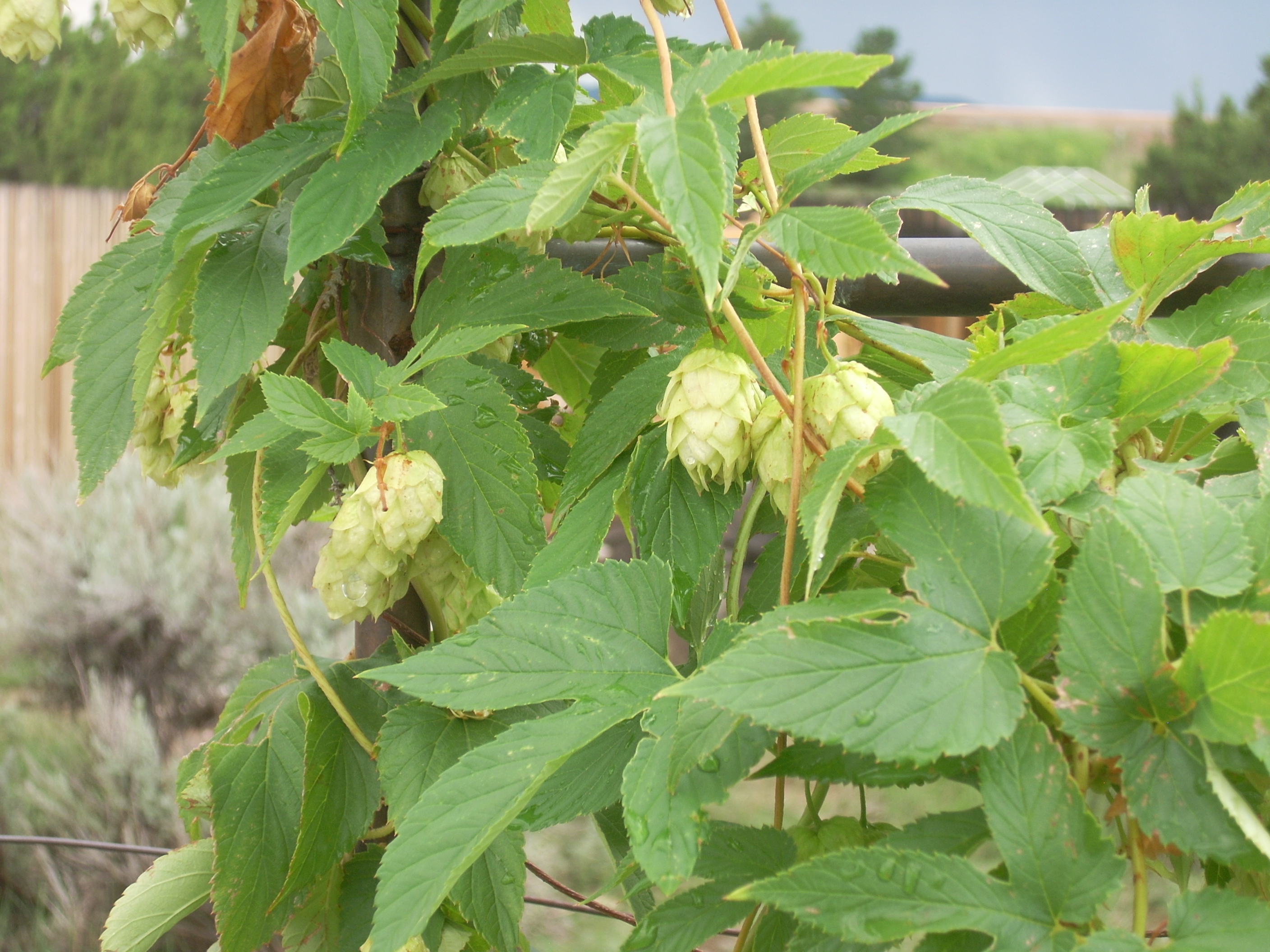
You know what’s really boring? Beer without hops. Straight malt liquor. Go dump that 40 and we’ll move on to where you will find words like bright and crisp in the description of the flavor. Hops are a rhizome, Humulus Lupus, that is for trivia’s sake very remotely related to weed. It’s a vine that produces little pine-cone lookin’ things like this:

What happens here is you boil those little buggers (or you get them processed into a form that looks like hamster food) and that moves alpha acids and oils from them into your beer. Those particular hops taste of lemons and grass, but the category overall ranges from pine, to citrus, to pepper, to fruit. Covering what every particular type of hops brings to beer flavors is a work more suited to something book-length, but there are some rough guides floating around without too much work at google. This one covers a good whack of the more commonly used hops in homebrewing. Some of the oils and acids are more volatile than others, and they’re used to bring beer much of its aroma. Since smell is so tied up with taste, the flavors translate pretty directly, you’re just tasting it through a different sensor for a bit before those volatiles finish vaporizing and wafting away. This is why a freshly opened beer is so much better than one that’s been sitting out for a while. The lack of carbonization in the old beer is related, since all that foamy fizz is carrying more of that hops addition up your nose in the fresh.
The last contributor, and by far the trickiest to nail down, is the yeast. There are as many strains of yeast that can produce beer practically as there are people who like beer. What flavor they contribute ranges even more widely than the contributions of hops, because the temperature at which the yeast does its work fermenting the wort (the cloying sugar water mentioned before) affects what byproducts the yeast produces other than alcohol and carbon dioxide. These are the strains offered just in one format from just one producer, and while I can’t take a sip and say “Why yes, this was made with the Belgian Saison strain!” the differences range from subtle to “holy shit.”
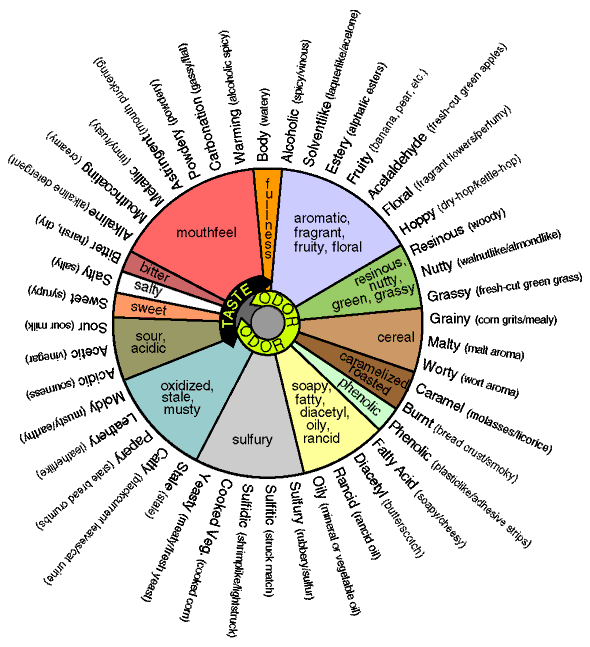
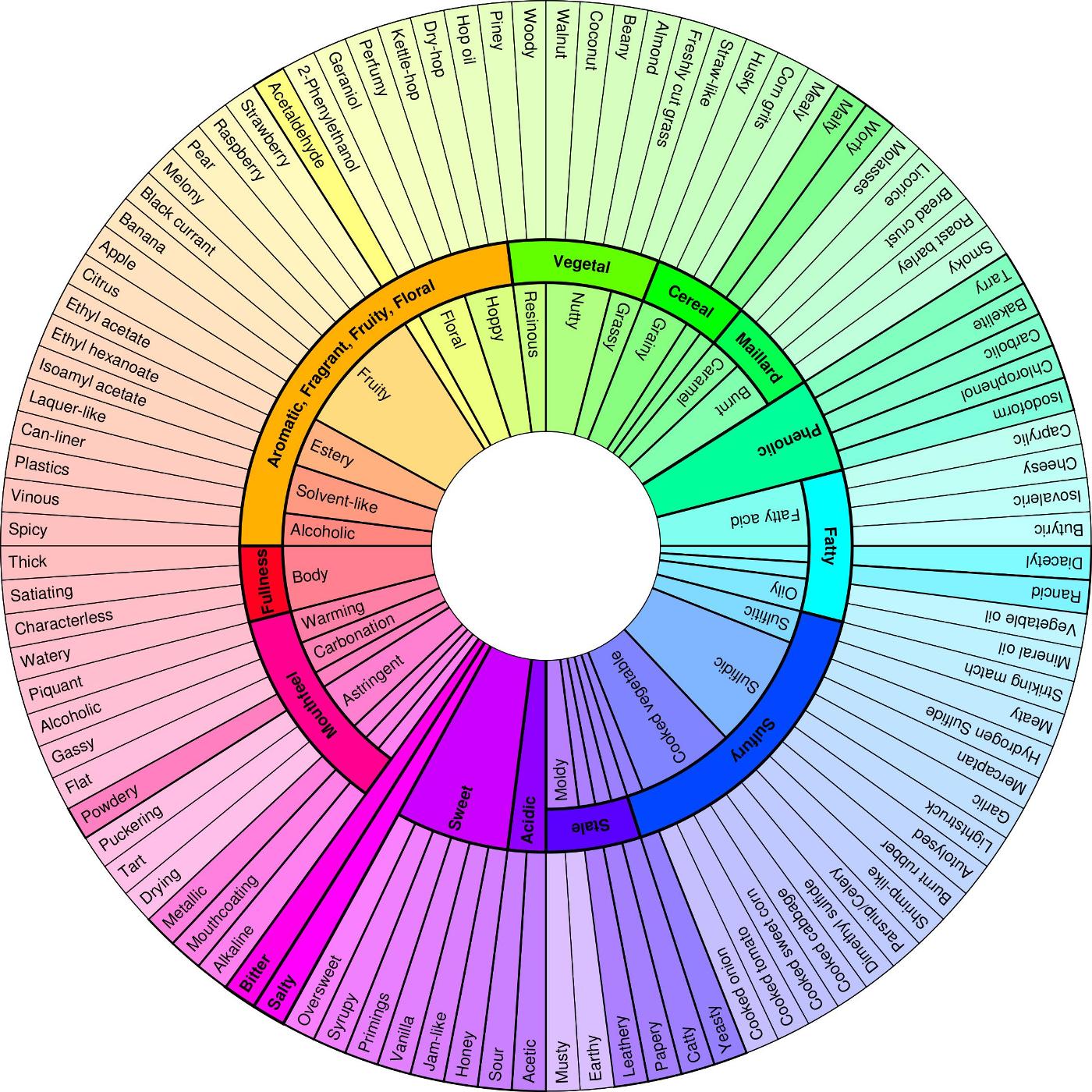
To over-simplify, there are two basic types of yeast, top fermenting, a.k.a. ale yeasts, and bottom fermenting lager yeasts. The difference is exactly what it says on the label. Using an ale yeast, if you do your fermenting in a glass container letting you see the action, you will see a foamy raft floating on top of the concoction. Using a lager yeast, there’ll be a pile-up at the bottom of the jug. From there, it breaks down basically into what you’re feeding your yeast and the temperature you’re working them at. Alcohol and carbon dioxide are obviously the main products, but it’s the other byproducts that give different strains their flavor profiles. Esters are the most common, and arguably important, compound produced, and they lend themselves to descriptions such as fruity. They’re also fairly volatile and affect the aroma quite a bit. Diacetyl and 2,3-Pentanedione ketones chip in, and mostly affect the difference in how a “new” beer feels in your mouth vs. an older, aged beer (not the stale one sitting out from the hops example). Think buttery mouthfeel when you think of those compounds. Fusel alcohols come in from the yeast, and those aren’t necessarily good things. Too high a concentration of them leads to descriptions like “solvent.” Guess why. Smaller doses can help open up the palate, but it still goes back to what type of yeast you have, and what you fed it. Some people think more visually, so maybe this’ll help:

(Courtesy of Salamander via Alabev)
Alternately:

Again, a thorough and fully correct examination of how yeast affects beer flavor is a book-length subject better left to someone who didn’t just barely squeak through chemistry because he had a copy of “Alice in Quantumland” hidden behind his textbook. Atoms are easy. Fuck molecules.
And now, having spent in excess of 1400 words vaguely waving my hands about a subject described better and at greater length and clarity by many people who are not me, I can confidently extend my middle finger to LabRat’s latest attempt to look slightly less awesome, secure in the knowledge that I have muddied the waters for all. And now I’m going to drink a beer.