Archive for the ‘Science: we’ll fuck you up’ Category

FUCK AND YES.

April 23, 2012 - 8:36 pm Comments Off

Dear Federal Government,
Lick the private sector’s taint.
Sincerely,
Everybody who wants off this asshole-choked rock (and the less misanthropic group who just think space exploration is really really cool)

Private space-mining possible by 2025? I could drive railroad spikes with this erection.

Sociability In Beta

April 6, 2012 - 2:45 pm Comments Off

Just ’cause Stingray pointed out the obvious solution to me spinning around in my office chair debating if there was anything I could possibly find to say more than a Twitter’s worth of words about today.

A great deal of time and energy has been spent on the domestication and social behavior of dogs, because they are an obvious candidate; they’re our oldest domesticated species by far, they’ve played the most different roles in our species’ history and forms of civilization, they’ve returned to feral states in a few times and places along the path and provided that additional data point, and being dogs, they are generally cooperative with our efforts.

Another thing that makes dogs particularly felicitous to study as the ur-example of domestication is that they have a life history and ecological niche that is relatively close to ours; humans and canines are both group-living, cooperatively foraging, cooperatively breeding generalist predators. It was not a huge leap for a canine to allow us to share care and raising of their young, as packs of canids generally all pitch in to a litter of puppies. We understand each other relatively easily; even if we are wide branches apart in our physiology and history, we have a shared world and outlook.

Cats are different. Canids have a long and robust history of group living and sociality, but felids are most often solitary with a few scattered species here and there that have some degree of group living, or at least mutual toleration. Lions are the only felid that has fully embraced group living and cooperative breeding and hunting, and even then it’s the former rather than the latter that truly benefits them. Two to three lions would do best bringing down the biggest game that would give the whole group the biggest share of food, and indeed that is the size of the groups the bachelor males tend to form when between prides- more lions gives less food per lion for the same general amount of effort. Big prides don’t bring lions more food, they bring them babies that live- Having a few lionesses looking after the cubs at all times brings them a much lower infant mortality rate than other felids can manage, even accounting for the attrition of unlucky cubs to new incoming males*.

Until the last twenty years or so, the generally accepted dogma was that lions were the only truly social felid out there, and any and all other social behavior witnessed was due to adaptation to unnatural conditions. It is now known that wild male cheetahs will do some cooperative group living and behavior under the right circumstances, and that colonies of domestic cats, whether feral, living within shelters, or living within households definitely feature some wide-scale organized social behavior as well. As an artifact, when reading older literature about cat behavior, you’ll often see their social behaviors framed in terms of redirected fragments of other behaviors; cats rub against you because they’re scent-marking you as their property (not true, rubbing is an affectionate feline social gesture, and one most commonly directed from someone lower in the pecking order to someone higher), cats relate to you as though you were their mother (because it was thought that the only relevant social behaviors cats had were from mother to young or mate to mate), and so on.

As it happens, groups of domestic cats act much like lions; when they form on their own without human influence, they tend to be centered around groups of related females, the territory itself tends to be held and inherited among those females, and males come and go, sometimes forming partnerships with brothers or even unrelated buddy males. (The latter types of coalitions between unrelated intact males are more fragile for domestic cats than they are for lions, but they do happen- male lions simply need each other more.) Domestic colonies tend to be much more stable than lion prides, with fewer dramatic ousters of resident males and more males being able to coexist in relative peace.

Cat societies are less rigid than canine societies; while dogs tend to have a fairly structured heirarchy based on sex, relatedness, and seniority, with strict conditions on who is allowed to breed, cats tend to have one or two boss cats, a large middle stratum of member cats, and the odd pariah cat, who often will not stick around long if he or she is able to leave. Even within that structure, the rule of possession tends to prevail; a boss cat may have privileged access to prized sleeping spots and have other cats move out of his or her way as they go, but won’t be able to take food or a mating opportunity from a subordinate cat without a fight.

Behaviors and gestures once classified as crude uses of fragments of territorial and maternal behavior are probably more like the basic feline toolkit of relating to one another; they probably DO have their roots in those behaviors because their roots are indeed in solitary animals, but they seem to have much more flexibility and specificity as social behaviors than we once thought. Cats have a wide range of temperaments; while a dog is a social animal down to its bones, a given individual cat may range from completely solitary (and effectively untamable, even with recent domesticated ancestors) to gregarious and highly preferring the company of other cats as friends, far beyond the potential to mate. It IS known that kittens have a window from about three weeks of age to twelve weeks in which the species they are readily prepared to accept as friends and companions- and which as food- but it’s not completely hard and fast. A feral cat may still be tamed as an adult, but it really is more like taming a wild animal than adopting a pet domesticate.

It’s possible that, even without much direct effort on our parts, that humans are responsible for turning cat-as-we-know-it from a solitary species into a sociable one. Even before it occurred to the cat or the human that friendship would be a good idea, there would have been pressure on cats to coexist in denser numbers around the rich food supplies that colonies of rodents in human grain fields and storage would represent. Even most species of wild cats will live more densely when food supplies are rich, mostly in the form of maturing young spending more time with their mothers and females tolerating the company of their local ranging males for longer and more sociably. Once humans started bringing cats into hearth and home rather than appreciating their good work in the field, the pressure for cats to be capable of- and even thrive off- companiable coexistence would have been quite intense.

Still, evolving from a basic-but-present level of sociability to a more complex and intense form over thousands of years instead of millions shows in places. Dogs seem to have more, and more sophisticated mechanisms for resolving intra-group conflicts and relieving pressures; cats mainly rely on avoiding one another until either everyone calms down or someone can leave altogether. Displacement aggression is much more common in cats than dogs, as are spiraling anxiety-rooted behavior problems. Cats that must live in a group but aren’t friends tend to establish small sub-territories and live around one another rather than with each other, and when they are forced into each other’s territories, problems sometimes explode into existence.

Personally, I find it likeliest that cats know exactly what we are- a non-cat species that can be befriended and can act like a mother, sibling, or baby** as the situation and the roles shift. Thankfully mate stays off the table; we smell all wrong for that.

*Lions are interesting in that they are one of the few species with male infanticide where mothers, and coalitions of related females, will regularly unite to defend as many young as they can from the males. If the cub is old enough to have a fair shot at survival, a mother may leave with her subadult cub. In most other cases (as in primate) the mother and child are more or less screwed, and in a pack of canids the most likely individual to kill a mother’s cubs is her own mother or other older, dominant female relatives. There is now some evidence that related female domestic cats may mutually defend kittens from marauding nonparental males as well.

**The likeliest explanation I have seen for why cats bring us dead or wounded prey as gifts is that they are trying to help us start out hunting. There isn’t, so far as I’m aware, another context to this gifting behavior seen among wild cats.

Sex, Gender, Biology, Society

March 26, 2012 - 3:11 pm Comments Off

A post over at Quizzical Pussy (NSFW, good for discussion) on… I’m not even sure what I’d nutshell it as, maybe transphobia, maybe gender issues in general, maybe I-don’t-even seems to have provoked minor kerfluffle, as for some reasons such subjects often do. I’d actually go over there and read it if you want to talk about it*.

Couple of comments:

1) On “YOU CAN’T DENY BIOLOGY YOU CRAZY SOCIAL CONSTRUCT LIBERAL BIOLOGY DENIER”. My instinctive response is “bitch, you don’t even know how weird biology gets, and this is tame as hell by comparison”.

My constructive response is that sex, as in male vs. female has a very straightforward definition in biology, and gender has a separate, much less straightforward definition, and even outside of we’re-just-talking-about-mating-fish it gets much weirder in human society.

Sex goes like this: If you belong to a species in which gametes are differently sized, and almost all species are anisogamous (the fancy word for “gametes differently sized”) because the numbers seem to work out a lot better for both participants that way, then the individual with the big gametes is female and the individual with the small gametes is male. Every other detail is elaboration, and the elaboration is not even remotely uniform. Some species pack both in one, to have gametes for every occasion, and they are hermaphroditic. Some species change sex depending on circumstance or age, which is much easier when the hardware for your gametes remains similar between sexes. (Many fish handle sex this way.)

Gender goes like this in biology, which really isn’t the same thing as in human society: It’s still complicated as hell and currently the subject of a genteel firefight. The thing is that, in anthropology and until relatively recently the rest of biology agreed, animals don’t have gender, just sex, because animals don’t have culture and gender is culturally constructed. However, some animals seem to have more than one concrete and consistent way to be male or female, and these animals definitely don’t have culture. How you will see this described in the literature varies a great deal; sometimes it’s referred to as “alternate mating strategies” (although lots of other animals have multiple mating strategies that are chosen on the fly as seems advantageous rather than having their mating strategy and life history linked to obvious physical forms), sometimes they’re referred to as “morphs” (even though most physical variations we refer to as morphs in other species aren’t linked to behavior and life history), sometimes it’s both at once. Some biologists have suggested that maybe “gender” is a pretty useful concept to describe critters that have more than one physically distinct mating strategy and life history per sex, but this is far from broadly accepted- but then, no single way to frame such problems really has broad acceptance.

With humans, everything gets much more complicated. Not even sex is completely and totally straightforward, given that there are enough of us for just about every biological intersex condition under the sun to have appeared, been documented, and caused some kind of legal problem. Gender goes along culturally constructed lines depending on the culture born into- but consider that for humans, very nearly everything, no matter how biological, has some degree of cultural construction; the way we eat and what we eat has a huge cultural component, and even the way we poop does as well. How many genders, and how gender is defined or assigned, varies from culture to culture.

What fascinates me on a personal level is how close to the bone gender seems to be for most people, and how entitled they seem to feel in a fish-have-no-words-for-water sort of way to other people’s. If you choose not to advertise your religious or political affiliation no one will make an issue of it, but if you choose not to advertise your gender identity very clearly some people get aggressive about it. Nature has taken care of secondary sex characteristics for me with no ambiguity unless I catch a cold and wear a camping tent for clothing, but when I wore my hair very short I’d get the occasional “Are you a BOY or a GIRL?” from total strangers, and the occasional outright hostile “Sir“. The latter fascinated me more than insulting me, mostly by the clear intent to insult that was always behind it.

What makes it yet more interesting to me the longer I think about it is that typically the same factions I hear “male and female are ironclad biological constructs anyone is foolish to deny” from are the ones that also believe in enforcing the boundaries thereof with a great deal of applied cultural force. Nobody has to be taught to poop (although they do have to be taught where it’s appropriate to do so and how to clean themselves afterward in their own cultural fashion), but the training and rules for properly expressing one’s gender start at birth and have been a subject of obsession for parents since the beginning of written history. Schools have been founded around it, entire fields of study have been founded around it, religions usually have a great deal to say about it; learning how to be a man/woman, as well as NOT to be a man/woman, is one of the most intense acculturation experiences on Earth. It’s also a pretty big source of culture clash.

I’m not trying to say that gender is pure and entire social construction either, because I don’t think it is; if so social constructs for additional genders per sex would probably not be necessary, nor would the existence of a diagnosed “gender dysphoria” in societies where gender is very strictly binary, even after permissible roles for women and men have loosened to the point where you can be a man or a woman with some pleasures and behaviors from the opposite gender, and have that be unremarkable. Most of human life is things from our biology mediated and shaped by culture, not a nature-nurture dichotomy.

I AM trying to say that neither the biology nor the sociology is crystal clear here, and that if there’s a whole lot more going on for animals that are no brighter than a lizard or fish and have no culture whatsoever… who are we to assume that “biology” makes gender simple?

*This took me all damn weekend plus a big chunk of today to write. It was one of those “one sentence requires twenty minutes of research, revision, and mind-changing” things. After I hit post I’m going back to searching YouTube for Beyonslay highlights.

Just Exactly Like We Planned?

March 19, 2012 - 4:17 pm Comments Off

By now most of you who pay attention to such things have probably already heard of the planned collaboration to resurrect the mammoth by injecting an elephant egg nucleus with mammoth DNA and incubating the result in a female Indian elephant.

The linked article mentions the background of many of the involved scientists with cloning, and indeed something like that has been done before in the Audubon exercise of having a domestic cat incubate black-footed cat embryos and successfully birth and raise the kits.

What I’m really wondering about is the impact genomic imprinting is going to have on this experiment. Imprinting is not well understood, but it’s something mammals do and other groups of animals don’t, and it seems to be most heavily involved in embryonic development. It’s why there aren’t any parthenogenetic species of mammal; in order to develop normally, mammals need input from both parents on various developmental epigenetic tags. This wasn’t a problem with the black-footed cats because that was in vitro fertilization with an already-made embryo using frozen sperm, and presumably researchers who clone have found at least a partial workaround in order to deal with eggs that technically only have one parent… but that’s dealing with a living species whose toolkit you can study and maybe borrow. We have no mammoths, and both the egg and the incubation environment will be elephant, not mammoth.

The article linked ends as is typical of these things with a crack about the sci-fi possibilities of Resurrected Mammoths Gone Rampage, but I would worry less about that and more about getting what amounts to another Asian elephant with a bizarre pedigree, which developed as its available epigenetic switch-thrower instructed. Presumably researchers with a heavy cloning background know a lot more about the pitfalls and how to avoid them than I do, but a great deal of the idea seems to head straight through “here be dragons” developmental biology territory.

Horrors of Robotics

March 16, 2012 - 8:43 pm Comments Off

Use headphones if you need to but watch this with the sound ON, not off. Without sound the video is merely weird. With sound it dropped me screaming into the deepest, most hellish trench of the uncanny valley.

A sensible voice from my intellect informs me this thing has a good training reason to exist and certainly beats going from printed page to real screaming bloody life with no difficulty slider. It’s drowned out by the gibbering from the rest of me that occasionally manages to babble that the noises the thing makes really do sound like it’s howling in pain, and occasionally almost like it’s trying Lamaze breathing.

Handsy

March 1, 2012 - 6:48 pm Comments Off

A bit of moderately interesting afternoon fluff from the NYT: hands and fingers.

From the article directly, four tests. Before you read on beyond the quote block, try them all.

• Make a fist with your nondominant hand, knuckle side up, and then try to extend each finger individually while keeping the other digits balled up tight. For which finger is it extremely difficult, maybe even impossible, to comply?

• Now hold your hand palm up, fingers splayed straight out, and try curling your pinky inward without bending the knuckles of any other finger. Can you do it?

• Imagine you’re an expert pianist or touch-typist, working on your chosen keyboard. For every note or letter you strike, how many of your fingers will move?

• You’re at your desk and, without giving it much thought, you start reaching over for your water bottle, or your pen. What does your hand start doing long before it makes contact with the desired object?

And here is what happened when I tried them, behind the fold: (more…)

That word you keep using….

February 15, 2012 - 9:16 am Comments Off

Talking with NFO about “pathological science”, the anti-gun movement, and what we usually describe the same thing as today- pseudoscience. He’s part one; I’m part two.

The first thing I want to talk about is the notion that there is a single, real thing called Science and any confusion between it and pseudoscience (or “pathological science” as Langmuir codified it, which I had not encountered until recently and rather like) is like misidentifying species. It’s not true; it’s closer to true now that it ever was historically, although we often talk as though science has been an unchanging edifice or force, but it’s a reification of a collection of processes, models, and methods rather than a thing unto itself. The idea is to make a model for acquiring reliable knowledge that is robust against all the cognitive biases and fallacies of human thought processes; however, given that the entire enterprise is still done by humans, it’s merely better than less careful approaches, not infallible.

To give examples, here are some things that, within the lifetime of many readers, were either still serious scientific debates or were seriously held and debated theories: status thymicolymphaticus (died out for good in the 60s), whether plate tectonics is a real thing (considered crank science until the late 60s, seriously debated by the credible well into the 80s), whether menstruating women secrete toxins into their blood and sweat (didn’t start to really die out until the 1980s). Science and purely rational processes can come to completely wrong conclusions if the data or assumptions are bad.

That said, there are some things that are fairly telling markers of pseudo, or pathological, science:

1. Not only is falsification of the underlying theory not seriously tried, it seems to not be thought of at all.

It’s not enough to make predictions about things that happen, real science needs to make predictions based on theoretical logic that can be fully laid out and also account for cases in which the theory makes predictions that fail to happen. Predictions that fail don’t in and of themselves falsify theories, but they do call for explanation and investigation; in real science, predictions that fail wildly are a major engine of further research and progress.

Or, to return to what we were speaking of, when people predict an uptick of gun violence in states or cities where greater legal access to guns is granted, their next interest should then be whether that actually happens or not and if it fails to, investigation into exactly why. If it fails to happen over and over again, that should be the hottest topic in the field, not a minor detail.

2. Proponents of the theory treat every event as being clearly and solely about it.

Again to use an example NFO brought up, the Loughner shooting case is a case of gun violence, and a case of a dangerously mentally ill man having been able to get his hands on a gun. But it’s also a case of fixation and stalking, and all of the implications of “a mentally ill man was able to do a thing normal citizens are” are thought through, it raises a serious debate about freedom and security and how we logistically expect to differentiate “dangerously mentally ill” from the vastly more common “just mentally ill” and what justifications we may invoke to lock someone up and drug them against their will. There are also issues of privacy and the question of what happens to people who work with guns for a living, such as the danger for law enforcement and military in fearing mental health services due to a rational fear of being diagnosed mentally ill and thus potentially being diagnosed out of their careers. For professions with serious risks of depression and PTSD, no small concern*.

When it remains reduced to “access to guns” as the sole issue, that’s a sign there is something wrong.

3. Relevant experiments conducted by outsiders are ignored or only selectively acknowledged.

See the first point. In the case at hand, “experiments” are done nationally and locally on both a legislative level and a “local reality” level. This is much more glaring when said experiments are only noticed when they appear to confirm the theory; to give an example of an “experiment”, we have Japan, a country that has always had very strict gun laws. According to the theory that the presence of guns is a controlling variable for violent deaths, low/strict access to guns leads to fewer homicides and fewer suicides. Japan has a substantially lower homicide rate than the United States, which is touted as a fulfilled prediction- but its much higher suicide rate is left unaddressed.

Now, both the anti-gun/Violence Policy Center/Brady position and the pro-gun/NRA/Second Amendment Rights positions are politics, not science. Ultimately, they both start from an explicitly ideological position** and exist to justify their own existence. The reason I’m holding it up to the mirror of pseudoscience is that a great deal of anti-gun argumentation uses social science as its justification, and that social science must be judged by scientific standards; ignored evidence, ignored variables, manipulated data, and arguments based on faulty or disingenuous assumptions all count. This goes for the pro-gun side as well, and they have their own problems (OH JOHN LOTT NO)***, but ultimately their argument rests on the idea that access to tools for effective self-defense is a human right, not that private ownership of guns will make society better or is even in all cases a necessarily good idea for an individual.

The argument that private citizens should not be allowed to own guns because they shouldn’t be allowed to own/do anything that could result in the death of another citizen, no matter the circumstances, is not psudedoscience. Pseudoscience does not mean “disagrees with me”. Treating the presence or mere existence of guns as a strong controlling variable in ostensibly serious social science about violent acts and deaths, no matter the the circumstances, is.

*See this VPC editorial on military suicides. Note that the VPC position is unambiguously that anyone diagnosed as mentally ill at any point should be barred forever from owning firearms; note also the complete lack of concern or acknowledgment that such a policy might make veterans suffering from PTSD, depression, or plain old serious life issues reluctant to seek help or even acknowledge there is any sort of problem.

**Ideology is not inherently wrong just for being ideology. My position that we should under no circumstance put puppies in blenders is pure ideology, which does not make it in any way a bad idea, belief, or value.

***Or, more seriously, the domestic violence issue, on which both sides can be awful. The presence of a gun is not a bigger variable than the presence of an abuser willing to threaten or kill, but likewise its presence is not a magic talisman against the specter of killing a loved one. If abuse victims are often reluctant to report explicitly because they fear ruining their abuser- a loved one’s- life, how willing are they likely to be to shoot them?
Throw It Out

December 12, 2011 - 5:54 pm Comments Off

From the “Inbox that we check shamefully infrequently” files, a question about this study and how legit it is. Asked, answered.

The title of the article: “Researchers find poop-throwing by chimps is a sign of intelligence”. We can just dispense with that right there and wonder if the reporter felt any twinge of shame, or merely glee, at crafting that headline.

Content of study: Researchers did brain scans of chimps that threw stuff a lot versus those that did so less often, also tracking how often they actually hit what they were aiming at, and found that chimps that did more throwing showed more development in an area of the cortex had more development in the areas associated with motor functions, and also with Broca’s area, which is associated with speech in humans. The researchers in question go on to speculate that throwing stuff has more to do with communication than anything else, and that getting really good at throwing stuff might have supported our progression to speech as hominids.

Credibility of study: Middling to low. The journal it’s published in is not all that high-profile in primate circles, and doesn’t seem to be getting much buzz or traction in primate circles.

My major reaction to this thing is that it’s kind of an odd approach and an odd reaction to take from that data. It’s been known for a long time that motor functions and language functions are very tied up, neurologically speaking, and that the circuitry we have for observing actions and learning from observation seem to be tied up with motor functions; if you’ve ever heard of mirror neurons, they’re neurons that fire both when we perform an action, and when we see someone else perform that same action, as though we’d done it ourselves. These neurons were first discovered in monkeys, seem to also exist in humans, and occur for us in Broca’s area and in other primates in the area where Broca’s would be if their brains were but bigger and more developed. Broca’s area is where language seems to live.

We know that motor functions, our ability to imagine doing things, our ability to articulate doing things, and our ability to imagine another’s perspective are all tied up in Broca’s and in these motor neurons, but we don’t really know a whole lot more than that barring various tentative stabs. One general idea that has at least some traction is that speech and language in general are an exaptation- a repurposing by evolution of a structure meant to do one thing, into another thing- of very fine motor control, since the hardware required to make our hands and limbs do very precise things seems to be the same hardware that lets our lips, tongues, and vocal chords do other very precise things for the purpose of communication.

In light of this, taking from this data the idea that throwing things is specifically related to communication, and that throwing things is primarily communication, is rather odd. Certainly throwing behavior is something that humans are really good at and seems to be a uniquely human skill- but so are a lot of other things that seem to be dominated by very fine motor control. Chimps are crap at it, even if some chimps are slightly less crap relative to other chimps at it. A human can combine speed, power, and control into a 80 mph fastball that goes straight through a strike zone from sixty feet away; a chimp is fairly lucky to hit a target from six feet away.

From this angle, a chimp who can throw things better being also a chimp who communicates better don’t look like a statement on throwing things, they look like a statement on that same fine motor control- two consequences of the same developmental advantage, rather than one driving the other. It’s just easier to test a chimp’s throwing abilities than their writing abilities.

Bad Blend

November 18, 2011 - 5:33 pm Comments Off

There’s a cool article at the Primate Diaries about Ilya Ivanov’s bizarre efforts to create half-human, half-chimpanzee hybrids and some of the mythology associated with it, as well as what really happened and what really motivated it. (Short version: it wasn’t Communism or any other ideology, it was one scientist- who was justly famous in his field- and his strange obsession with whether something could be done regardless of whether it should.)

The myth associated with it, which seems to originate from a fundamentalist Christian organization trying to link “Darwinism” to toxic ideologies, is that Stalin ordered Ivanov to crossbreed apes and humans in order to create “super-soldiers” for him. Johnson at PD does a fine job of taking apart the historical inaccuracies (suffice to say Stalin did nothing of the sort), but I’d like to comment on the scientific weirdness of the whole premise.

One of the consequences of our strange psychological relationship with “nature” is that we tend to think of our species as a whole as somehow outside of it and diluted from whatever our “natural” origin and state is. We tend to think of humans as frail but brainy creatures and animals, apes included, as fabulously strong and healthy and fierce. This effect tends to spill over to the animals we’ve domesticated, like dogs, and a fair amount of the civilization-savage dichotomy often affects them as well.

The thing of it is, though, is that all animals, humans included, are finely and specifically adapted to whatever niche they fill, including artificially selected animals. The human-ape super-soldier of the imagination is summed up in the quote by Creation Ministries’s fictional Stalin:

Stalin is said to have told Ivanov, ‘I want a new invincible human being, insensitive to pain, resistant and indifferent about the quality of food they eat.’

While whether Stalin would actually have thought like that- the man was no scientific genius- is open to speculation, but whether that would have been the result actually obtained by crossing humans is not. Apes aren’t insensitive to pain nor indifferent to the quality of food they eat. They are stronger than humans, but that greater strength is a combination of sheer lever physics given their different builds and a bias to gross motor skills over fine- stronger, but clumsier. Much worse than that, even if an ape has a theoretically higher pain tolerance, he has far less of an urge and ability to cooperate, or to tolerate discomfort in the name of group solidarity- regardless of how much pain he actually felt, an ape would be vastly more inclined to scream and rip your nose off for inflicting it in the first place.

Ape-human hybrids wouldn’t be super soldiers, they’d be worse humans and worse apes at the same time; perhaps stronger, but also much more poorly adapted to bipedality and fine motor coordination, so unable to march or operate weapons nearly as well. They’d be vastly worse cooperators, and thus much more likely to fight within their group than to watch each others’ backs. They’d have less patience and capability to delay gratification, so you can throw soldierly discipline right out the window. They wouldn’t be as bright, which might be an advantage in the mind of someone whose picture of the ideal soldier is less ability to question, but with vastly less inclination to be obedient that wouldn’t matter either. Some super-soldier.

Again, this applies to dogs as well. There’s a lot of legend and myth-making (as well as some scattered cases of actual doing) about dogs and wolves and breeds of dogs supposedly outcrossed with wolves to make them better sled dogs or fiercer guard dogs; again, wolves are well-adapted for being wolves and working dogs are vastly better designed to be working dogs. A wolf parent wouldn’t make a sled dog a better or tougher sled dog, it would make him a less efficient runner (the extra mass wolves have in their fore, neck, and jaws for taking down large prey would be dead weight to a sled dog), more likely to fight within his team, vastly less inclined to take orders from a human, and equally less inclined to work himself to exhaustion for the fun of it or on someone else’s say-so.

Likewise, a guard dog with a wolf parent might at best have bigger teeth and jaws, but would be equally less cooperative, more likely to challenge its own charges for dominance, less inclined to protect the group at all costs, and less territorial. For either a guard dog or a sled dog, a wolf parent would make it less able to thrive on a lower meat and higher “scrap” ration in its food, making it more expensive to feed.

Apes are well-adapted to being apes and humans are well-adapted to being humans, as wolves are well-adapted to being wolves and dogs are well-adapted to being dogs. The things that make them strong in their own roles wouldn’t necessarily bring anything useful to the other, and even when we go to war we aren’t being more “animal” and needing those strengths, we’re doing another human thing in our particularly human (or doggy) way.

How To Get There From Here

November 4, 2011 - 4:42 pm Comments Off

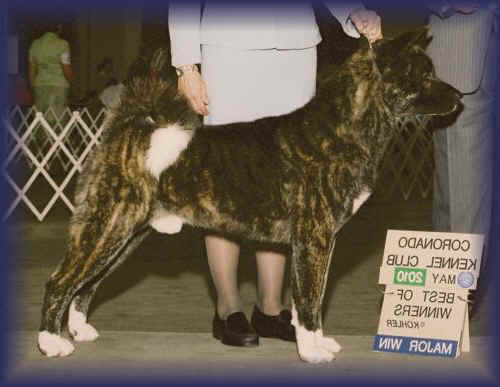
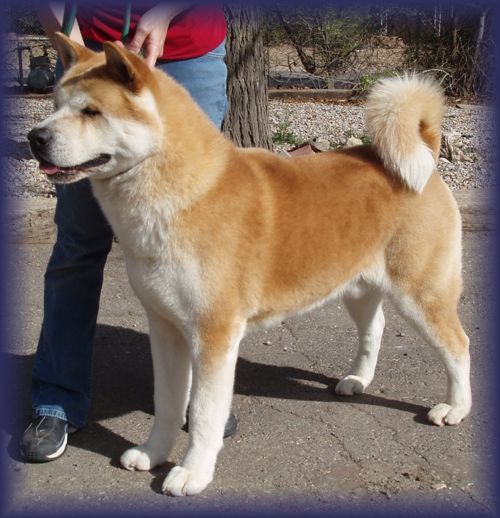
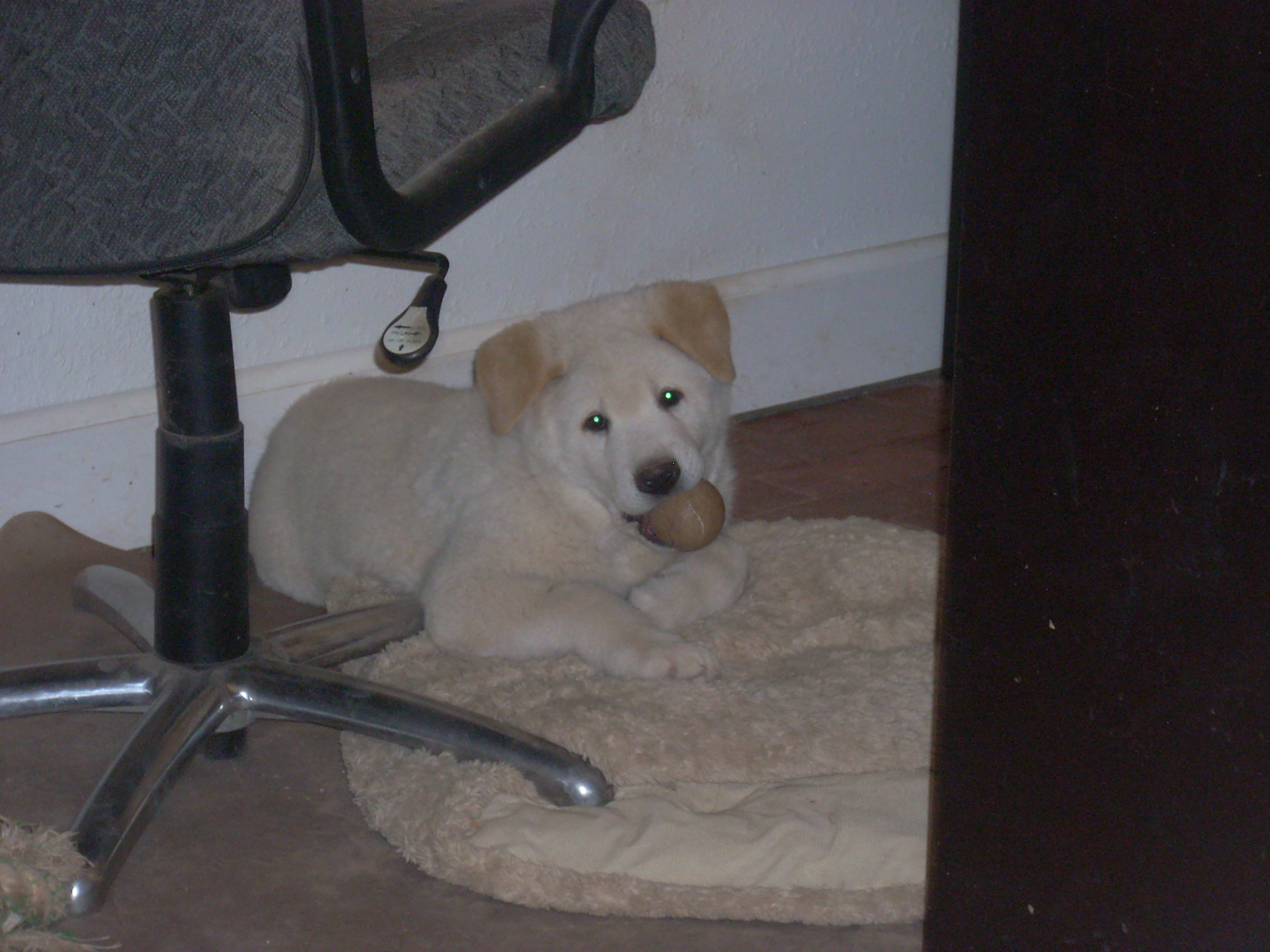
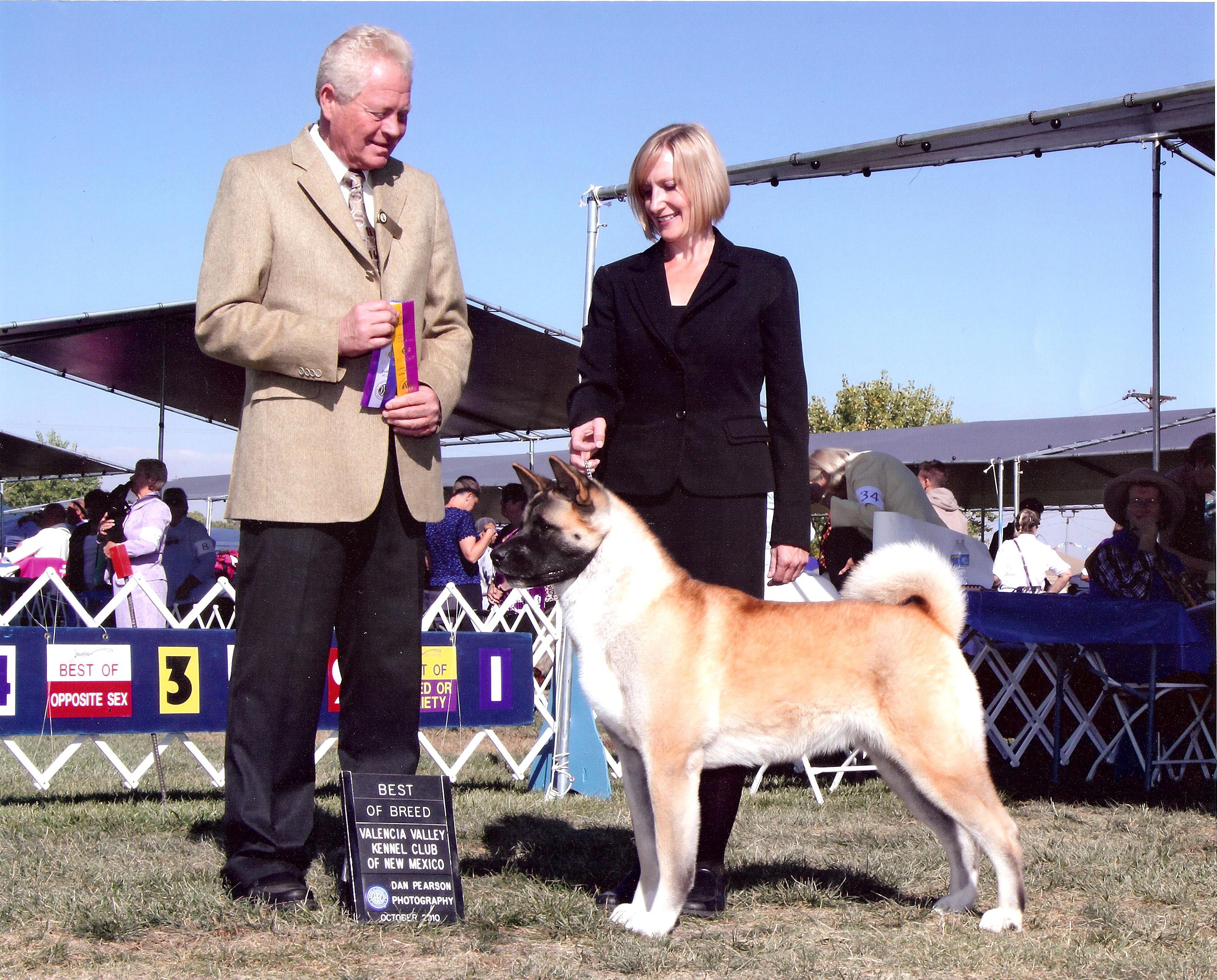
Tank is a ten-week-old Akita puppy, a breed in which all colors are permitted. His littermate is the same color as he is. He looks like this:

His mother looks like this:

His father looks like this:

There are no white dogs anywhere up to five generations back in his pedigree, although there is one that shares a grandsire with him out there. How, genetically speaking, do you get a result like this?

The answer begins with an epistatic effect. To explain how it works, we’ll go to a genetically simpler breed, in which only three colors are permitted instead of all of them.

All Labrador retrievers are, genotypically, black dogs. There is a genetic locus in dogs, the K locus, that determines whether a dog will be black, brindle, or whether some other color will be allowed to express; every single Labrador has the dominant gene at the top of the series, K. There are no kbr or k dogs in the breed- K is fixed.

The starting color for each and every Lab puppy is black, but other genes can modify it; one way is for the dog to have a recessive at the B locus. Big-B is normal black, but several alleles that are recessive to it will turn all black pigment to brown; one way to recognize its presence in a dog whose coat color is something other than black is that these genes also affect the skin on the nose and around the eyes, so that their noses turn from black to liver. A Labrador with one of the browning recessives at that locus will be modified to chocolate rather than black- at least genetically speaking.

I say “at least” because the other locus of concern in terms of what you get out of a litter of Lab puppies is the E locus. The E locus has four alleles in the series, but only two of them are present in Labs- E and e. Big E allows normal production of eumelanin, the pigment that produces shades of brown and black, and is dominant to little e. When there are two e’s at that locus, it acts as an epistatic switch: all eumelanin production is turned off in the hair shafts. Whatever black pigment would have been otherwise present in the coat goes away, and the only thing left is phaeomelanin, the pigment that produces yellow and red shades. Phaeomelanin is present anyway in a black dog’s coat, and can sometimes be seen as reddish highlights, but normally it isn’t very visible. A yellow Lab with a black nose is a dog that would have been black otherwise; a yellow Lab with a brown nose is one that would otherwise have been chocolate, sometimes called a Dudley. The ee switch only affects the hair shafts, not the skin, so the normal black pigmenting or modified brown still happens.

Tank’s grandsire on his sire’s side looks like this:

Neither this male’s sire nor his mother are clear red like this- his mother is a shaded grey, and his father is a red brindle. It’s impossible to know whether he himself is a brindle, because this dog is ee; all the black pigment in his coat has been turned off. This pattern- “white faced red”- is much more common in Japanese dogs than American ones, but ee Akitas from either country will usually look like this. There is a white-faced red in Kang’s pedigree as well, but that dog is four generations back.

So, we get a red Akita with white markings and no black hairs with the ee epistatic shutdown of all black pigment. The other half of Tank’s creamy complexion comes from a different gene that also modifies normal expression of coat color, but presents different appearances based on the starting base color.

The dog that sired Tank has the ee red sire and a black brindle dam, but both of his grand-dams are the same black-shaded grey color, referred to in this breed as silver. Genetically, they are most likely red, like Kang; the reason they appear silver instead is another locus, which has not yet been found in the laboratory but whose behavior is clear in a lot of breeds- the hypothetical I series affects phaeomelanin, rather than eumelanin. The dominant I lets phaemelanin express at normal intensity, one copy of the i recessive will cause phaeomelanin to lighten, and two i’s will bleach all red pigment in the coat. A black and tan pointed dog with a double i will have silver or white points instead of tan- and a red dog with black shading will appear greyish, silver, instead. The more black in the dog’s coat, the darker the overall visual effect.

What happens to a dog with no black pigment in its coat at all? The only pigment present in the coat, phaeomelanin, is all bleached- giving a white or nearly white dog, as the bleaching effect can be incomplete- which is why Tank’s ears are a pale peach color rather than fully white, and he has very faint red shading on the areas of his coat where the unmodified red would normally be most intense as well.

This is how you get a white dog from two lines with no white dogs in them: start with one recessive that removes all black, and then add in another recessive that bleaches all red. Since there are only two kinds of pigment in the coat, black and red, the result is white by default.

I mentioned when I talked about piebald that there is more than one way to get white onto an animal or to get an all-white animal- this would be one of the others. Since the genes in the piebald series stop pigment-producing cells from fully migrating out of the neural crest in the first place and the two genes responsible for Tank’s color only affect the hair shaft, his eyes and nose are normally colored and there is no risk of deafness; under the fur, he is pigmented normally, including the nerves that require it to develop properly.