Archive for the ‘media slaves’ Category

Cabin In The Woods Capsule Review

April 18, 2012 - 8:12 pm Comments Off

All the reviews I read prior to deciding it was worth theater price to check out said that it was basically impossible to talk much about the movie itself without spoiling it to hell and gone, but that it was awesome. This turns out to be because this is the truth.

I am 100x more hopeful about Avengers now that I have seen evidence that Joss Whedon can do a new project without indulging all or even any of his bad habits and well-worn ruts.

That’s right up there with Behind The Mask as one of my favorite genre-exploring horror movies. Maybe even above. We’ll see how the rewatches go after the DVD comes out.

Best movie ticket payoff since… *thinks*… Iron Man.

Avengers Gone Sinister

March 2, 2012 - 9:08 pm Comments Off

So, as Topless Robot is wont to do, Topless Robot is having a reader contest, for the worst ways Avengers could go horribly, horribly wrong.

Now, for those who aren’t in the comic-geek general movie loop, Avengers is the culmination the recent decade of Marvel Universe movies have been building up to; the Ed Norton Hulk, both Iron Man movies, Thor, Captain America, and so forth. A lot of worldbuilding, time, and oceans and oceans of money have gone into it, and the fans of both the comics and the movies are rabidly excited about it.

Avengers is also written and directed by Joss Whedon, a geekworld writing god with as much dark reputation as bright. While Whedon has done many brilliant things, once you’ve watched enough of his work for long enough, certain… patterns begin to emerge. Repeated patterns.

Thus, my capsule summary of Avengers, gone horribly wrong.

The movie opens on Hawkeye talking to Nick Fury about Stark’s shooty-suit with the rocket things, or possibly Jane’s work on the glowy-times bridge to the god-place that Thor came from. Black Widow wanders through the background, barefoot for some reason, as she will be for most of the rest of the movie. Speaking of Widow, in a surprise move given the success of the Iron Man and Captain America movies, she will be the focus of the A plot, revealing her troubled background of early childhood abandonment and later government manipulation and brainwashing, including her false memory of being a ballerina, which explains why she looks great barefoot*. A B plot involves Tony Stark’s ill-considered affair with Black Widow and Steve Rogers simultaneously, which destroys his relationship with Pepper Potts. Tony is later killed senselessly by a random piece of falling space debris in the third act. Hawkeye is killed in a blink-and-you’ll miss it moment during the climactic final battle, during which Black Widow kills over nine thousand bad guys. In the end, the heroes prevail, but everyone is completely miserable and all traces of happiness have been brutally eliminated. In the final stinger scene, we see Agent Coulson reporting to a shadowy board room filled with people in menacing labcoats, plus one Skrull.

*This is, in fact, canon already. Minus the feet.

Must-Hate TV

January 31, 2012 - 9:38 pm Comments Off

Watching some of the commercials that run during my dwindling supply of favorite shows, I find myself in the curious position of seriously considering watching a show featuring Jamie Oliver.

This is a curious position because I truly loathe Jamie Oliver. I hate his smugness, I hate his accent, something about him makes me want to punch him until his dentistry justifies said accent. I found him merely offputting until I saw his chicken-nugget demonstration, at which point my hatred blossomed into its full fire*. There’s nothing wrong with promoting fresh, real food for children, which is an agenda I agree with, but he manages to do it on a basis of what seems to be primarily shame and disgust, which is no kind of healthy relationship to have with food. It’s also more than a little classist- some people don’t eat Kraft dinner because they don’t know any better, but because they have little time, little money, and it keeps forever on the shelf and provides enough calories to get through the day.

So now, apparently, Jamie Oliver is road-tripping his way through America on BBC America. And I really want to see it, because it will be like the finest, blackest espresso of hate. I don’t know why this should be; most of the time, people and characters I hate make me change the channel. But not this time. I think it would be genuinely entertaining to hate on Oliver for an hour or so a week.

Is this the appeal of reality TV?

*The upshot of the demo is he butchers a chicken carcass, then blends the scrap meat with fillers, breads it, and fries it. Apparently this is disgusting and horrifying because it’s not whole skeletal meat and chicken carcasses are gross. Our grandmothers would have called that responsible use of meat, and a professional chef like Oliver ostensibly is would call a chicken carcass materials for stock, not a gross thing to be thrown away. That’s not responsible food education, that’s teaching kids that only pretty food is good food. The stuff he blends, breads, and fries is perfectly good meat- it’s some of the fillers and preservatives that make commercial chicken nuggets less than ideal.

A Mystery For The Reader

January 19, 2012 - 5:32 pm Comments Off

Somewhere in this 40 second clip is the platonic cartoon ideal of Stingray.

I leave it to the reader to identify it.

B Movie Review: The Last Exorcism

January 9, 2012 - 9:03 pm Comments Off

In which I will try to say as little as possible about the actual plot beyond the beginning, because the movie does such a good job retaining mystery and unanswered questions for so long that it’s worth going in unspoiled.

Our grocery store DVD shelves seem to inexplicably specialize in offering a selection based around an overarching theme of movies no one would ever want to buy; they cover all decades, but are composed mostly of movies that went nowhere because they were either self-evidently terrible, no one ever heard of them at any point, or a they were unexpectedly terrible but a terrorized earlier audience saved the rest of us from it. Occasionally there’s the remnant of the latest blockbuster to hit disc, but those always disappear quickly and leave the remaining collection of losers unchallenged once more.

Which is why I was sort of intrigued to be browsing the Failure Bowl waiting for Stingray to finish checking out, and pick one DVD up that actually seemed sort of interesting and like I might theoretically actually want to watch it. I didn’t do anything so rash as to actually buy it on that premise, but when I went home I found it was available on Netflix Instant, and also that the Bloody Disgusting review was pretty positive, and they are not inclined to review every or even most movies positively. The reviewer extolled the virtues of going in cold, so once it was apparent he really liked the movie I took that advice for once and only read the rest after watching it.

Last Exorcism is a pseudo-documentary/hand-taped footage movie in the vein of Blair Witch, Cloverfield, and Paranormal Activity, which I normally don’t care for a lot- I was underwhelmed by Blair Witch, and thought Paranormal Activity was an hour of excruciating boredom followed by twenty effective minutes- but I liked this one almost immediately. The big difference is that Last Exorcism completely eschews the Twenty Minutes With Jerks trope in favor of quickly establishing character and motivation and then moving on to the meat of the movie. Rather than making us spend a long time developing a thorough distaste for characters we then won’t mind see dying, it takes the path of making characters quickly sympathetic and then spending the same amount of time slowly pulling on the suspense ratchet until literally the final minutes of the movie.

What’s interesting about that is the main character shouldn’t actually be sympathetic, but the writing and Patrick Fabian’s acting do an excellent job of making the guy likable anyway. The premise of the movie- and I will spoil nothing you won’t learn in the first fifteen minutes- is that Fabian’s character is a charismatic fundamentalist preacher who was raised by his father from a boy in that role, and that for most of his life aside from revivals he’s made his bones in fake faith healing and exorcisms. Now that he’s an adult and has had time to mature, and have a family that includes a boy with some kind of developmental disorder (implied to be autism), he feels he can’t continue and plans one last “exorcism” that he will film as a documentary revealing exactly what the fraud is, what he’s playing on, and how he does it.

Given that the main character spends most of the movie consciously scamming the distressed family he chose for this last unveiling, we should hate him, but we don’t. The character comes off as having genuine faith, just not in demons, and of genuinely caring for the welfare of the people he ministers to- he’s just become disgusted with the idea of using their fear, pain, and superstition to perpetuate fraud, even if that satisfies them in the short term. He genuinely wants to help the “victim”, and as soon as it becomes apparent she’s in real trouble her well being becomes his top priority, even well past the time it’s also become apparent she is dangerous.

The other characters in the movie are also well done, and the script and acting do a fair bit of playing with them and the audience to bring their perspective, logic, and general validity of their point of view to stretch out the question of what is really going on nearly to the very end without becoming tedious.

The ending seems to be a point of controversy for viewers; either it broke the movie for them or it was just fine. I’m in the latter camp- there’s cries of “punch-out” ending, but if you are paying attention you’ll see it doesn’t come out of nowhere, though it’s still a bit of a hard left turn. I actually rather liked it for the sense of having passed a point of no return without being aware of it, but your mileage may vary. I hear there is a sequel planned. I think this is a really bad idea, as it would do the ending the most justice to stand completely on its own.

Still haven’t decided whether I will rescue a DVD copy from the Failure Bowl, as I’m not sure it would work as well on second viewing, or would actually become better. Regardless, this one is worth watching at least the once.

Moving Pictures

January 5, 2012 - 4:18 pm Comments Off

Via Peter, Roger Ebert gives six reasons why movie revenues are declining.

Some of it is dead-bang on, and some of it is “you kids get off my lawn”, since a lot of what applies to him in his list of reasoning doesn’t necessarily apply to, say, a family with young kids or a teenager. Ebert is a lot more jaded by Hollywood’s lack of originality than a 17-year-old would be, as well as much sicker of bad behavior in theaters.

Still, though, he’s fundamentally right. Stingray and I are yuppies; we have a pretty darn good home theater setup. The sound can rattle the windows, the picture’s pretty big and pretty clear, it has a pause button, no one beyond us cares how well or poorly we behave, the popcorn’s as far away as the stove and it has real butter, there’s a bar, a humidor, and pants are optional. We can play whatever we want, be it an esoteric flick from South Korea or Event Horizon for the 75th time. As options go, this is always a pretty damn tempting one.

If I’m going to leave the house and plunk down cash on the counter for a movie, I want three things:

1. I want my popcorn and soda, and unless the ticket cost ten dollars or less, which it won’t, I want it for less than the price of the ticket. I’d also like there to be not so much of both that it necessitates a bathroom break in the middle of the movie.

2. I want to be more absorbed by what’s on the screen than distracted by what’s going on in the seats. No film can survive an ambience more reminiscent of a Middle Eastern street protest than a theater.

3. I want a damn show. The only downside to watching movies at home is that it’s home, and there’s that pause button, so suspension of disbelief can be difficult and it’s pretty easy to treat the movie as the most diverting thing in the background rather than the experience it was meant to be. This is just fine and even preferential for mediocre movies, but these days it takes a truly excellent movie- and one I’ve never seen before- to make the film my world for two hours, which is how I think movies operate at their best.

Movie theaters are a darkened little world that exists in large part to make this process easy, or at least as easy as it’s going to get. Subdividing theaters into shoebox multiplexes running more and movies of less and less spectacle factor has hurt this process, as has Ebert’s lamented rise of the bright-screened texting idevices, which each create their own competing glowing screen in the dark world. If Avatar can do well despite having minimal decent acting and a plot ranging from thin to actively offensive because it made for great spectacle, the justification for Mr. Popper’s Penguins is much more difficult to find.

So far as I can tell, the audience actually going regularly to theaters consists roughly of the following:

1. People on dates. Movies are the ideal date activity not because of the cost or food, but because it gives you a couple of hours of pressure-free time together, gives you something to talk about afterward, and, should the date be going well (or this being part of an ongoing relationship), gives you a good setting for some light physical contact. People on dates have fairly low standards for what they watch as long as it’s not going to put their partner in a horrible mood, but they do want an inviting theater experience.

2. Teenagers. It’s something you can do with your friends and without your parents that’s (relatively) private, within price reach, where no one’s really going to question where you disappeared to for a couple of hours or what you were doing or who you were doing it with. They tend to have low standards, limited budgets, and to want the theater to be a welcoming… playground.

3. Parents with kids in tow. As long as the kid is old enough or phlegmatic enough to keep quiet, it’s a couple of hours off your feet and not micromanaging with some entertainment. The movie might even be good enough to be entertaining outside its aimed age range. They have low standards for entertainment factor for the movie, some very specific hot buttons about its content, and really, really want the theater not to be too rowdy unless it’s just little-kid rowdy. Without the kid, their standards jump to maximum level for everything, because the connection between their time and their choices for spending money is really, really apparent.

4. Fanboys. These people only turn up for very specific movies, but do so with great enthusiasm and usually multiple times. They are in a party mood and it shows. They usually buy lots of concessions and make the other types of patron want to murder them.

5. People who love movies and the movie experience. Ebert is in this last category. They want an experience worth the ticket and concession price, and they get downright surly when they don’t get it. These people swarm out of homes and into theaters like ants out of a mound when something good hits the screen. Hollywood spends most of its time trying to figure out how to make that happen, and usually resorts to filling a carefully actuarial number of seats by trying instead to appeal to groups 1-4. This is how there are seven Saw movies, an Adam Sandler career, and a blockbuster Twilight franchise.

I actually don’t see the end result of the evolution of these market forces as not necessarily a bad thing. As Ebert points out, a lot of the most popular stuff on Netflix isn’t what Hollywood thinks will sell, it’s more obscure movies, directors, and actors who get eyeballs through word of mouth and word of Netflix’s rating and recommendation systems. I’d LOVE it if the standard for the likelihood of a movie getting made were as much how it would perform on Netflix, Vudu, and other such systems, as how many butts it would put in theater seats. I’d love it even more if it were recognized that the audiences for different kinds of movies are often very distinct and have very distinct desires for what to get for their money, rather than trying to smush together as many groups as possible for any given movie for the greatest possible draw.

I’d be holding my breath waiting for that to happen, but I think instead I’m gonna pull a beer, pop some popcorn, and maybe watch Dead Man instead.

Sleep Mode Activated

December 27, 2011 - 5:00 pm Comments Off

Sorry again for the continued radio silence, but now that the dust has settled we’ve downshifted into a combination of catching up on our sleep (good lord am I tired of falling asleep on the couch- or even at my desk) and getting a few projects polished off to wrap up the year. By New Year’s the attic should be fully insulated, our next brew experiment begun, and 2011 metaphorically taken out back and shot.

Anyway, memery is easy content, so I’ll follow Tam and Daddy Bear’s lead and do a top-howevermany songs played by my music gewgaw. Because I am sure you all care intensely.

My software doesn’t allow me to view the straight up most often played tunes, so I set the thing up to spit out a playlist of everything that’s gotten more than ten plays, which turns out to be twenty songs.

1. Fresh Feeling - Eels
2. Short Skirt/Long Jacket - Cake
3. Bohemian Like You - Dandy Warhols
4. Losing Streak - Eels
5. Hey Man (Now You’re Really Living) - Eels
6. Sex and Candy - Marcy Playground
7. Get Off - Dandy Warhols
8. Black Betty - Spiderbait
9. Linus and Lucy - Built to Spill
10. Smile Like You Mean It - Killers
11. Fistful of Fury - Turbo A.C.’s
12. Girls and Boys - Blur
13. Let’s Get Fucked Up - Cramps
14. Psychobilly Freakout - Reverend Horton Heat
15. Dope Nose - Weezer
16. Galaxy 500 - Reverend Horton Heat
17. Alternative Girlfriend - Bare Naked Ladies
18. Pork and Beans - Weezer
19. Jack the Lion - Harvey Danger
20. Nothing’s Forbidden - Turbo A.C.’s

a)You can tell almost to the year how old I was when I started regularly buying my own music rather than listening to the radio or pirating.

b)I’m evidently more of an alternative hipster puke than I thought.

c)The music player and the music software on my main PC have stopped speaking to each other, so this list isn’t so much my musical taste overall as it is what I play when I’m either trying to write something or playing video games while drunk. The player’s stats would probably have a lot more metal and punk, but that’s disruptive when I’m trying to write something that isn’t an angry screed and tends to cover up my healer yelling important information at me like “SLOW DOWN DAMMIT”. He’s been ever so much happier since they added griefgrip to WoW.

Election Cycles

December 15, 2011 - 10:46 pm Comments Off

Every time one rolls around, before it ramps up I think to myself “Surely, this time there will be at least one electable candidate who does not make me vomit with rage and/or/and terror and more rage. Humanity can’t be this fucked up.”

If you’ll excuse me, I’m going back to finding a way to make atmospheric nitrogen burn on its own.

Cult Movies

December 9, 2011 - 6:24 pm Comments Off

Sorry for the intermittent free ice cream. We’ve been long on busy and rather short on inspiration. In fact that last part hasn’t really changed, which is why I’m leaping on Peter’s meme like a starving otter on a sardine.

Seems NPR is helping some dude promote his book on “cult movies” by putting out a list of the top 100, which is one of those things that’s always guaranteed to get a large portion of the internet, including this one, devoting energy to a topic they normally care about somewhere below the level of “favorite breakfast meat” but above “best brand of toothpaste”.

I’m a little more generous with the definition of “cult movie” than Peter is- I don’t think it has to be good, or even technically qualify as a story, I just think it has to be something that, for whatever reasons, never gained mainstream popularity but did gain enough of a tiny niche with enough people that it still gets watched years or decades after it was made.

List below, what I’ve seen bolded, with comments italicized where I have ‘em.

2001: A Space Odyssey, Stanley Kubrick, 1968 I’ve seen it twice, and neither time was I able to successfully stay awake the whole time. One of the most majestically boring movies ever made.

Akira, Katsuhiro Otomo, 1988 It was relevant in 1988, it’s relevant if you’re interested in the history of anime, much better things to do with your time have been made since.

Angel of Vengeance, Abel Ferrara, 1981

Bad Taste, Peter Jackson, 1987 Worth watching once if you like Peter Jackson. Dead Alive is almost the same movie, only good.

Baise-moi, Virginie Despentes, Coralie Trinh Thi, 2000
Begotten, E. Elias Merhige, 1991

Behind the Green Door, Artie Mitchell, Jim Mitchell, 1972 I’ve watched a lot of classic porn, but not this one. Couldn’t be bothered.

La belle et la bête, Jean Cocteau, 1946
Beyond the Valley of the Dolls, Russ Meyer, 1970

The Big Lebowski, Joel Coen, Ethan Coen, 1998 The Coen brothers are hit or miss for me. This was a hair-parting miss, though it had some priceless lines.

Blade Runner, Ridley Scott, 1982 I rate it as moderately diverting and worth watching at least twice to figure out what the fuck is going on. Stingray likes it a lot more than me.

Blue Sunshine, Jeff Lieberman, 1978
Brazil, Terry Gilliam, 1985
Bride of Frankenstein, James Whale, 1935
The Brood, David Cronenberg, 1979
Das Cabinet des Dr. Caligari, Robert Wiene, 1920
Café Flesh, Stephen Sayadian, 1982
Cannibal Holocaust, Ruggero Deodato, 1979
Casablanca, Michael Curtiz, 1942
Un chien andalou, Luis Buñuel, Salvador Dalí,1928
Coffy, Jack Hill, 1973
Daughters of Darkness, Harry Kümel, 1971

Dawn of the Dead, George A. Romero, 1978 Seminal to the zombie genre. Brilliant for its time. Romero hasn’t really had anything new to say since, though the remake was a good remake.

Deadly Weapons, Doris Wishman, 1974

Debbie Does Dallas, Jim Clark, 1978 Modern porn doesn’t have anywhere near this much of a sense of fun anymore, which I find really sad.

Deep Red, Dario Argento, 1975 I haven’t watched this specific one, but the thing about Dario Argento is you either like him and should see absolutely everything he’s made, or hate him and only see one thing. Sadly I saw two.

Dirty Dancing, Emile Ardolino, 1987
Django, Sergio Corbucci, 1966

Donnie Darko, Richard Kelly, 2001 This is one of those things I always really mean to see and always wind up more or less concluding I don’t actually need to.

Don’t Torture a Duckling, Lucio Fulci, 1972 It’s in our Netflix queue. Close enough?

Edward Scissorhands, Tim Burton, 1990 Tim Burton tries to do John Waters. Mixed results.

Emanuelle and the Last Cannibals, Aristide Massaccesi, 1977
Emmanuelle, Just Jaeckin, 1974

Enter the Dragon, Robert Clouse, 1973 Every Bruce Lee movie is the same movie, but this is probably the best of them. Everyone should watch something with Bruce Lee just to see near-complete physical perfection achieved by fanatical and creative training.

Eraserhead, David Lynch, 1977 One third of it, before we concluded paying for a headache wasn’t worth being able to say we’d seen David Lynch’s issues with women and pregnancy at full length.

The Evil Dead, Sam Raimi, 1981 The next two were better, but the first is Raimi proving a point and rather effectively at that.

Fight Club, David Fincher, 1999 I can actually say I saw this one in the theater at midnight before anyone knew how big a hit it was going to be. Fun times, and it holds up surprisingly well.

Flaming Creatures, Jack Smith, 1963
Freak Orlando, Ulrike Ottinger, 1981

Freaks, Tod Browning, 1932 Good movie. Pity it essentially destroyed Browning’s career.

Ginger Snaps, John Fawcett, 2000 Part of. I was a self-absorbed angsty teenage girl for too long to particularly enjoy watching a re-enactment with werewolves.

The Gods Must Be Crazy, Jamie Uys, 1981 No, but I want to. In fact I think I’ll check to see if any of our streaming movie services have it tonight.

Godzilla, Ishirô Honda, 1954 It’s a big rubber monster. Sort of interesting strictly as watching Japan work out its issues onscreen, until that kept going for twenty years.

The Harder They Come, Perry Henzell, 1972

Harold and Maude, Hal Ashby, 1971 Part of. Combine the dullness of Space Odyssey with the angst of Ginger Snaps and there you have it.

Häxan, Benjamin Christensen, 1922

Hellraiser, Clive Barker, 1987 It’s very pretty. If you try to make sense of it you will go insane. Is that meta, for horror movies?

The Holy Mountain, Alejandro Jodorowsky, 1973
The House with the Laughing Windows, Pupi Avati, 1976
I Walked with a Zombie, Jacques Tourneur, 1943

Ichi the Killer, Takashi Miike, 2001 In the Netflix queue. We’ve seen Audition by the same director and it was terrifying.

In Bruges, Martin McDonagh, 2008
Invasion of the Body Snatchers, Don Siegel, 1956
Invocation of My Demon Brother, Kenneth Anger, 1969
It’s a Wonderful Life, Frank Capra, 1946
The Killer, John Woo, 1989
Lady Terminator, H. Tjut Djalil, 1988

The Lord of the Rings, Peter Jackson, 2001–3 The first two. I understand they are a wonderful adaptation of Tolkien’s world and works. I don’t like Tolkien. Also, why is this “cult”? It was massively popular!

Mad Max 2: The Road Warrior, George Miller, 1981 Was there any doubt? As violently nonsensical as the first one, but with better set pieces.

Man Bites Dog, Rémy Belvaux, André Bonzel, Benoît Poelvoorde, 1992

Manos, the Hands of Fate, Harold P. Warren, 1966 Through the Mystery Science Theater filter. It wasn’t enough.

The Masque of the Red Death, Roger Corman, 1964

Monty Python and the Holy Grail, Terry Gilliam, Terry Jones, 1975 Just to be contrarian, I will not quote it. At all.

Near Dark, Kathryn Bigelow, 1987
Nekromantik, Jörg Buttgereit, 1987

Night of the Living Dead, George A. Romero, 1968 This scared the piss out of suburban America when it was aired. Now, not so much.

Pink Flamingos, John Waters, 1972 No, but I’ve enjoyed other Waters when he wasn’t working out his issues quite so pressingly.

Piranha, Joe Dante, 1978
Plan 9 from Outer Space, Ed Wood, Jr, 1959

Re-Animator, Stuart Gordon, 1985 Good movie. Incredibly vile in places, but a good movie.

Reefer Madness, Louis Gasnier, 1936 Yes, but I can barely remember any of it, and no, not for the obvious reason. This one is so nonsensical you don’t need chemical help to be disoriented.

Repo Man, Alex Cox, 1984

Ringu, Hideo Nakata, 1998 Only the American remake. I really ought to see the original.

The Rocky Horror Picture Show, Jim Sharman, 1975 Yes, and I want those hours of my life back. I think this one is only fun with the audience participation.

Rome Armed to the Teeth, Umberto Lenzi, 1976

The Room, Tommy Wiseau, 2003 I’ve seen parts of it. There aren’t enough drugs in the world to make me think seeing all of it unfiltered is a good idea.

Salò, or the 120 Days of Sodom, Pier Paolo Pasolini, 1975
She Killed in Ecstasy, Jesús Franco, 1971
Showgirls, Paul Verhoeven, 1995
Soul Vengeance, Jamaa Fanaka, 1975
The Sound of Music, Robert Wise, 1965

Star Wars, George Lucas, 1977–2005 Yes and I hated it. AGAIN HOW ARE THESE CULT MOVIES? Being science fiction or fantasy does not automatically make a movie cult!

Superstar: The Karen Carpenter Story, Todd Haynes, 1988

Suspiria, Dario Argento, 1977 This is one of the Argentos I saw. Whether you like it depends on whether the imagery is so captivating for you you don’t care if it makes any sense or not.

Tank Girl, Rachel Talalay, 1995 Seen it, have it on DVD. Like it a lot. Even though it, also, makes no sense. To enjoy this one you have to like 90s comics and Lori Petty.

Tetsuo, Shinya Tsukamoto, 1989
The Texas Chainsaw Massacre, Tobe Hooper, 1974

This Is Spınal Tap, Rob Reiner, 1984 No, but I’ve seen most of the mockumentaries it inspired.

Thriller: A Cruel Picture, Bo Arne Vibenius, 1974
Thundercrack!, Curt McDowell, 1975
El Topo, Alejandro Jodorowsky, 1970

The Toxic Avenger, Michael Herz, Lloyd Kaufman, 1984 Troma films are love/hate. This is probably the best of them. I did not love it.

Two-Lane Blacktop, Monte Hellman, 1971

Two Thousand Maniacs!, Herschell Gordon Lewis, 1964 No, but I saw the Wes Craven remake, which was actually kinda good for what it was.

The Vanishing, George Sluizer, 1988
Videodrome, David Cronenberg, 1983

The Warriors, Walter Hill, 1979 Have the DVD, even. Stingray likes it more than me. It’s kind of like being on cough syrup without the syrup, and prettier.

Witchfinder General, Michael Reeves, 1968
Withnail & I, Bruce Robinson, 1987

The Wizard of Oz, Victor Fleming, 1939 When I was a very small girl. It’s actually a pretty damn scary movie to show a little kid. Return to Oz is much worse, and why the fucking Disney channel aired it as a kids’ movie is a mystery to me. Actually, why isn’t Return on this list? It’s got a much better claim to being a cult movie than some of these.

Why Bad Taste and not Dead Alive? Same director and they’re both obscure, but Dead Alive is a vastly better movie. Why so much Italian horror but no Devil’s Backbone or Orphanage, del Toro before he hit popularity in the states? Why Ichi and not Audition? Why don’t I see any of the Korean cult hits on here- no Old Boy or Tale of Two Sisters?

And thus, NPR gets me to react exactly as I am supposed to to lists like these.

Your turn.
Gaze of the Beholder

December 5, 2011 - 5:39 pm Comments Off

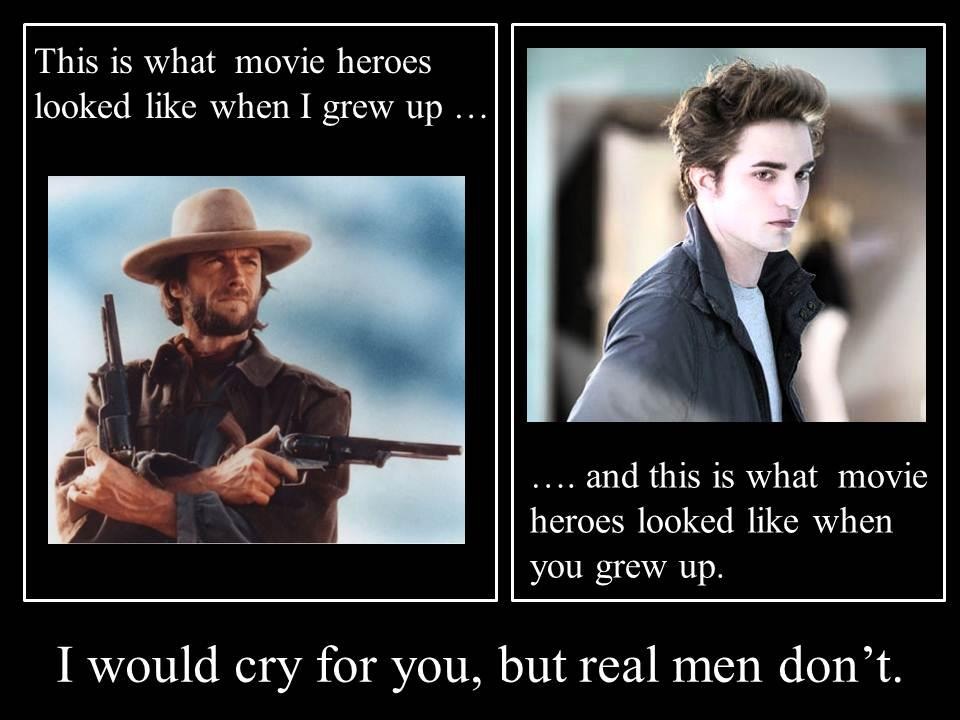
By way of Peter through what was apparently Michael Z. Williamson’s Facebook page, a bit of visual snark:

Now, what I want to talk about is only tangentially related to the point Peter set out to make, and I have no idea what the context of Williamson’s post looked like, but I still think it makes for something interesting to write about, so.

Whether we’re talking about Pattinson in Twilight or Leonardo DiCaprio in Titanic or Justin Bieber, guys: don’t worry about these dudes. Don’t worry that they’re not what you’d want to be or want your son or any other guy to be. They’re not for you, and they’re not for your son or any other man. They’re for women, and mostly for younger women and outright girls at that. The modern equivalent of Clint Eastwood in the sixties and seventies isn’t Robert Pattinson, it’s Daniel Craig or Jason Statham. The equivalent of Robert Pattinson forty to fifty years ago isn’t Clint Eastwood, it’s David Cassidy or any of the Monkees. You find them unappealing and vaguely horrifying because they’re NOT what men hopefully imagine themselves to be, or want to be. No man wants to be Cassidy or Pattinson unless the prospect of an endless sea of women in a berserk lust is so appealing they’ll do anything, no matter how degrading*. They’re not a male fantasy at all, nor were they ever designed to be by the people who made and marketed their careers: they’re a sexual female fantasy.

There’s a concept out there you’ll sometimes see referred to in those circles what wonk on about media and gender issues, which is called male gaze. The image above, and especially related issues that are more explicitly about how “gay” people like Pattinson and Beiber are, summarizes male gaze perfectly: it’s the idea that the default viewer, of anything, is a straight man. The only way you can take someone pretty who’s made their entire career off selling their image and body to women is “gay” is if you implicitly assume that whoever is taking them in and enjoying them and paying for them is, well, male, because that’s what consumers of media are.

Media is in the business of selling fantasies, and not all fantasies are for everyone. Hollywood and other entertainment media still mostly go by the default rules of male gaze, so most male characters aimed to sell a fantasy are male power fantasies- what men themselves would like to be themselves. Accordingly, most female characters are primarily constructed around male sexual fantasies- what they’d like to have from a desirable prop in their lives. The older James Bond movies are a pretty pure illustration of this; we’ve got James Bond, who is cool and smart and powerful and brilliant and has every gadget in the world- power fantasy- and any Bond girl, who have names like Pussy Galore. A woman may enjoy media like this (I often do, when it’s not blatantly misogynistic as well as simply centered around male gaze), but it’s not for her, not in the sense of being a fantasy designed for her.

Women have consumer dollars to spend too, so there is also a smaller, but very defined, market for media entirely constructed around female gaze. Twilight is pure female gaze, and all the male characters are constructed as female sexual fantasy the same way that the Bond girls are male sexual fantasy. At first just about all female-gaze products were this kind of fantasy, but as more female writers broke out of the pure dungeon of the romance novel, female power fantasies akin to the male power fantasies started to appear as well**; the “urban supernatural” genre is heavily dominated by female authors, female gaze, and female fantasies, and True Blood would be an excellent example of a piece of media that is mostly if not entirely defined by female gaze- the characters and plotlines are a mix of female sexual fantasy and female power fantasy.

The two assumed points of view and sold fantasies aren’t necessarily kept in their own separate ghettos; female action stars and characters are very often an attempt to combine female power fantasy with male sexual fantasy. (See: anything Joss Whedon has ever done, ever. The lead character in Resident Evil. Most female comic book characters that actually do anything.) The counterpart, male power fantasy and female sexual fantasy, is a bit rarer and usually much more subdued on the female sexual fantasy front, but if the lead character of an action movie always seems to find a way to lose his shirt and has seemingly gratuitous sensitive moments, it’s likely he’s at least a little of this. The lines here get pretty blurry, but if I had to pick examples again, I’d say most James Bond movies are pure male power fantasy, and the Indiana Jones movies are mostly male power with a dose of female sexual mixed in. Indy spends an awful lot of time shirtless, the camera treats Harrison Ford’s body lovingly, and he doesn’t shoot his girlfriends even when they deserve it.

This Shortpacked! cartoon is a pretty good distillation of the divide between male and female gaze and power fantasies versus sexual fantasies. Comic art, by its nature, tends to give away very quickly who it’s by and who it’s meant for. Rob Liefeld: all male power fantasy, male sexual fantasy, all the time. Shoujou***: all female power and sex fantasy, all the time. The Justice League animated series is an interesting example that, even judging by the art alone, seems to be about power fantasy for both sexes with sexual for both taking a backseat but present role; the character designs are exaggerated (the burlier male characters all seem to have shoulders that are about six feet wide), but instead of having their breasts and butts exaggerated as is standard for American superhero comic art, they’re exaggerated in the same way the men are- wide shoulders, big upper arms, smaller hips. Nobody’s bust is bigger than her shoulders are. The women (mostly) have more revealing costumes than the men, but it’s hard to tell how much is to be sexually appealing and how much is simply the legacy of their original character designs in earlier comics- and the male models have some concessions to female gaze as well.

Neither Twilight men nor Bond girls represent anything approaching realism or really even healthy fantasy, but they are what they are and they don’t exist to make the gender they’re not made for, comfortable, or to model anything for them except by collateral damage, as it were. The more explicit they get and the more they descend into the realm of pure fantasy and its rules, the more they tend to make the gender they’re stylizing deeply uncomfortable, precisely because being a pure object is an uncomfortable position to be in. When these types actually have the chance to become dangerous is when few or no alternative, aspirational fantasies are available- when a kid would be in a position to think the sexual fantasies of the opposite sex are the only available aspiration. This is why a dearth of female power fantasy characters that aren’t equally or even moreso male sexual fantasies is a problem, and while it would be if the reverse were true, I don’t think that’s the situation we have today so much as simply some prominent male characters (and I would argue people like Bieber are as much characters as anything) who are straight up female sexual fantasy. This is not to say there isn’t some deeply problematic stuff in it, or in some of the material sold to men and boys as power fantasies- just that I don’t think the risk of men and boys thinking Edward the Sparklepire is a model meant for them to emulate is one of those issues. As with most pure fantasy, the biggest risk for both sexes with the material aimed at them is in coming to believe it has anything much to do with reality.

Or, South Park can talk about it…

The Ring
Get More: SOUTH
PARK
more…

*Footnote for men of my generation: Did you want to be a Backstreet Boy or a member of N’Sync when you grew up? Even though all the girls your age were wild for them? No? I thought not.

**This is not to say that aspirational fantasy fiction aimed squarely at women is modern; explicit power fantasies are much moreso. Much of what Jane Austen wrote is aspirational and sexual fantasy for women.

**Okay, maybe not quite entirely all, but going into the details unpacking cultural, gender, and marketing issues there would take a longer post of its own. Suffice to say shoujou anime and manga is still built primarily around female gaze and has its own art style for good reason.