Archive for the ‘Booze and Fine Hooch’ Category

It’s Martini Time

June 11, 2012 - 7:22 pm 14 Comments

…Because it’s easy content, that’s why.

Matt polls his audience at large about the canonical martini, and its ingredients.

Agreeing with basically all of the commenters, in our opinion the original drink was made with gin, vermouth, and some variety of garnish, with the olive being the most classic and the lemon twist being another . (There are some who will say the kind with a cocktail onion is called a gibson; I tend to take the belief that unless you’re bartender with a showy repetoire, it’s a damn martini with yet another in a long line of pickled or preserved vegetable garnishes.)

James Bond popularized the vodka variant, and as Americans have never been nearly as fond of gin as the British (possibly due to cultural memory of associating it with cheap flavored poison from Prohibition days), it became the favored version in America. The argument can be made that after five decades or so of dominance in this country it is some version of “classic”, it’s just not the original.

Vodka martinis are easier to like (they used to be my preference too) just because there’s so much less pressure on vodka to be high quality not to ruin a cocktail. Really good vodka doesn’t taste of much, and bad vodka just tastes pretty much like any clear spirit; bad gin tastes like medicine-flavored paint thinner, and while bad vodka can be drowned out with just about any mixer, bad gin will destroy all it touches.

I didn’t really learn to like gin until Spear set out to convert me, and one thing I did learn is that, like absinthe, it’s a liquor you simply can’t cheap out on, and also that there is a huge variety in flavors and preferences for said flavors from drinker to drinker. What botanicals a distiller puts in besides the juniper varies tremendously, and those botanicals make all the difference in how the gin should be garnished and what kinds of drinks it should go into.

Right now there are five different gins in our collection: Hendrick’s, which is our general favorite for use in gin and tonics and tastes of a mixture of herbs with a bit of cucumber (and is best garnished with cucumber, or mixed with cucumber soda), Magellan’s, which I’m particularly fond of and always garnish with lime, basic Tanqueray, which goes into the martinis because Stingray likes ‘em dirty with pickle brine and that crushes any subtler flavors, Rangpur Tanqueray which is pretty much exclusively my drink, and Rogue spruce gin, a gift I favor as a true Pink Gin*. I probably won’t be able to lay my hands on any more of the Rogue locally, but they’re all there for a reason otherwise.

The choice of vermouth is up to you; sweet vermouth is the very original with “dry” meaning dry vermouth, but these days “dry” more usually means not much vermouth at all. I prefer the dry vermouth in general, and don’t see the logic in leaving it out of the drink entirely. If I just want gin with a garnish, that’s what I’ll drink, and I’ll pick the garnish to suit the gin.

As for the garnish: pick what you like and what plays well with the ingredients you chose. The twist of lemon goes great with the more citrusy gins, and the sharp saltiness of an olive or something pickled has its own appeal. Stingray likes his with any of the veggies pulled out of a jar of Farm Mom’s hot dill pickles; the cucumber slices themselves are the most numerous, the hot peppers give the hardest kick to the drink (and it’s surprisingly pleasant, in a martini- or at least I was surprised), though he claims the absolute best are the pickled garlic cloves.

And I… would almost always rather have a gin and tonic or pink gin. Though I think I’ll be trying that pickled okra variant just for grins.

*Meaning, I turn it into one, not that it already is one as opposed to simply being pink after aging in wine barrels. It plays quite well with the bitters.

My Drink is Cooler Than Your Drink.

January 3, 2012 - 10:01 pm Comments Off

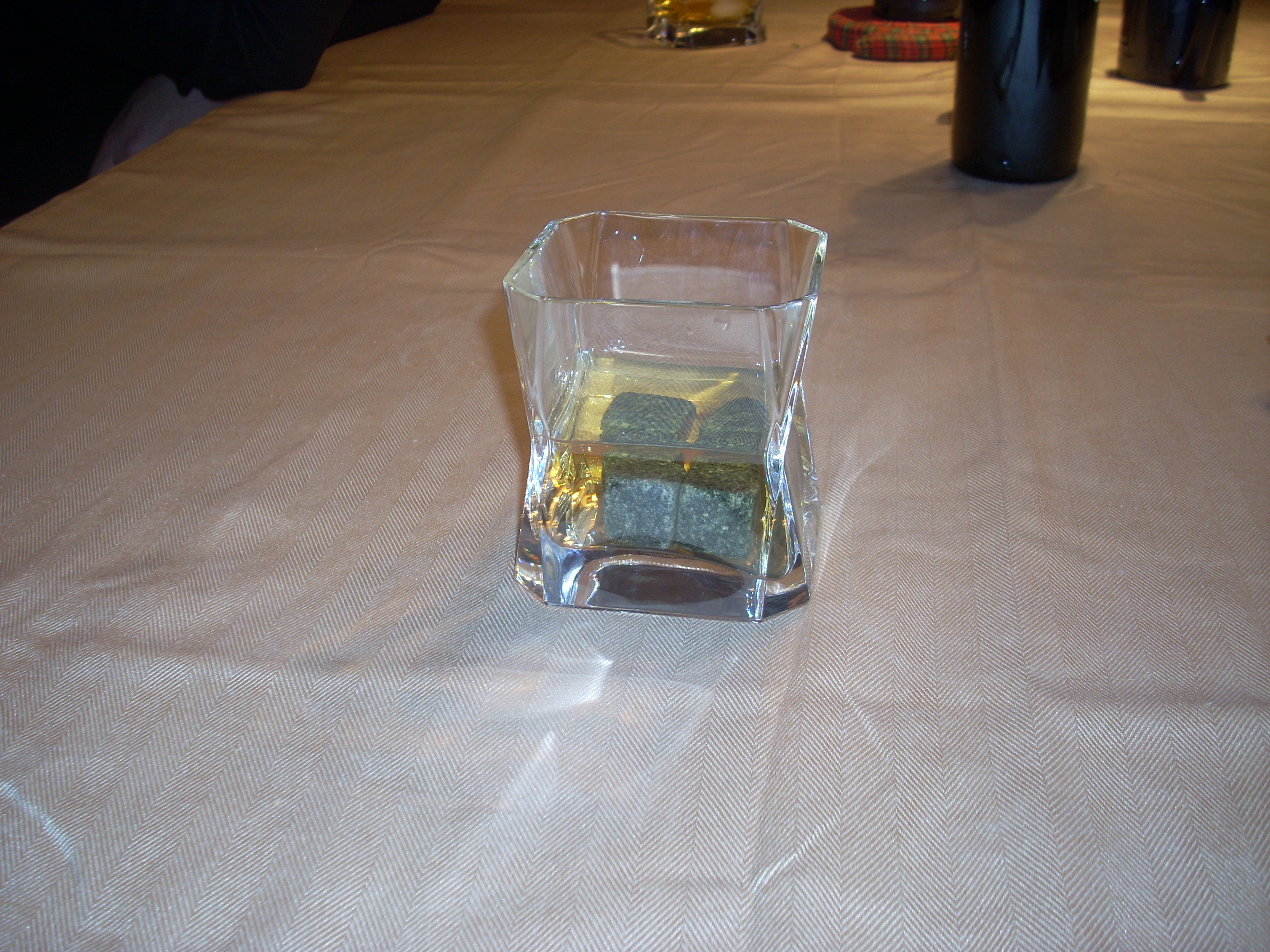
Not only for the handy whisky stones (thanks, Alan!), but more importantly for the glass.

Not for skinjobs.

And if you recognize it without looking at the file name or alt tag, you’re possibly an even bigger nerd than me.

What? It’s a new year. There’s plenty of time for depressing content about the shitsack we’re passing off as an election later.

Overheard At The Liquor Store

December 28, 2011 - 4:47 pm Comments Off

“What’s the cheapest absinthe you sell?”

Kids, believe me, the night that starts with that sentence ain’t gonna end how you want it to.

Free Advertising

October 16, 2011 - 2:47 pm Comments Off

Just because they got me.
I brew beer. What’s your contribution to society?

Yup.

Home again, home again

October 10, 2011 - 1:45 pm Comments Off

…jiggedy-jiawfuckIforgotthegarand.

Oh well. The person it’s with is trustworthy enough the only thing to worry about is him saying “Huh, I can improve that…” and having it come out either 10,000x more awesome, or breaking whatever strange mojo makes it so already awesome. Or he’ll just put it in a corner and I’ll get it later.

Rumors of my resemblance to Kjell Nilsson are extremely exaggerated. If ever there were a litmus test for beer goggles, that’s it right there.

And most amazingly of all….comments weren’t filled with raging assholes when we got back!

Seriously.

That’s never happened before.
Well done, the lot of you! I even laughed at some of the stuff in there!

Your 'Like I Know What I'm Doing' Guide to Beer

September 7, 2011 - 3:28 pm Comments Off

Most of you know LabRat as your basic all-knowing font of biological type sciencey goodness. In a trait common to advanced-functioning robots such as her and Data from Star Trek, she sometimes feels the need to appear more human. Her ill-advised method this time is to badger me until I write a post about where the flavors in beer come from and how to identify what you’re tasting in a given bottle of suds, because clearly I have not just been getting my recipes from books in the format of “Put this in and do the usual shit to it.”

Just bear with me and we’ll try to muscle through this so she can go back to normal.

Before we can start figuring out flavor, we have to figure out what the possible sources of those flavors are. To that end, way back in the day, there was the Reinheitsgebot, or Bavarian Purity Law, which stated that the only allowable ingredients in beer were barley, hops, and water. That law is pretty stupid since it ignores the yeast that sort of has just a bit to do with turning it from cloying pine-scented sugar water into beer, but people were in general stupid back then and didn’t know about yeast or what it does. So really, not much has changed.

Ok, so water, barley, hops, and yeast. You want to know what the main flavor in your beer is? Well, by volume the dominating characteristic pretty well has to be the water. Taste whatever you’re brewing with- if it occasionally bursts into flame and tastes like the chassis of a ’49 Buick left in a field for 30 years, that’s what your beer will mostly taste of. Whatever flavor is in the water the beer is made from is the easiest to ignore. I mean, it’s water. Of course it’s in the beer. Who cares what water tastes like? Dassani, Arrowhead, et al thank you for your interest in that topic.

After the water, the next largest contribution would be, essentially, sugar. Malted barley is barley grains that have been allowed to start the process of germinating/growing in order to take advantage of the plant converting complicated starches in the grain into simpler sugars, and when the beer is made, those sugars are extracted either through a process that basically makes grain-tea (steep ~15lbs of various grains at 155F for an eternity or two, then collect the steep water), or by paying someone else to get all those sugars out and concentrate them into malt extract, either dry or liquid.

Extract is by far the easier to work with, and more consistent. Since it’s basically sugar, that’s where you get any sweetness in your beer’s flavor profile. Let us all now thank LabRat for badgering me into telling everybody that sugar makes things sweet. None of us could’ve seen that one coming, Counselor Troi! With extracts, there are various levels of darkness (light extract, amber extract, dark extract, etc) and the darker one goes, the more earthy and roast-y the malt flavors tend to be. Any grains used can contribute to this effect too, bringing flavors like chocolate or coffee or nuttiness into the mix. If words like “bright” or “crisp” spring to mind trying to describe a flavor, you’re not talking about something brought in by the malt. Bread-like flavors? Gosh, working with grain where on earth could those have come from? Wheat and rice are used in some recipes to shake things up from all-barley all the time, and they bring flavors to beer pretty well in line with the flavors they bring to anything else. Adding some rice won’t transform your beer into sake (well, if you go crazy overboard you can basically just make the sake, same as beer more or less), but it will give it a bit of the same sort of tang. If you really want to get into this for not a lot of cash, visit a beer making supply store, and just get a quarter pound or so of as many types of grains as they have that catch your eye, and have them crushed. Take them home, and do each one up like you’re trying to make oatmeal basically, and whatever that tastes like… well, that’s how it’d go into beer. You can probably get 10-15 types of grain to try for less than $20.

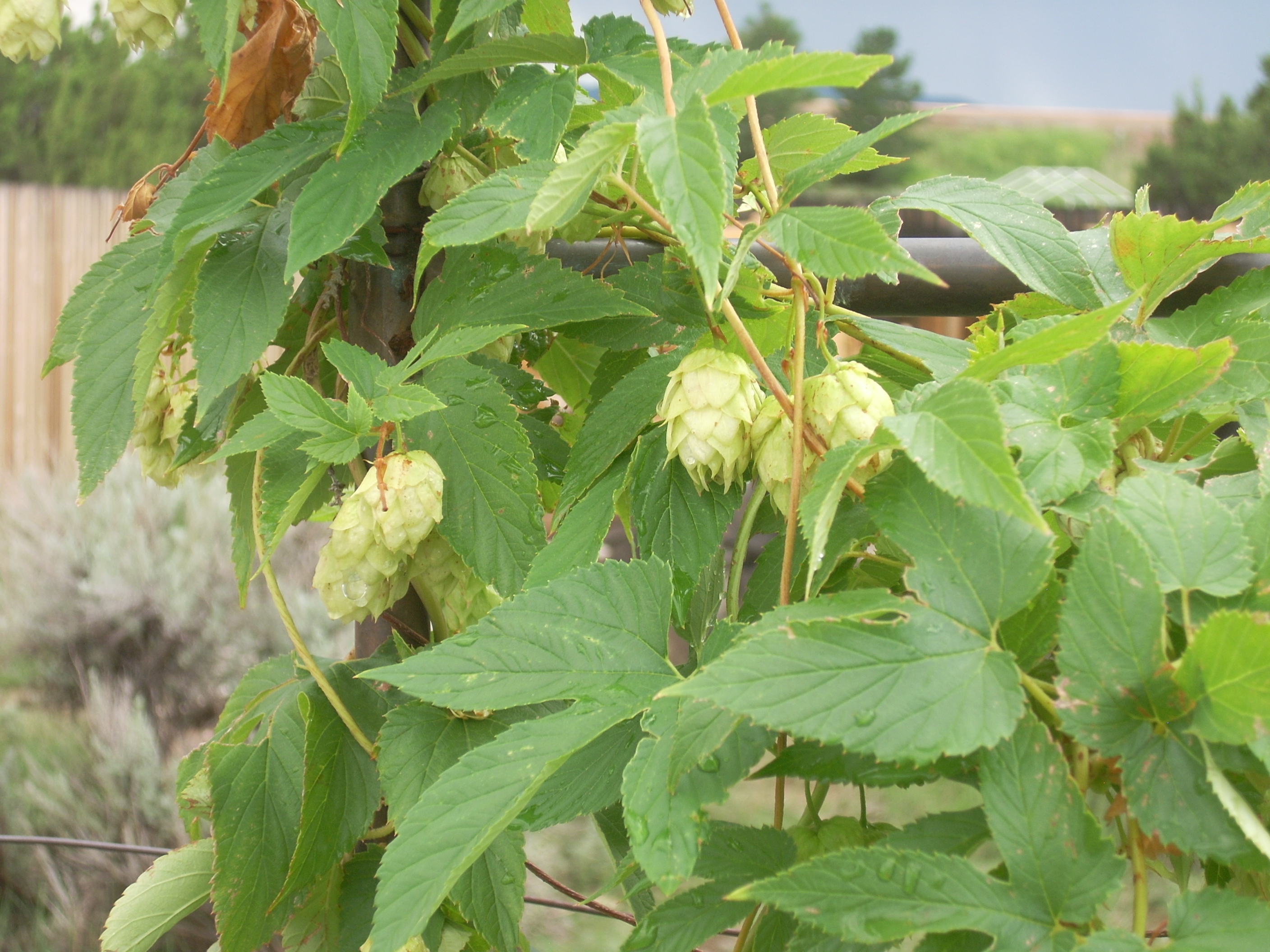
You know what’s really boring? Beer without hops. Straight malt liquor. Go dump that 40 and we’ll move on to where you will find words like bright and crisp in the description of the flavor. Hops are a rhizome, Humulus Lupus, that is for trivia’s sake very remotely related to weed. It’s a vine that produces little pine-cone lookin’ things like this:
Home grown, no less.

What happens here is you boil those little buggers (or you get them processed into a form that looks like hamster food) and that moves alpha acids and oils from them into your beer. Those particular hops taste of lemons and grass, but the category overall ranges from pine, to citrus, to pepper, to fruit. Covering what every particular type of hops brings to beer flavors is a work more suited to something book-length, but there are some rough guides floating around without too much work at google. This one covers a good whack of the more commonly used hops in homebrewing. Some of the oils and acids are more volatile than others, and they’re used to bring beer much of its aroma. Since smell is so tied up with taste, the flavors translate pretty directly, you’re just tasting it through a different sensor for a bit before those volatiles finish vaporizing and wafting away. This is why a freshly opened beer is so much better than one that’s been sitting out for a while. The lack of carbonization in the old beer is related, since all that foamy fizz is carrying more of that hops addition up your nose in the fresh.

The last contributor, and by far the trickiest to nail down, is the yeast. There are as many strains of yeast that can produce beer practically as there are people who like beer. What flavor they contribute ranges even more widely than the contributions of hops, because the temperature at which the yeast does its work fermenting the wort (the cloying sugar water mentioned before) affects what byproducts the yeast produces other than alcohol and carbon dioxide. These are the strains offered just in one format from just one producer, and while I can’t take a sip and say “Why yes, this was made with the Belgian Saison strain!” the differences range from subtle to “holy shit.”

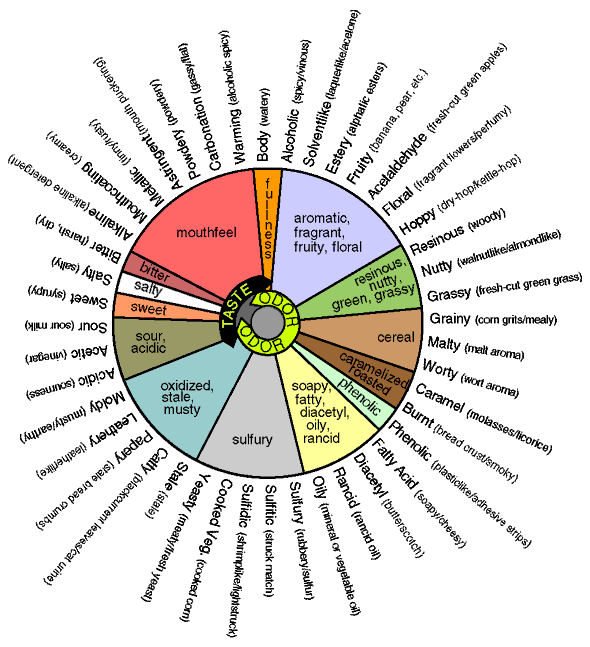
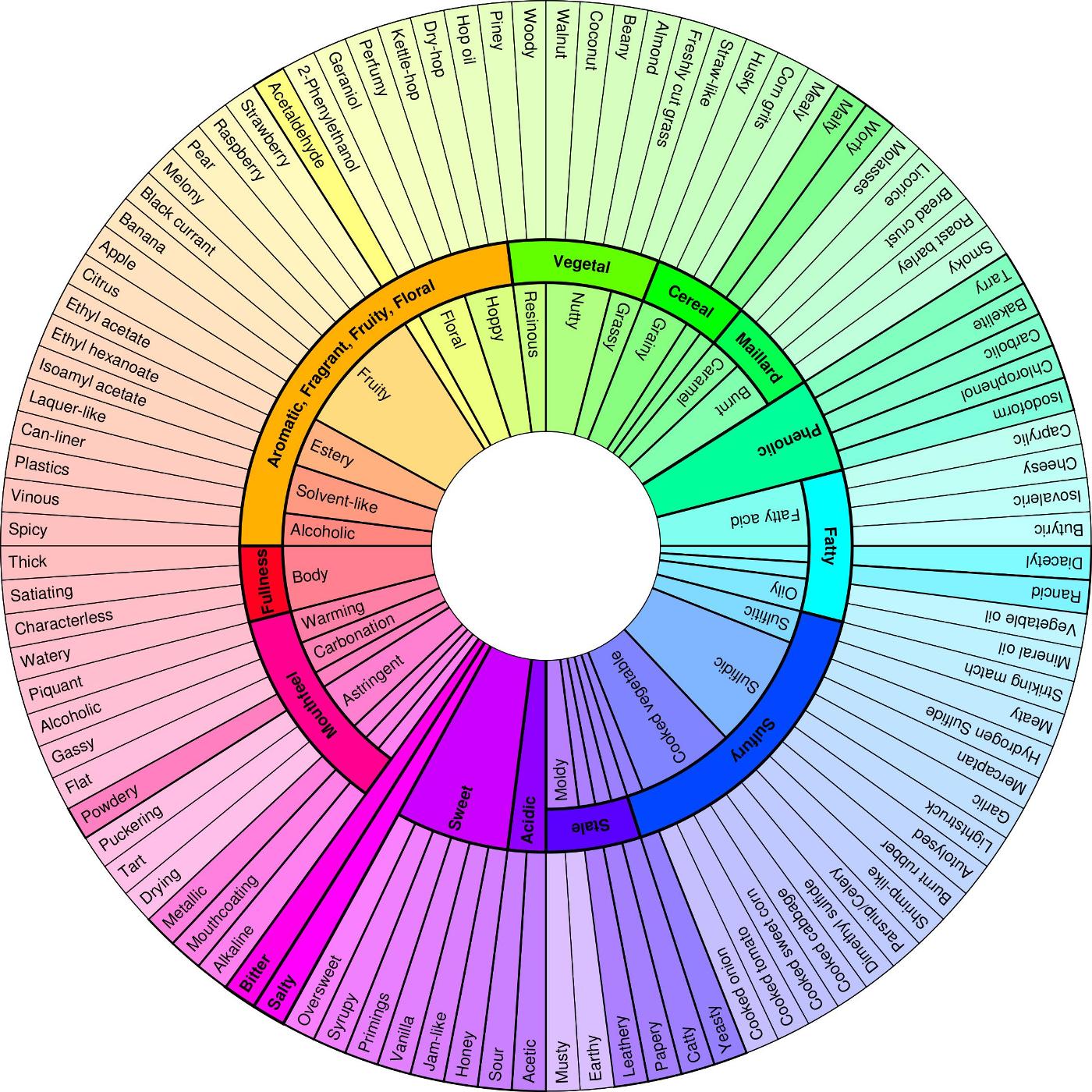
To over-simplify, there are two basic types of yeast, top fermenting, a.k.a. ale yeasts, and bottom fermenting lager yeasts. The difference is exactly what it says on the label. Using an ale yeast, if you do your fermenting in a glass container letting you see the action, you will see a foamy raft floating on top of the concoction. Using a lager yeast, there’ll be a pile-up at the bottom of the jug. From there, it breaks down basically into what you’re feeding your yeast and the temperature you’re working them at. Alcohol and carbon dioxide are obviously the main products, but it’s the other byproducts that give different strains their flavor profiles. Esters are the most common, and arguably important, compound produced, and they lend themselves to descriptions such as fruity. They’re also fairly volatile and affect the aroma quite a bit. Diacetyl and 2,3-Pentanedione ketones chip in, and mostly affect the difference in how a “new” beer feels in your mouth vs. an older, aged beer (not the stale one sitting out from the hops example). Think buttery mouthfeel when you think of those compounds. Fusel alcohols come in from the yeast, and those aren’t necessarily good things. Too high a concentration of them leads to descriptions like “solvent.” Guess why. Smaller doses can help open up the palate, but it still goes back to what type of yeast you have, and what you fed it. Some people think more visually, so maybe this’ll help:

(Courtesy of Salamander via Alabev)
Alternately:

Again, a thorough and fully correct examination of how yeast affects beer flavor is a book-length subject better left to someone who didn’t just barely squeak through chemistry because he had a copy of “Alice in Quantumland” hidden behind his textbook. Atoms are easy. Fuck molecules.

And now, having spent in excess of 1400 words vaguely waving my hands about a subject described better and at greater length and clarity by many people who are not me, I can confidently extend my middle finger to LabRat’s latest attempt to look slightly less awesome, secure in the knowledge that I have muddied the waters for all. And now I’m going to drink a beer.
Business And Beer As Usual

July 26, 2011 - 5:36 pm Comments Off

Not much of note going on here. It’s obnoxiously hot, like it is nearly everywhere in the US right now except the Pacific northwest. Things to do, people to see, news to not blog about because it’s just not really worth it. Politicians more concerned with own skins than future of country! Junkie who wrote a hit song about refusing to get help dies! Republican field of contenders hopeless disaster except for those with no hope! President gives speeches with no concrete ideas and a lot of scolding of opposite party and American people in general! Water to remain wet until further notice, stay tuned!

On the bright side, we got our first real harvest of hop cones- six ounces’ worth- off the most vigorous of the native hop vines. One other is just beginning to cone, another is aburst with flowers that will become cones. Initial smell-and-taste shows good alpha acids and bright flavors. We are thinking once the harvest is fully in of applying them to a pilsner or American-style pale ale.

Whatever other stupidity is going on, there will be beer.

Weekend Drink Recipe

July 3, 2011 - 12:34 pm Comments Off

Courtesy Spear, whose kitchen table we were appropriating for internet during the exile and who arranged us a safe and pet-friendly place to land within the four minutes previously stated. This was his solution to bedraggled and cranky refugees.

Burning Manhattan Project

As much rye whiskey as you judge necessary to de-crankify the drinker, 1-3 shots. Beam was more than adequate to the task.

6-8 drops Fee Bros. cherry bitters

1 glug sweet vermouth

Ice

Combine. He used a cocktail shaker, a spoon in a glass would be fine.

Very simple and straightforward, scales just fine with a bigger or smaller dose of the hard stuff, and frankly I liked it more than most of the proper Manhattans I’ve had with better rye. We will be adding a bottle of the cherry bitters to our little bar.

Grain Snobs In Grapeland

April 18, 2011 - 4:49 pm Comments Off

So, as I think I’ve mentioned before, Stingray and I are pretty enthusiastic about beer, with a pretty wide range of styles and individual brews sampled. We’ve had enough to get picky about it, and to have developed very specific ideas on what we like and how to put those kinds of flavors into our own brew. We know what kind of beer to pick to go with food when we’re dining out, should the restaurant have any kind of beer selection, and in general we think fermented grains belong pretty much right alongside other fermented products when it comes to the range and sophistication of flavor you can get out of them.

Wine, however, we have always been less enthused about. I came to the general conclusion a long time ago that I just flat don’t like fermented grapes very much, and while I tested this assumption multiple times in multiple contexts- usually at some high-end restaurant or another- it pretty much always bore out that while I like champagne all right, wine ranges from “meh” to “BLEH!” for me no matter how much it costs and whose wine list it was on.

Time passed, and on some lark picking through Netflix or Hulu looking for afternoon entertainment, Stingray happened across John Cleese’s Wine For the Confused. Cleese is amusing in just about any context, so he felt blowing an hour of his afternoon with a cigar, a beer, and Cleese was worth sitting through potential wine snobbery. I was off amusing myself in some other context- probably gaming- so I was left out for the time being.

At least, until wine bottles started appearing on the kitchen counter and glasses of various dark red substances started appearing next to his mousepad on weekend evenings in place of the usual IPA, Manhattan, or gin and tonic. I mostly ignored this until invited to share the Pinot he was opening, which I drank a glass of and conceded was inoffensive. At which point I was also invited to hear the message of the Cleese, which boiled down to “wine often tastes good, what you will like will depend on what tastes you like rather than its source or price tag, and anyone who tries to sell you wine based on those characteristics is shitting you”. The rest outlined the basic families of wine and their likeliest characteristics so as to give an idea of how to look for something that tastes like things you like.

Fair enough, I conceded. Reasonable enough endeavor- find cheap with at least some approximation of cheap and tasty, try various things based on educated guessing, see if we can’t develop some sort of a palate for the stuff.

Here’s what we’ve learned so far:

- Wine snobs still drive us insane and make us want to punch them in the face. No change there. But of course not everyone who likes wine is an insufferable snot about it.

- Wine tastings in which perfectly good wine winds up spit somewhere baffle us utterly. Okay, we get that the point is to avoid being smashed, but if you’re spitting out something good, fer Chrissakes either turn in your car keys or taste fewer things! You don’t see beer people go around spitting perfectly good brew into buckets at parties.

- The reason I had so strongly disliked just about every spendy wine I’d been served in a restaurant is partly because I had no idea what I was ordering beyond “white or red, if it costs that much it’s got to be as good as the food”, partly because Stingray was usually doing the choosing and our preferences are extremely different, and partly because between the two of us we’d been managing to go after French reds that were roughly 60% Cabernet Sauvignon and 40% tannins.

- So far we have discovered a complete non-relationship between how much something costs and how much either of us will like it. Zero, no correlation at all. This was at least a mild surprise. There does seem to be some relationship between the cost and the complexity of the flavor, however. Much to our chagrin, one of the best bets for a glass of plonk at dinner that will please both of us seems to be known as “Two-buck Chuck”. Much worse, Trader Joe’s seems to be one of the best places to scout out good bets. Wading through Santa Fe hippie nests every month is making us grouchy, at least until we open the results.

-However, we HAVE discovered that some wines not only pair well with food, they actually require food to be tasty. One bottle went from obnoxious to thoroughly likeable just by bringing out something with a bit of fat in it to snack on. No wonder wine and cheese are such a die-hard pairing. Beer is just not this picky.

- Naturally we have nearly opposite tastes. I like sharply tart whites with a slightly sweet finish, he only seems to like very dry whites. He likes big, aggressive reds that taste like someone’s been soaking their cigar in it; I only tend to like much mellower, fruitier reds. Probably not a surprise given our respective tastes in beer.

- The whole experience thus far has made this series an exercise in hilarious schadenfreude. (There seems to be a trend in British television for demystifying wine. I wonder which winery is donating to the BBC?)

Bloody Thursday

June 24, 2010 - 4:14 pm Comments Off

So far today: aggressively clogged sink, plumbers that don’t call back, the discovery that plumber’s snakes in excess of 30 feet cost truly exorbitant amounts of money*, my magic ability to break computers in new and fantastic ways, the ongoing joyful work experience that is abetting the efforts of two major government agencies to speak to each other with no understanding ever gained, and an overall theme of fuck it, time to pour drinks and kill Alliance. On hot summer evenings, that means bloody mary time. There are many recipes like it but this one is ours.

Ingredients:
Your largest big fuck-off beer stein or similarly proportioned vessel
Two shots vodka
1-2 tsp Worcestire sauce, depending on taste
Three drops Tabasco
A few grinds black pepper
A shake of celery salt
Lots of ice, because it’s disgusting warm
Enough tomato juice to top off your big fuck-off stein

Stir drink ingredients together. Let the ice cool the drink. Drink the drink. Repeat as necessary depending on the bloodiness of your day.

*We have already received our lifetime RDA of plumbing advice from #gunblogger_conspiracy and do not require any further. Rest assured Top Men are on the job.