Archive for the ‘Science: we’ll fuck you up’ Category

Science Update

December 18, 2012 - 6:30 pm 14 Comments

Just so we’re clear, we’re not dropping the hot dog bun thing. Unfortunately, they take a while to go properly stale. Gonna set up a pipeline this time.

Vintage

November 1, 2012 - 11:55 pm 11 Comments

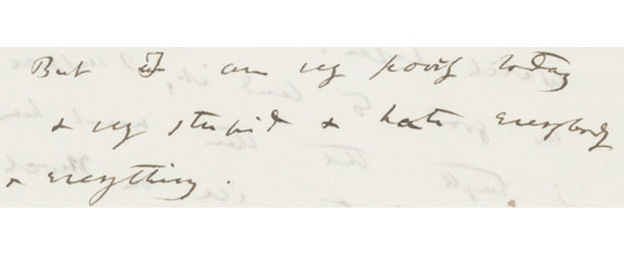
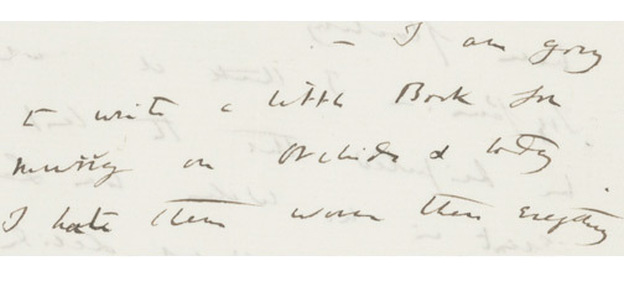
Today I found the best thing on the internet, which are these excerpts from a letter Charles Darwin wrote to Charles Lyell in 1861.

For those who aren’t experts on Charles Darwin and can’t make out his handwriting, which appears to have been developed on the theory that if one is having difficulty forming a word one should simply press on and eventually it will all be over*, the quote is this:

“But I am very poorly today and very stupid and hate everybody and everything.”

Oh Charles. Buddy. I can so relate.

It goes on like this:

“I am going to write a little book for Murray on orchids, and today I hate them worse than everything.”

I HAVE HAD THIS MORNING. SOMETIMES IT LASTS WELL INTO EVENING.

*Which, not to bash on Darwin, everybody who’s ever had to quickly take notes develops awful handwriting regardless of how beautiful their penmanship began. Mine looks like it was written by someone who is having a seizure, or possibly jotting something down quickly during an earthquake. I worry someday someone who has to deal with my checks or credit card slips will notice my signature is never the same twice.

Sex != Fitness

May 25, 2012 - 6:42 pm 15 Comments

Hey, kids, it’s time for another round of Bullshit Evo-Psych! YAAAAAAY!

Title of article: Do Men Find Dumb-Looking Women More Attractive?
A new study says yes.

Oh, you know this one’s going to be fun. It’s also another entry in the classic genre of “equally dim views of men and women”.

In an article soon to be published in Evolution and Human Behavior, University of Texas–Austin graduate student Cari Goetz and her colleagues explored what they called the sexual exploitability hypothesis. The hypothesis is based on the differences between male and female reproductive strategies as humans evolved. For ancestral women, casual intercourse with an emotionally unattached man who had no clear intention of sticking around to raise any resulting offspring constituted a massive genetic gamble. By contrast, for a man with somewhere around 85 million sperm cells churned out every day—per testicle—the frivolous expenditure of gametes was far less detrimental to his genetic interests.

An classic framework. Kind of a bit too classic, given that this basic assumption can suffer a lot when the life histories of species or entire groups are taken into account. As I will go into in further detail.

Goetz and her team began with the assumption that—because our brains evolved long before prophylactics entered the picture—female cognition is still sensitive to the pregnancy-related consequences of uncommitted sex and women remain more reluctant than men to engage in it

You don’t need… “female cognition” to understand that random sex can have more potential negative consequences for her than for him. Not all of them or even most of them have anything to do with pregnancy, either. What’s foremost in a woman’s (or, well, a female North American college student, but at least the two study demographics were the same) mind when considering accepting or rejecting casual offers from men actually seems to be the twin questions of whether he presents a physical threat to her safety, and whether he’s likely to be any good in bed.

I mean, you can and apparently these authors are making the argument that it’s actually our primitive ladybrains evaluating the chances of pregnancy completely outside our consciousness, but assuming we do things for secret hidden reasons rather than conscious reasons that are actually perfectly sound and utilitarian is questionable at best.

They set out to test the idea that any indication that a woman’s guard is lowered—that she’s “sexually exploitable”—is a turn-on for your average man. “[T]he assessment of a woman’s immediate vulnerability,” surmise the authors, “may be central to the activation of psychological mechanisms related to sexual exploitation.”

Fill in the appropriate square on your “misogyny and misandry are buddies” bingo card.

This is an inflammatory hypothesis, of course, and the language employed in the field doesn’t help matters. It’s worth noting that in the evolutionary psychology sense, the word exploitable simply means that a woman is willing or can be more easily pressured into having sex—which takes her own desires, rather disturbingly, out of the equation. Even if she’s the aggressor, a prostitute, or a certifiable nymphomaniac, having casual sex with her would still constitute “exploiting” her (or at least her body), according to this model.

Thank you, author, though I’m not going to be very nice to you in this post, for at least acknowledging that if not continuing to think it through- specifically that it assumes the viewpoint that a sexual encounter that doesn’t result in marriage involves the man “winning” and the woman “losing”.

From a strictly biological viewpoint, this worldview is baffling. Translated into terms evolution actually operates on, the strategy makes one party more fit and another party less fit or no more fit. In order for the male to increase his fitness, the mating has to result in offspring and the offspring have to grow to become reproductively successful themselves, which is exactly what needs to happen for the female to increase her fitness. There is no scenario in which the male increases his fitness but the female does not. There are scenarios in which the male gains fitness at less cost or risk to himself than the female and vice versa, but none in which, biologically speaking, all sexual encounters that result in a fitness gain for the male are exploitation.

Underlying this entire model (not to mention article) is a conflation of mating events with reproduction. This is a frequent weakness in sexual selection research, but at least researchers studying wild animals have a somewhat plausible excuse in that the difficulty of observing their target population makes definitively tying matings with offspring by parent, event, and identity difficult, but no one studying humans has this excuse. We have geneaology, interviews, and DNA tests to answer nearly any possible question we may have about someone’s grandchildren, lack thereof, and what in their life path led to children, grandchildren, or none of the above. Which is one of many reasons why making your study demographic one that almost entirely consists of people who aren’t yet ready or willing to reproduce* for the purposes of this kind of study insane.

Using matings and offspring as interchangeable things with any hope of producing useful results depends on several things about your target species: you need the window in which its members are willing to mate and the window in which they are fertile to be identical or nearly so, and you need the cost of raising offspring to be relatively low, so that an individual who mates is pretty much the same as an individual who reproduces. If you are studying, say, snakes, this model is fine and dandy. If you are studying (most) birds, you have half of what you need; an obvious window of fertility and matings, but costly offspring that are by no means guaranteed to make it to reproductive age without a great deal of investment. If you are studying humans neither is true; humans are willing to mate regardless of fertility status, and the cost of raising offspring is extremely high.

So high, in fact, that it would have been impossible for a lone woman to raise an infant to adolescence on her own during our evolution. So high that some anthropologists estimate it couldn’t be done in the environment we evolved in with just the mother AND the father alone, either. “WOOP FOOLED YOU SURPRISE BABY OFF TO SPREAD MY SEED KTHX BAI” would have been a complete nonstarter as a reproductive strategy just because the only way the baby would actually survive would be if the child had substantial investment from other people besides the mother.

Chimpanzee mothers don’t need or want paternal investment from the males because the period of dependence is much shorter and the nutritional needs of the infant are less dramatic; they raise their babies entirely by themselves and are very protective, and possessive, of them. Human women, in all cultures around the globe, seek out helpers to help them with their children- and also unlike chimps and most other primates, are vastly more willing to abandon or kill a baby, especially under stress. (And even the devoted single moms of primatehood have their thresholds.) It’s not just us, either; in birds with very high investment requirements to raise offspring, abandoning eggs or chicks when confidence in the mate’s investment (or, more compassionately, confidence in the odds of raising them being possible) drops sufficiently is a common thing.

This is not to say that promiscuity cannot be a perfectly workable reproductive strategy, for a male OR a female; the mother simply needs to have sufficient investment from other sources, like relatives, a social network of friends (who like as not are mothers themselves), or those who will help with childcare in trade for something else. Under this model, however, what should make a woman attractive to a promiscuous male isn’t her exploitability, but rather her support network, especially if she’s successfully raised at least one other child to prove she can do it. A promiscuous male seeking out a female looking for strong paternal investment a isn’t win/lose fitness arrangement if he gets her pregnant, it’s lose/lose. Promiscuous men/promiscuous women in which all the men invest a little bit and family helps is win/win. Highly invested man/highly invested woman is win/win. Some blend of the two in invested polygyny or polyandry is also win/win. Humans are very flexible like that, and each arrangement as its advantages and disadvantages; but promiscuous/low or no investment plus individual seeking high investment is a combination that’s much less effective for anybody**.

Back to the article.

So how did this team put their sexual “exploitability” hypothesis to the test? Goetz and her colleagues planned to call a bunch of undergraduate males into the lab and ask them to rate a set of women in terms of attractiveness based on their photographs. But first they needed to pick the appropriate images. To figure out which sorts of women might be deemed most receptive to a sexual advance or most vulnerable to male pressure or coercion, they asked a large group of students (103 men and 91 women) to nominate some “specific actions, cues, body postures, attitudes, and personality characteristics” that might indicate receptivity or vulnerability

I see no possible way in which this line of approach could be compromised or confounded by cultural variables. How bout you guys?

These could be psychological in nature (e.g., signs of low self-esteem, low intelligence, or recklessness), or they might be more contextual (e.g., fatigue, intoxication, separation from family and friends). A third category includes signs that the woman is physically weak, and thus more easily overpowered by a male (e.g., she’s slow-footed or small in stature). According to the authors, rape constitutes one extreme end of the “exploitation” spectrum—cheesy pickup lines the other.

The sad part is this would function just fine as a study of how people seeking to actually sexually exploit someone select victims. It’s just a complete failure as a study of evolved reproductive strategy.

By asking students for the relevant cues, the experimenters reasoned, they’d keep their own ideas about what makes a woman “exploitable” from coloring their study. When all was said and done, the regular folks in the lab had come up with a list of 88 signs that—in their expert undergraduate opinions—a woman might be an especially good target for a man who wanted to score. Here’s a sampling of what they came up with: “lip lick/bite,” “over-shoulder look,” “sleepy,” “intoxicated,” “tight clothing,” “fat,” “short,” “unintelligent,” “punk,” “attention-seeking,” and “touching breast.”

Attempting to keep out confounding variables fail. The next paragraph is also pretty much just a quick and dirty anthropological review on straight male undergraduates’ ideas of which women are “easy”. Although the fact that they took their study images off the internet is possibly relevant, in a “their study was pulling people’s photos off Facebook and OKCupid” kinda way.

Now it was time for the test. A fresh group of 76 male participants was presented with these images in a randomized sequence and asked what they thought of each woman’s overall attractiveness, how easy it would be to “exploit” her using a variety of tactics (everything from seduction to physical force), and her appeal to them as either a short-term or a long-term partner. The results were mixed.

That should not be surprising.

Physical cues of vulnerability—the pictures of, say, short women and hefty ones—had no effect. These women were not necessarily seen as easy lays, nor were they judged as especially appealing partners for either a casual fling or a lifelong marriage.

I’m… glad we had a study to determine this.

On the other hand, the more psychological and contextual cues—pictures of dimwitted- or immature-seeming women, for example, or of women who looked sleepy or intoxicated, did seem to have an effect: Not surprisingly, men rated them as being easy to bed. But more importantly, they were also perceived as being more physically attractive than female peers who seemed more lucid or quick-witted. This perceived attractiveness effect flipped completely when the participants were asked to judge these women as potential long-term partners. In other words, the woozy ladies were seen as sexy and desirable—but only for fleeting venereal meetings. They lost their luster entirely when the men were asked to rate these same women’s attractiveness as prospective girlfriends or wives.

One might almost take this as a hint that sex is actually not the same thing as reproduction, psychologically speaking.

The possible evolutionary logic behind this interaction is fairly straightforward: In the latter case, the man would risk becoming the cuckoldee, not the cuckolder. (Of course you could also argue that men might rather marry a woman who looked like she could hold up her end of the conversation over French toast.)

Oh, obvious and non-hateful explanation, you so crazy. Alternatively, there’s an important and substantial difference between what people seek when they’re after the pleasure of sex itself and what they seek when they’re after a partner to relate and reproduce with- and this need not be complex evolutionarily produced psychology, but rather basic observation and reasoning skills.

In a follow-up study (that ended up being published first), the authors tried to add some nuance to their sexual exploitability hypothesis. Graduate student David Lewis led a project to narrow in on the specific type of man who would be most alert to the sort of “exploitability” cues outlined above. Not every man, it seems, is equally proficient at homing in on these weak spots in women. So he and his colleagues asked 72 straight men to evaluate the same photos as before, and in the same way. But this time, the researchers also measured some key personality traits in the male raters, as well as the extent to which they desired and pursued uncommitted sex. The students were asked, for instance: “With how many different partners have you had sexual intercourse without having interest in a long-term committed relationship with that person,” and, “How often do you experience sexual arousal when you are in contact with someone you are not in a committed romantic relationship with?”

Again, this would be an excellent sociology study of sexual exploitation.

The main finding to emerge from this follow-up study was that the more promiscuity-minded men who happened also to have deficiencies in personal empathy and warmth were the ones most vigilant and responsive to female “exploitability” cues. Men without this critical calculus—say, a disagreeable man who prefers monogamy, or a caring one who likes to play the field—are more likely to have these cues fly right past their heads and miss the opportunity to capitalize on an “easy lay.”

….Framed this way it almost seems like some sort of defect in these guys.

o rather than the sexual exploitability hypothesis summing up the male brain as one big ball of undifferentiated stereotype, the caveat here is that there are multiple subtypes of reproductive strategies in men. Not all men are pricks, in other words.

Happily I didn’t need either the author of the article or the architects of the study to tell me that. And the exploitative men are still much likelier to be the losers in the fitness game. Sadly they won’t disappear in a few generations as a result, because evolution almost certainly didn’t directly create them in the first place.

It’s easy to see the sexual exploitability hypothesis as misogynistic, but I don’t believe the authors are advancing a chauvinistic ideology

Nah, I just think they’re using a chauvinistic ideology to inform their ideas of what constitutes fitness instead of thinking through the reproductive math and taking into account what raising children requires for a savannah forager*** instead of a North American youth.

Take those kinds of complaints up with natural selection, not the theorists untangling its sometimes-wicked ways. The authors are trying—admirably, I think—to decipher an implicit social algorithm in the hopes of better understanding gender relations.

Why is it the people saying “IT’S JUST SCIENCE YOU CAN’T ARGUE WITH IT” are almost always citing lazy, shoddy science?

I’m not going to bother fisking the rest of it; the upshot is the author takes some stabs in the dark at recognizing that there’s more to fitness than mating events, that their “easiness” variables are hopelessly muddled, and also that evolutionary psychology is cripplingly prone to just-so storytelling. Read the rest of it if you like (it may make you think better of the author), but as for salient points to make, I’m done right here.

*This is not the same as “young people”, see also, rates of teen pregnancy in which the parents willingly set out to have a child. But these people don’t usually go to college, at least not then.

**Bear in mind I’m talking about African hunter-gatherers and NOT modern North Americans. The environment in which we developed our reproductive behavior did not contain any form of social services, food banks or food stamps, orphanages, easy long-distance travel, charitable organizations, free clinics, or anything else that makes an unintentional child with minimal paternal/family investment possible to raise to adulthood. Infanticide of children whose needs were beyond low available resources was a sad, unfortunate norm until we developed civilizations- and our sexual psychology must have evolved millions of years before that happened.

***Another thing missing from this model is that humans don’t occur in lone, ranging patterns outside of civilization, they form small, tight communities. Exploitative behavior of all kinds tends to have a very high social cost unless it’s embedded in the structure of the culture itself. (Which sometimes happens, but generally only in cultures richer in resources that can afford to outbreed the loss of children due to neglect.) In other words, a serial deceiver generally isn’t fooling anyone after long at all.

Dentistry

May 17, 2012 - 8:58 pm 15 Comments

Busy busy light content. Have visitor, had league meeting, yeah.

You had baby teeth when you were a kid. Then you had adult teeth and the baby teeth went away. Have you ever stopped and thought about what was actually, physically going on in your skull while that happened?

Now you have.

They're Light Years Ahead Of Us In Ass Technology

May 10, 2012 - 4:23 pm Comments Off

There’s really no way to set this up or lead in gently, so I’ll put it bluntly: it’s an emotional robotic ass. Its whole reason for existence is to be a butt that conveys emotions the user can perceive, although I think they have not entirely succeeded in this given that my ass does not vibrate when I’m scared or pulse when I’m happy. Or at least I’m pretty sure it doesn’t. I’ve never noticed anyone else’s ass do this either, although I’m pretty sure I’ve seen it in cartoons drawn by John Kricfalusi.

If I had to take a guess as to why someone has gone to the effort to create an interactive emotional mechanical ass, I’d speculate that gluteal muscles are a lot easier to simulate mechanically than the tiny muscles in the face responsible for expression, and thus it’s an easier target. This is pretty much just wild speculation, though, as the subtitles explaining the robot ass seem to take it as self-evident that users would want to interact with a buttbot and read its feelings. I still really, really want to read the grant proposal for that, though.

Question as posed by the subtitles: “And second is to raise the argument as to what perceptions will be manifested in the minds of people who communicate with SHIRI”

and answered by Stingray: “I think topping the list will be ‘why am I talking to this ass?’”

They’re Light Years Ahead Of Us In Ass Technology

May 10, 2012 - 4:23 pm 18 Comments

There’s really no way to set this up or lead in gently, so I’ll put it bluntly: it’s an emotional robotic ass. Its whole reason for existence is to be a butt that conveys emotions the user can perceive, although I think they have not entirely succeeded in this given that my ass does not vibrate when I’m scared or pulse when I’m happy. Or at least I’m pretty sure it doesn’t. I’ve never noticed anyone else’s ass do this either, although I’m pretty sure I’ve seen it in cartoons drawn by John Kricfalusi.

If I had to take a guess as to why someone has gone to the effort to create an interactive emotional mechanical ass, I’d speculate that gluteal muscles are a lot easier to simulate mechanically than the tiny muscles in the face responsible for expression, and thus it’s an easier target. This is pretty much just wild speculation, though, as the subtitles explaining the robot ass seem to take it as self-evident that users would want to interact with a buttbot and read its feelings. I still really, really want to read the grant proposal for that, though.

Question as posed by the subtitles: “And second is to raise the argument as to what perceptions will be manifested in the minds of people who communicate with SHIRI”

and answered by Stingray: “I think topping the list will be ‘why am I talking to this ass?’”

Good Luck With That

May 1, 2012 - 6:54 pm Comments Off

A ways back in the week when I was pretty crunched for time and motivation, Blunt Object ranted about an article on Slate badly misunderstanding genetics and what we can know from it. It’s pretty typical boilerplate biology-is-scary stuff, or at least the part he’s ranting about is; there’s essentially one paragraph of raw stupidity in the middle of an otherwise reasonable piece talking about the implications of fetal genotyping. The relevant paragraph:

What fetal genes might one day suggest about a baby’s eye color, appearance, and intellectual ability will be useful to parents, not insurers. But with costs coming down and insurers interested in other aspects of the fetal genome, a Gattaca-like two-tiered society, in which parents with good access to health care produce flawless, carefully selected offspring and the rest of us spawn naturals, seems increasingly plausible.

Well… no, not really. To put it mildly. If the world worked like this I’d be able to write poetry in Linear A, but merely finding something that does something in particular and making some more or less educated guess as to what it does does not translate into being able to use it for engineering.

The analogy Blunt used was programming, and it’s a pretty good one; I set out to quote it for effect but wound up concluding it really just needs to be read in its entirety. It’s not long, and is resistant to excerpting.

The only issue with his analogy is that it doesn’t even capture the impossibility of pulling off something like the Slate author’s scenario adequately; at least a piece of computer hardware and its programming were produced via a process we could find relatively intuitive. Genomes were produced by evolution, with no one on hand trying even remotely to ensure that the code was efficient or clean, let alone commented. Kludges and elegant solutions exist side by side, sometimes in several different copies, some of which are broken and others of which do subtly different things in each version. Much of the information is if-then instructions and operating instructions, sometimes to provide for cases that are remote or no longer exist. If your computer were equivalent, it would have every operating system and program you had ever used installed at once, with the instructions for which pieces work for what and are active at any given time being completely hidden information. All possible hardware styles and protocols are present as well, and which ones are active or not is equally obscure.

Among the list of what the fetal testing is meant to do: determine Rh-factor, sex of child, presence of Down’s syndrome. Testing for any of these things is not like looking for a line of code in a computer program; it’s like seeing if a hard drive rattles or not when you pick it up, or how many USB ports there are. The number of chromosomes as well as what kind there are at pair 23 is determinable by technology we’ve had since the early part of the twentieth century; it is to genotyping as correctly naming a shape to be a square is to polygonal geometry.

Let’s tackle the first line in the author’s GATTACA scenario piece by piece:

What fetal genes might one day suggest about a baby’s eye color, appearance, and intellectual ability

1. Do you know we currently have no idea how eye color genetics work beyond two genes that happen to handle “blue” or “brown” relatively straightforwardly? Beyond that we know that there are many more genes that affect eye color, that there are two more genes that definitely do something though we’re not positive what, that there might be as many as 16, and that green and gray and hazel are handled somewhere entirely different, but you’re simply not going to know what color a baby’s eyes are going to be based on even its entire genome- because we only know what two genes are going to do and can’t even find the rest to see if they’re present and what they’re going to do.

2. You can know everything about a baby’s appearance that is determined by a single, stand-alone trait that we know about, understand to be a trait influenced by a single gene or at least a manageable handful of them, and know exactly which gene does that. Compared to all factors of a baby’s appearance, the number of traits this describes is teeny tiny. If the driving force of your curiosity is knowing whether a baby boy’s ears will have attached pinnae, you’re in luck*.

3. We don’t currently even know what intellectual ability quite is. We can’t nail down a single test accurately measuring “general intelligence”, all the tests we currently have produce wildly different results from one another, and while we know more or less that there are different cognitive domains and skills, we can’t nail any of them down particularly well either. Worse than that, we understand vaguely that intelligence is more of an emergent property of many systems and skills, but we can’t quantify or measure it well. For something like a car, “speed” is an emergent property with no corresponding part of the car that develops out of nearly every other part of the car- but we can concretely and easily measure speed.

Most of what we know about genetics and intelligence can be summed as this: 1)It seems to be, broadly, heritable, and 2)cognitive impairments are much, much easier to detect and quantify than variations in normal intelligence or extremely high intelligence. This is, in fact, what IQ tests were originally designed for- picking out those sufficiently impaired to need different schooling. We can expect legitimate bioethics issues surrounding the ability to detect those sorts of cognitive impairments caused by developmental disorders that are known and genetically quantifiable- not engineered superbabies versus dull “naturals”.

So, of the author’s three projected super-baby traits, one of them is a simple thing that turns out very much not to be on the genetic end, and two are emergent gestalt qualities we cannot even quantify, let alone reverse-engineer. Provided we develop the ability to directly engineer in the first place, which currently we can’t.

As science-fiction-come-reality scares go, I’m not that impressed.

*Actually I’m lying. This old chestnut of simple Mendelian genetics, as well as sex-linked traits, turns out to involve multiple alleles of opaque effect as well. Surprise!

FUCK AND YES.

April 23, 2012 - 8:36 pm Comments Off

Dear Federal Government,
Lick the private sector’s taint.
Sincerely,
Everybody who wants off this asshole-choked rock (and the less misanthropic group who just think space exploration is really really cool)

Private space-mining possible by 2025? I could drive railroad spikes with this erection.

Sociability In Beta

April 6, 2012 - 2:45 pm Comments Off

Just ’cause Stingray pointed out the obvious solution to me spinning around in my office chair debating if there was anything I could possibly find to say more than a Twitter’s worth of words about today.

A great deal of time and energy has been spent on the domestication and social behavior of dogs, because they are an obvious candidate; they’re our oldest domesticated species by far, they’ve played the most different roles in our species’ history and forms of civilization, they’ve returned to feral states in a few times and places along the path and provided that additional data point, and being dogs, they are generally cooperative with our efforts.

Another thing that makes dogs particularly felicitous to study as the ur-example of domestication is that they have a life history and ecological niche that is relatively close to ours; humans and canines are both group-living, cooperatively foraging, cooperatively breeding generalist predators. It was not a huge leap for a canine to allow us to share care and raising of their young, as packs of canids generally all pitch in to a litter of puppies. We understand each other relatively easily; even if we are wide branches apart in our physiology and history, we have a shared world and outlook.

Cats are different. Canids have a long and robust history of group living and sociality, but felids are most often solitary with a few scattered species here and there that have some degree of group living, or at least mutual toleration. Lions are the only felid that has fully embraced group living and cooperative breeding and hunting, and even then it’s the former rather than the latter that truly benefits them. Two to three lions would do best bringing down the biggest game that would give the whole group the biggest share of food, and indeed that is the size of the groups the bachelor males tend to form when between prides- more lions gives less food per lion for the same general amount of effort. Big prides don’t bring lions more food, they bring them babies that live- Having a few lionesses looking after the cubs at all times brings them a much lower infant mortality rate than other felids can manage, even accounting for the attrition of unlucky cubs to new incoming males*.

Until the last twenty years or so, the generally accepted dogma was that lions were the only truly social felid out there, and any and all other social behavior witnessed was due to adaptation to unnatural conditions. It is now known that wild male cheetahs will do some cooperative group living and behavior under the right circumstances, and that colonies of domestic cats, whether feral, living within shelters, or living within households definitely feature some wide-scale organized social behavior as well. As an artifact, when reading older literature about cat behavior, you’ll often see their social behaviors framed in terms of redirected fragments of other behaviors; cats rub against you because they’re scent-marking you as their property (not true, rubbing is an affectionate feline social gesture, and one most commonly directed from someone lower in the pecking order to someone higher), cats relate to you as though you were their mother (because it was thought that the only relevant social behaviors cats had were from mother to young or mate to mate), and so on.

As it happens, groups of domestic cats act much like lions; when they form on their own without human influence, they tend to be centered around groups of related females, the territory itself tends to be held and inherited among those females, and males come and go, sometimes forming partnerships with brothers or even unrelated buddy males. (The latter types of coalitions between unrelated intact males are more fragile for domestic cats than they are for lions, but they do happen- male lions simply need each other more.) Domestic colonies tend to be much more stable than lion prides, with fewer dramatic ousters of resident males and more males being able to coexist in relative peace.

Cat societies are less rigid than canine societies; while dogs tend to have a fairly structured heirarchy based on sex, relatedness, and seniority, with strict conditions on who is allowed to breed, cats tend to have one or two boss cats, a large middle stratum of member cats, and the odd pariah cat, who often will not stick around long if he or she is able to leave. Even within that structure, the rule of possession tends to prevail; a boss cat may have privileged access to prized sleeping spots and have other cats move out of his or her way as they go, but won’t be able to take food or a mating opportunity from a subordinate cat without a fight.

Behaviors and gestures once classified as crude uses of fragments of territorial and maternal behavior are probably more like the basic feline toolkit of relating to one another; they probably DO have their roots in those behaviors because their roots are indeed in solitary animals, but they seem to have much more flexibility and specificity as social behaviors than we once thought. Cats have a wide range of temperaments; while a dog is a social animal down to its bones, a given individual cat may range from completely solitary (and effectively untamable, even with recent domesticated ancestors) to gregarious and highly preferring the company of other cats as friends, far beyond the potential to mate. It IS known that kittens have a window from about three weeks of age to twelve weeks in which the species they are readily prepared to accept as friends and companions- and which as food- but it’s not completely hard and fast. A feral cat may still be tamed as an adult, but it really is more like taming a wild animal than adopting a pet domesticate.

It’s possible that, even without much direct effort on our parts, that humans are responsible for turning cat-as-we-know-it from a solitary species into a sociable one. Even before it occurred to the cat or the human that friendship would be a good idea, there would have been pressure on cats to coexist in denser numbers around the rich food supplies that colonies of rodents in human grain fields and storage would represent. Even most species of wild cats will live more densely when food supplies are rich, mostly in the form of maturing young spending more time with their mothers and females tolerating the company of their local ranging males for longer and more sociably. Once humans started bringing cats into hearth and home rather than appreciating their good work in the field, the pressure for cats to be capable of- and even thrive off- companiable coexistence would have been quite intense.

Still, evolving from a basic-but-present level of sociability to a more complex and intense form over thousands of years instead of millions shows in places. Dogs seem to have more, and more sophisticated mechanisms for resolving intra-group conflicts and relieving pressures; cats mainly rely on avoiding one another until either everyone calms down or someone can leave altogether. Displacement aggression is much more common in cats than dogs, as are spiraling anxiety-rooted behavior problems. Cats that must live in a group but aren’t friends tend to establish small sub-territories and live around one another rather than with each other, and when they are forced into each other’s territories, problems sometimes explode into existence.

Personally, I find it likeliest that cats know exactly what we are- a non-cat species that can be befriended and can act like a mother, sibling, or baby** as the situation and the roles shift. Thankfully mate stays off the table; we smell all wrong for that.

*Lions are interesting in that they are one of the few species with male infanticide where mothers, and coalitions of related females, will regularly unite to defend as many young as they can from the males. If the cub is old enough to have a fair shot at survival, a mother may leave with her subadult cub. In most other cases (as in primate) the mother and child are more or less screwed, and in a pack of canids the most likely individual to kill a mother’s cubs is her own mother or other older, dominant female relatives. There is now some evidence that related female domestic cats may mutually defend kittens from marauding nonparental males as well.

**The likeliest explanation I have seen for why cats bring us dead or wounded prey as gifts is that they are trying to help us start out hunting. There isn’t, so far as I’m aware, another context to this gifting behavior seen among wild cats.

Sex, Gender, Biology, Society

March 26, 2012 - 3:11 pm Comments Off

A post over at Quizzical Pussy (NSFW, good for discussion) on… I’m not even sure what I’d nutshell it as, maybe transphobia, maybe gender issues in general, maybe I-don’t-even seems to have provoked minor kerfluffle, as for some reasons such subjects often do. I’d actually go over there and read it if you want to talk about it*.

Couple of comments:

1) On “YOU CAN’T DENY BIOLOGY YOU CRAZY SOCIAL CONSTRUCT LIBERAL BIOLOGY DENIER”. My instinctive response is “bitch, you don’t even know how weird biology gets, and this is tame as hell by comparison”.

My constructive response is that sex, as in male vs. female has a very straightforward definition in biology, and gender has a separate, much less straightforward definition, and even outside of we’re-just-talking-about-mating-fish it gets much weirder in human society.

Sex goes like this: If you belong to a species in which gametes are differently sized, and almost all species are anisogamous (the fancy word for “gametes differently sized”) because the numbers seem to work out a lot better for both participants that way, then the individual with the big gametes is female and the individual with the small gametes is male. Every other detail is elaboration, and the elaboration is not even remotely uniform. Some species pack both in one, to have gametes for every occasion, and they are hermaphroditic. Some species change sex depending on circumstance or age, which is much easier when the hardware for your gametes remains similar between sexes. (Many fish handle sex this way.)

Gender goes like this in biology, which really isn’t the same thing as in human society: It’s still complicated as hell and currently the subject of a genteel firefight. The thing is that, in anthropology and until relatively recently the rest of biology agreed, animals don’t have gender, just sex, because animals don’t have culture and gender is culturally constructed. However, some animals seem to have more than one concrete and consistent way to be male or female, and these animals definitely don’t have culture. How you will see this described in the literature varies a great deal; sometimes it’s referred to as “alternate mating strategies” (although lots of other animals have multiple mating strategies that are chosen on the fly as seems advantageous rather than having their mating strategy and life history linked to obvious physical forms), sometimes they’re referred to as “morphs” (even though most physical variations we refer to as morphs in other species aren’t linked to behavior and life history), sometimes it’s both at once. Some biologists have suggested that maybe “gender” is a pretty useful concept to describe critters that have more than one physically distinct mating strategy and life history per sex, but this is far from broadly accepted- but then, no single way to frame such problems really has broad acceptance.

With humans, everything gets much more complicated. Not even sex is completely and totally straightforward, given that there are enough of us for just about every biological intersex condition under the sun to have appeared, been documented, and caused some kind of legal problem. Gender goes along culturally constructed lines depending on the culture born into- but consider that for humans, very nearly everything, no matter how biological, has some degree of cultural construction; the way we eat and what we eat has a huge cultural component, and even the way we poop does as well. How many genders, and how gender is defined or assigned, varies from culture to culture.

What fascinates me on a personal level is how close to the bone gender seems to be for most people, and how entitled they seem to feel in a fish-have-no-words-for-water sort of way to other people’s. If you choose not to advertise your religious or political affiliation no one will make an issue of it, but if you choose not to advertise your gender identity very clearly some people get aggressive about it. Nature has taken care of secondary sex characteristics for me with no ambiguity unless I catch a cold and wear a camping tent for clothing, but when I wore my hair very short I’d get the occasional “Are you a BOY or a GIRL?” from total strangers, and the occasional outright hostile “Sir“. The latter fascinated me more than insulting me, mostly by the clear intent to insult that was always behind it.

What makes it yet more interesting to me the longer I think about it is that typically the same factions I hear “male and female are ironclad biological constructs anyone is foolish to deny” from are the ones that also believe in enforcing the boundaries thereof with a great deal of applied cultural force. Nobody has to be taught to poop (although they do have to be taught where it’s appropriate to do so and how to clean themselves afterward in their own cultural fashion), but the training and rules for properly expressing one’s gender start at birth and have been a subject of obsession for parents since the beginning of written history. Schools have been founded around it, entire fields of study have been founded around it, religions usually have a great deal to say about it; learning how to be a man/woman, as well as NOT to be a man/woman, is one of the most intense acculturation experiences on Earth. It’s also a pretty big source of culture clash.

I’m not trying to say that gender is pure and entire social construction either, because I don’t think it is; if so social constructs for additional genders per sex would probably not be necessary, nor would the existence of a diagnosed “gender dysphoria” in societies where gender is very strictly binary, even after permissible roles for women and men have loosened to the point where you can be a man or a woman with some pleasures and behaviors from the opposite gender, and have that be unremarkable. Most of human life is things from our biology mediated and shaped by culture, not a nature-nurture dichotomy.

I AM trying to say that neither the biology nor the sociology is crystal clear here, and that if there’s a whole lot more going on for animals that are no brighter than a lizard or fish and have no culture whatsoever… who are we to assume that “biology” makes gender simple?

*This took me all damn weekend plus a big chunk of today to write. It was one of those “one sentence requires twenty minutes of research, revision, and mind-changing” things. After I hit post I’m going back to searching YouTube for Beyonslay highlights.